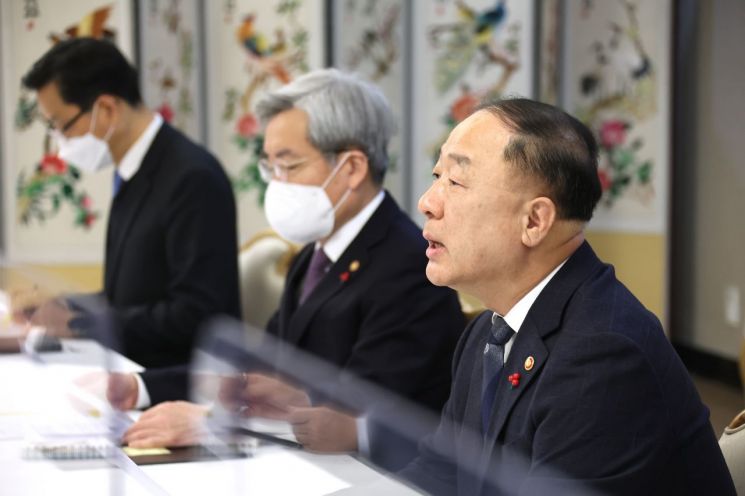
 Hong Nam-ki, Deputy Prime Minister and Minister of Economy and Finance, is speaking while presiding over the 36th Real Estate Market Inspection Meeting of Related Ministers held at the Government Seoul Office Building on the 5th. 2022.1.5 Photo by Yonhap News
[Asia Economy Reporter Son Seon-hee (Sejong), Reporter Moon Je-won] Hong Nam-ki, Deputy Prime Minister and Minister of Economy and Finance, announced, "We will supply 560,000 housing units annually until 2030, to the extent that it may raise concerns about oversupply." He characterized the recent slowdown in real estate price increases as a "shift to a downward stabilization trend" and intends to increase supply beyond market demand to continuously drive down housing prices. However, the market response is mixed, with some saying it is too early to interpret this as a clear signal of a price decline and others expressing skepticism that such a supply surge will be easily achieved.
On the 5th, Deputy Prime Minister Hong held a meeting with related ministers at the Government Seoul Office to review the real estate market, stating, "The housing prices that have risen excessively are expected to undergo some adjustment," and added, "The contraction in buying sentiment is spreading sequentially from Seoul to the metropolitan area and nationwide, with more local governments experiencing price declines, indicating an accelerating shift to a downward stabilization trend regardless of region."
In this context, he pointed out that among Seoul’s 25 districts, apartment prices in three districts?Eunpyeong, Gangbuk, and Dobong?recorded weekly declines, and that the "newly built housing under five years old," which had led price increases, turned to a decline in the fourth week of last month.
Deputy Prime Minister Hong further stated, "By 2030, 560,000 housing units will be supplied annually, to the extent that some in the market are concerned about 'oversupply,'" and added, "The scheduled move-in volume for this year is 488,000 units, exceeding the average level." This reflects an intention to accelerate the pace of the real estate price decline.
While Deputy Prime Minister Hong aims to stabilize the market through overwhelming housing supply, many in the industry believe it will be difficult to achieve the planned supply. Even now, various government-announced supply measures face opposition from residents and procedural delays. For example, the Seoul Mapo Western Driver’s License Test Center and Yongsan Camp Kim, designated as new housing sites under the August 4, 2020 plan, have shown no significant progress even after a year and five months. The site of the Nowon Taereung Golf Course has also seen its planned supply reduced from 10,000 to 6,800 units due to resident opposition, with subsequent procedures uncertain. The Urban Public Housing Complex Project, which plans to identify an additional 100,000 units next year, is also expected to face difficulties as it requires prior resident consent.
The public redevelopment project jointly promoted by the Ministry of Land, Infrastructure and Transport and Seoul City has not shown effective results, as the first project site, Heukseok 2 District in Dongjak-gu, has escalated to litigation due to resident opposition. Furthermore, the pre-sale process is faltering, with the Dongjak-gu Capital Defense Command site, which had attracted significant demand, suddenly excluded from the fourth pre-sale round.
Professor Shim Gyo-eon of Konkuk University’s Department of Real Estate said, "Given that the current supply measures are not going well, it is questionable whether supply plans that take five to ten years or more, announced ahead of the presidential election, will be effective," adding, "Housing prices have not yet fully turned to a downward trend, so the government’s optimistic outlook is premature."
© The Asia Business Daily(www.asiae.co.kr). All rights reserved.