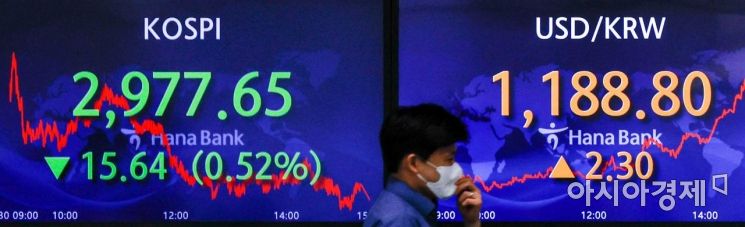
 On the 30th, KOSPI closed at 2,977.65, down 15.64 points (0.52%) from the previous trading day. Dealers are working in the dealing room at the Hana Bank headquarters in Jung-gu, Seoul. Photo by Jinhyung Kang aymsdream@
[Asia Economy Reporter Junho Hwang] An analysis has been raised that if the gradual decline of the dollar continues this month, the inflow of foreign investors into the domestic stock market is likely to persist.
Seojeonghoon, a researcher at Samsung Securities, said in the 'Weekly Shot' report on the 1st, "The supply and demand conditions of the domestic stock market this month are not easy," adding, "The profit-taking balance of financial investors aiming for year-end dividend income is likely to release volume from the beginning of the month, and the LG Energy Solution issue scheduled to be listed at the end of this month is also likely to stimulate selling pressure on surrounding large-cap stocks."
In this situation, individual investors have lowered investment sentiment due to sluggish stock market performance, and excluding institutional investors focusing on spot and futures arbitrage, there is no choice but to rely on foreign supply and demand. In the case of foreign supply and demand, the gradual weakness of the dollar is analyzed as the key to stock market inflow.
Currently, the dollar index is limited in its upward movement after the Federal Open Market Committee (FOMC) officially announced three interest rate hikes next year. This contrasts with the 2-year U.S. Treasury yield, sensitive to policy rates, reaching the highest level since the pandemic during the same period. Considering that it is the year-end and early-year period when seasonal demand for the dollar is high, the dollar's steady movement is intriguing. If we assume that the dollar rose first reflecting tightening possibilities, the subsequent upward momentum may slow down significantly. In addition, the phase of reduced Omicron concerns and the easing inflationary pressures that caused early tightening are factors that could exert downward pressure on the dollar. The fact that the Chinese economy, which was deeply concerned about recession, is seeking a turnaround also has a high potential to put downward pressure on the dollar.
If this trend continues, the foreign supply and demand in the domestic stock market is also highly likely to continue for the time being. In particular, expectations for improvement in the domestic information and communication industry's business conditions, including memory semiconductors, can play a significant role in improving overall index supply and demand. This is because the market capitalization weight of the sector is considerable and its profit contribution is also high. If foreign supply and demand can be maintained in the domestic electrical/electronics sector, at least the downside risk of the index will be limited. Furthermore, if a signal confirming the decline in Omicron spread is confirmed in a moderate dollar environment, the January effect is likely to appear more dramatically.
Researcher Seo said, "Since foreign investors hold the key to supply and demand, we should not overlook the possibility of large-cap stocks preferred by them outperforming," adding, "Whether companies can meet the required rate of return proportional to the increased cost of capital is expected to lead to future stock price differentiation."
© The Asia Business Daily(www.asiae.co.kr). All rights reserved.