Deposits Reach 68 Trillion Won on 29th
Standby Funds Hit Highest in 3 Months
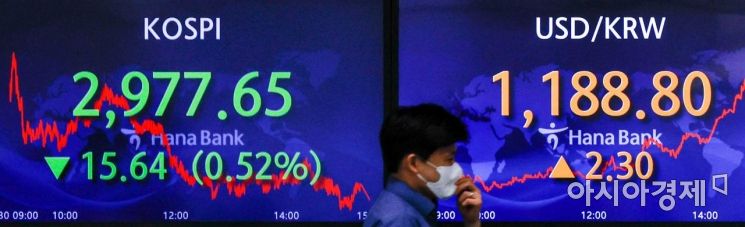 On the 30th, KOSPI closed at 2,977.65, down 15.64 points (0.52%) from the previous trading day. Dealers are working in the dealing room at the Hana Bank headquarters in Jung-gu, Seoul. Photo by Jinhyung Kang aymsdream@
[Asia Economy Reporter Hwang Junho] Stock market standby funds worth 68 trillion won are entering the new year of Im In Year (壬寅年). Attention is focused on whether the standby funds, which have risen to the highest level in three months, can serve as a foundation to push up the stock market in the new year.
According to the Korea Financial Investment Association on the 31st, as of the 29th, the size of deposit funds was 68.0015 trillion won, showing a sharp rise from 62 trillion won on the 22nd. This is the highest level since recording 70.0841 trillion won in October. The CMA balance also gradually increased from the 21st, reaching 68.3391 trillion won as of the 29th.
The increase in funds ready for the new year's stock market launch is analyzed as a sign of retail investors' struggle to avoid year-end capital gains tax. For 'Wanggaemi' (major retail investors) with a holding valuation of over 1 billion won, to avoid capital gains tax, they had to reduce their valuation to below 1 billion won by the 28th. Accordingly, retail investors sold a net amount of 2.3303 trillion won in the KOSPI over the 27th and 28th. Then, to repurchase, they bought a net amount of 2.6646 trillion won in a single day on the 29th. The KOSPI trading volume also exceeded 10 trillion won for the first time since the 17th.
However, the January stock market is expected to be as challenging as the year-end. Economic slowdown and the accelerated tightening pace in the U.S. are expected to exert downward pressure on next year's stock market. Kim Daejun, a researcher at Korea Investment & Securities, analyzed, "The new year market is expected to be difficult as usual," adding, "With the economy and policies not favorable to the market, profit momentum is gradually weakening." He also noted, "At least the expectation for growth industries such as the metaverse is maintained, which is positive from the market participants' perspective."
The resurgence of the COVID-19 variant Omicron and the strengthening of related quarantine measures are also expected to weigh on the economy. Lee Da-eun, a researcher at Daishin Securities, analyzed, "Due to strengthened quarantine measures, the consumer sentiment index and non-manufacturing BSI (Business Survey Index) turned downward again in December," adding, "If the current social distancing is extended for two more weeks, the slowdown is expected to continue until mid-January."
The initial public offering (IPO) of LG Energy Solution, starting from the 11th of next month, is also expected to be a burden on stock market supply and demand. LG Energy Solution plans to raise 10.9225 trillion to 12.75 trillion won in external funds through this IPO. This could act as a black hole absorbing stock market liquidity.
On the other hand, there is also a view that the resumption of supply chains in emerging countries due to vaccine distribution may positively affect foreign investors' supply and demand next month. Improvement in foreign investors' supply and demand is a positive factor for stock market vitality. Shin Han-geum, a researcher at Shinhan Financial Investment, said, "Domestic foreign investors' supply and demand switched to net buying from November, riding on the easing atmosphere of manufacturing disruptions in emerging countries," adding, "Considering the foreign investors' net buying pattern after large-scale net selling in the past, an additional inflow of 4 to 10 trillion won is possible, and since this year's foreign net selling was very large, there is a possibility of exceeding this pattern next year."
At the beginning of the year, the supply and demand of pension funds are somewhat free, so improvement effects may appear. Kim Byung-yeon, head of investment at NH Investment & Securities, observed, "In January, the 'January effect' may appear where supply and demand of individuals and pension funds improve," adding, "There are often cases where IT and healthcare sectors show strength."
© The Asia Business Daily(www.asiae.co.kr). All rights reserved.

















