Preservation Gains Importance Over Listing, 'World Heritage in Danger' Faces Delisting Risk
UK Liverpool Port Actually Removed from List... Need to Explore Overseas Solutions Like Partial Reduction
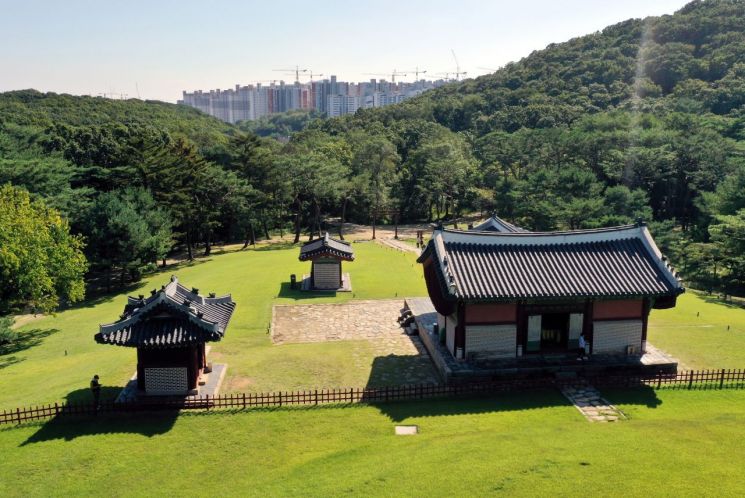
The Joseon Royal Tombs are at risk of losing their UNESCO World Heritage status. Apartments are being constructed in the Gimpo Jangneung Historical and Cultural Environment Preservation Area within the Incheon Geomdan New Town. Construction companies Daekwang ENC (construction by Daekwang Geonyeong), JS Global (construction by Geumseong Baekjo), and Daebang Construction recently withdrew their applications for alteration permits from the Cultural Heritage Committee. They judged that approval would be difficult with only changes to the exterior wall color and design. The Cultural Heritage Committee believes that without adjustments to the building height, the value of Gimpo Jangneung cannot be maintained. The Joseon Royal Tombs were recognized for their outstanding universal value in the 2009 World Heritage evaluation due to their unique natural burial traditions and tomb garden construction (陵園造營).
Recently, UNESCO has placed more importance on preservation management than on World Heritage registration. The operational guidelines of the World Heritage Convention are expanded and revised annually. A Cultural Heritage Administration official stated, "This is because development projects around World Heritage sites in urban areas have increased," and added, "We recommend the introduction of Heritage Impact Assessments (HIA) to each country." This is an indicator used to evaluate the impact of development activities on World Heritage sites. It is used to determine whether there is a negative effect on outstanding universal value and authenticity. In Korea, it has been applied to Gongju Gongsanseong, Seoul Taereung, Goyang Seooreung, Haenam Daeheungsa, and Gongju Magoksa. All received recommendations during Cultural Heritage Committee reviews. Although not legally binding, the purpose was to maintain the integrity of World Heritage sites and protect their outstanding universal value during the development planning stage.
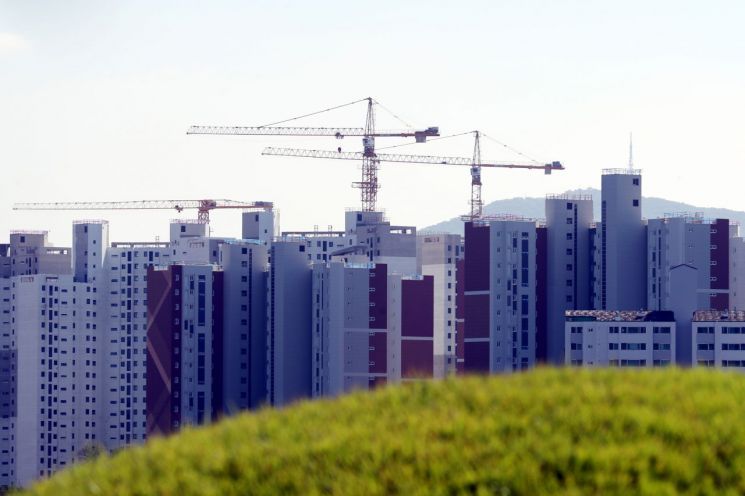
In fact, the historic district of Vienna, Austria, conducted an HIA in 2019 and is consulting with UNESCO regarding building heights and other matters. Before the introduction of HIA, in 2005, urban development threatened to damage the landscape. At that time, city authorities lowered the height limit for new buildings in buffer zones from 100m to 70m to maintain World Heritage status. However, new development projects such as a 76m high hotel were still pursued, leading to the designation of the site as a "World Heritage in Danger" in 2017. The Cologne Cathedral in Germany removed this label after two years. The city authorities halted high-rise building projects in 2004. By restricting building heights based on visual impact assessments, they were able to maintain World Heritage status.
There are also cases where the "World Heritage in Danger" label led to the loss of World Heritage status. The Liverpool Maritime Mercantile City in the UK, labeled in 2012, is a representative example. The historic value and existing landscape were damaged due to the forced urban redevelopment plans, including the construction of a football stadium. UNESCO judged that the site had lost its universal value and removed it from the World Heritage list. The Elbe Valley in Dresden, Germany, also lost its World Heritage status in 2009. The newly constructed bridge was deemed to have damaged the value created by the harmony between 19th-century architecture and the riverside.
The Joseon Royal Tombs, which include 40 royal tombs such as Jangneung, could fall into a similar situation. UNESCO recently raised concerns about the landscape damage to the Joseon Royal Tombs. A Cultural Heritage Administration official said, "They emphasized the need for careful consideration during surrounding development," and added, "We have requested information on the preservation status of Gimpo Jangneung." With the failure of the Cultural Heritage Committee review, self-adjustment has become difficult. Legal disputes with construction companies are anticipated. The official stated, "We understand the burden on construction companies and the anxiety of prospective residents," but added, "Since this is a matter tied to maintaining World Heritage status, it will inevitably lead to litigation."
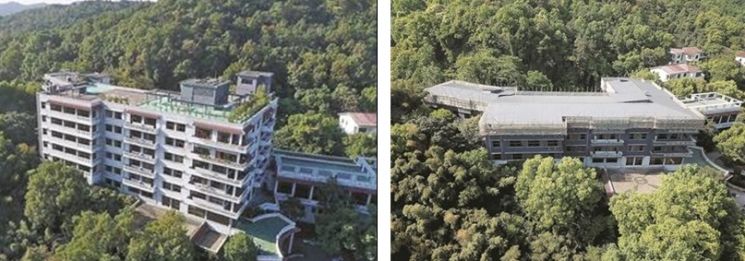 Shangri-La Hotel built in the cultural landscape of West Lake, Hangzhou, China. In March 2019, the upper 6th and 7th floors were removed and the exterior was repainted.
The Imam Square in Isfahan, Iran, is cited as a representative case where partial demolition helped protect the World Heritage landscape. Near this site, a complex facility including the 48m tall Jahan Nama Tower was constructed. When controversy arose over exceeding the height regulations within the protected zone, the Iranian government decided on a specific reduction plan in 2005 and partially demolished the upper floors by 2014. A Cultural Heritage Administration official explained, "From 2002 to 2014, we reported progress to the World Heritage Committee every two years and implemented their recommendations." The cultural landscape of West Lake in Hangzhou, China, also saw partial demolition of nearby buildings before its World Heritage registration in 2011. This included the 7-story Shangri-La Hotel, completed in 1961. Following UNESCO's recommendations, the 6th and 7th floors were removed in March 2019, and the exterior was repainted to help restore the World Heritage value.
© The Asia Business Daily(www.asiae.co.kr). All rights reserved.



















