This Year's Market Size 920 Billion KRW
2.4 Times Increase Compared to 2019
Art Investment Trend Booming
Youth Leading 'Fractional Investment'
NFT at the Core of Art Market
12 Billion USD This Year...170 Times Growth
Exhibitions Using Metaverse Also Surge
Over 23,000 Items Donated to the Nation
'Art Tax Payment in Kind' Adoption Accelerates
Famous Artists' Heirs Join Donation Movement
Local Governments Compete to Attract Donation Museums
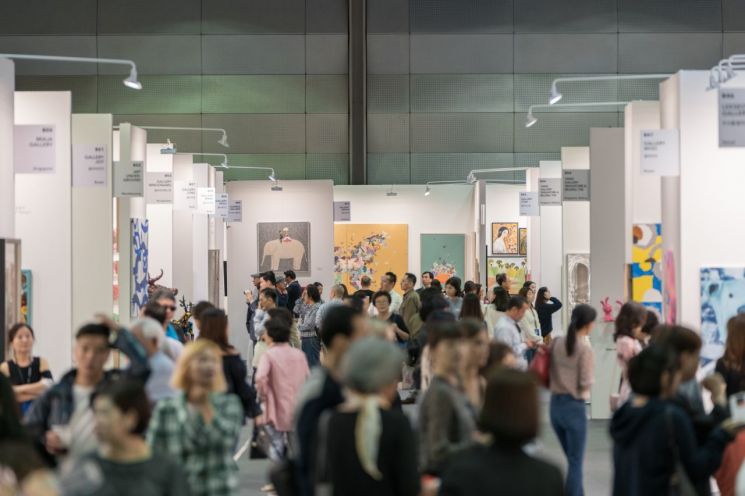 The view of the exhibition hall at the Korea International Art Fair (KIAF), the largest art market in Korea, held last October at COEX in Gangnam-gu, Seoul.
[Asia Economy Reporter Donghyun Choi] This year, the art market experienced a true 'quantum jump,' with both quantitative and qualitative growth occurring simultaneously. The market size reached an all-time high due to increased liquidity and the entry of the MZ generation (Millennials + Generation Z). New industries utilizing digital technologies such as Non-Fungible Tokens (NFTs) and the Metaverse (extended virtual worlds) also emerged. Foundations for steady growth in the art market were laid, including the donation of the 'Lee Kun-hee Collection' and the introduction of the art tax payment system.
Art Market Ignited by Auctions, Sparking Interest from the MZ Generation
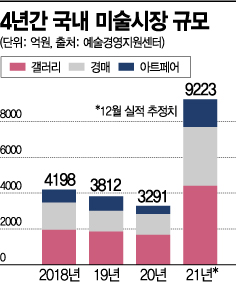
According to the Arts Management Support Center on the 31st, the total art market size, combining sales from galleries, auction houses, and art fairs, was estimated at 922.3 billion KRW this year. This represents a 2.4-fold increase compared to 381.2 billion KRW in 2019, before the spread of COVID-19.
The auction market ignited the art market fever at the beginning of the year. The works of the late 'Water Drop Painter' Kim Chang-yeul (1929?2021) were sold at high prices in major auctions held by Seoul Auction and K Auction early in the year, sparking the market’s rise. Subsequently, prices of works by overseas masters also soared. At the May K Auction, Marc Chagall’s 'Garden in Saint-Paul-de-Vence' (1973) sold for 4.2 billion KRW, setting the highest domestic auction price in the first half of the year. Last month, Yayoi Kusama’s 'Pumpkin' (1981) was sold for 5.45 billion KRW at Seoul Auction, breaking the highest auction record for the second half of the year.
As art prices surged, an art-tech (art + investment) craze swept the market. The main drivers were the MZ generation. Familiar with digital culture, they actively participated in online art auctions and fractional investments, rapidly emerging as key collectors in the market. They also actively engaged in offline art fairs, which resumed this year after a hiatus due to COVID-19. At the Korea International Art Fair (KIAF), which achieved a record-high sales of 65 billion KRW this year, first-time visitors accounted for 53.5% of attendees, of whom 60.4% were from the MZ generation.
NFTs and the Metaverse... Art Moving from Reality to Virtual
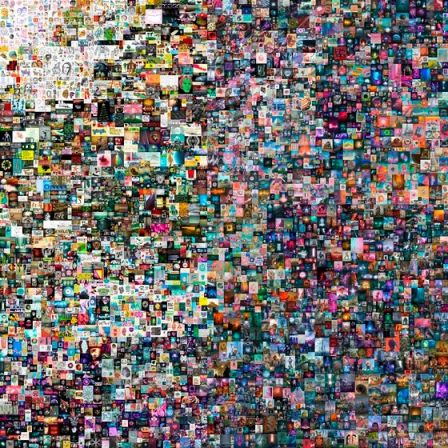 Digital artist Beeple (Mike Winkelmann)'s non-fungible token (NFT) artwork "Everydays: The First 5000 Days" was sold for $69.3 million (approximately 78 billion KRW) at Christie's auction in New York, USA, last March.
In March, shocking news spread across the global art market. The digital artist Beeple (Mike Winkelmann)’s work 'Everydays: The First 5000 Days' was sold for $69.3 million (approximately 78 billion KRW) at Christie’s auction in New York, USA. This work was an NFT composed of multiple JPG files combined into one, with no physical form. This event, marking the first time a digital artwork sold for hundreds of billions of won, propelled NFTs to the core of the art market. According to the virtual asset data company NonFungible.com, global NFT transaction volume is expected to reach about $12 billion (14.14 trillion KRW) this year, a 170-fold increase from last year.
Due to the prolonged COVID-19 pandemic, non-face-to-face exhibitions have become more active, and with the development of the metaverse industry, viewing and consuming artworks in virtual spaces has become frequent. Domestic galleries have also begun actively utilizing the metaverse for art exhibitions, education, promotion, and sales. Various genre exhibitions, including paintings, installations, and media art themed on the metaverse, have been held in many places.
Donation of the ‘Lee Kun-hee Collection’ Leads to Introduction of Art Tax Payment System
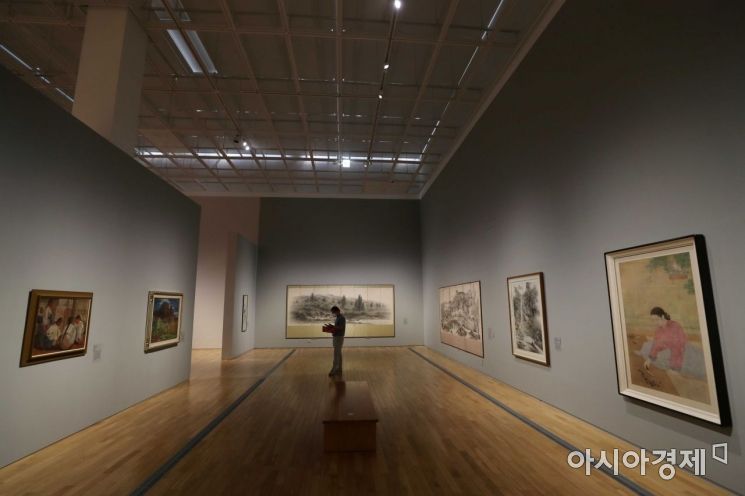 The scene of the "Lee Kun-hee Collection Special Exhibition" held last July at the National Museum of Modern and Contemporary Art, Seoul, Jongno-gu, Seoul.
The donation of over 23,000 pieces from the late Lee Kun-hee, Chairman of Samsung Group, known as the ‘Lee Kun-hee Collection,’ to the nation was also a hot topic this year. It is the largest donation ever, with an estimated value of 4 trillion KRW.
The donation of the Lee Kun-hee Collection had various ripple effects in the art world. First, it helped spread a culture of donation within the art community. Following the Samsung family’s donation announcement in April, the families of renowned domestic artists such as ink abstraction master Seo Se-ok and abstract sculpture pioneer Choi Man-rin also joined the donation movement. It also greatly influenced the introduction of the ‘art tax payment system,’ a long-standing wish of the art world for ten years. Recently, with the passing of famous artists and the generational shift of super collectors, museums, and galleries to the second generation, the introduction of the art tax payment system gained momentum. In this atmosphere, the donation of the Lee Kun-hee Collection was a major catalyst. The system finally passed the National Assembly plenary session earlier this month and is scheduled to be implemented from 2023.
There was also a wave of protests from civic groups and local governments regarding the construction of the ‘Lee Kun-hee Donation Hall,’ which will consolidate and exhibit the Lee Kun-hee Collection currently stored separately at the National Museum of Modern and Contemporary Art and the National Museum of Korea. The protests were based on the argument that the donation hall should be built outside the metropolitan area to promote regional balanced development. Ultimately, it was decided that the Lee Kun-hee Donation Hall will be built on a 37,141㎡ site in Songhyeon-dong, Jongno-gu, Seoul, with a floor area of 9,787㎡, to be completed by 2027.
Kim Yun-seop, CEO of the IF Art Management Research Institute, emphasized, "Next year’s challenge for the art market will be how to leverage favorable factors such as the Frieze Art Fair and the opening of major overseas galleries’ Seoul branches to revitalize the domestic market," adding, "It is also necessary to develop detailed strategies to address the newly emerging young demand groups, including the rapidly rising MZ generation as key customers."
© The Asia Business Daily(www.asiae.co.kr). All rights reserved.



















