Totaling KRW 18.1 trillion... Decline outside Terrestrial Broadcasting and IPTV
[Asia Economy Reporter Cha Min-young] Last year, the domestic broadcasting market's revenue growth rate stagnated at the 1% level, facing a slowdown in growth. The subscription fees, a major revenue source for comprehensive cable TV operators (SO), continue to decline, and the revenue of broadcasting channel usage providers (PP), excluding home shopping, is also on a downward trend.
The Ministry of Science and ICT and the Korea Communications Commission announced the results of the "2021 Broadcasting Industry Survey," which includes the 2020 domestic broadcasting operators' revenue status, on the 27th.
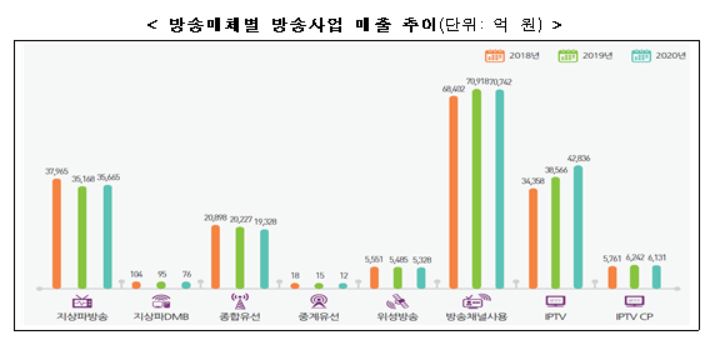
Last year, the broadcasting market size was 18.0118 trillion KRW in broadcasting business revenue, marking only a 1.9% increase compared to the previous year. The broadcasting business revenue growth rate, which reached 11.3% in 2012, has slowed down to 4.8% in 2018 and 2.1% in 2019.
Compared to the previous year, terrestrial broadcasting and IPTV revenues increased, while other media saw a decline. The total revenue of terrestrial broadcasting was about 3.6 trillion KRW, with a growth rate of 1.4%. Revenue by broadcaster was recorded as KBS 1.3522 trillion KRW (0.5%↑), MBC (including affiliates) 94.6 billion KRW (3.4%↑), and SBS 75.5 billion KRW (0.3%↓).
The total revenue of pay broadcasting operators was about 6.7 trillion KRW, a 5% increase from the previous year. Revenue by operator type was SO 1.9328 trillion KRW (4.4%↓), IPTV 4.2836 trillion KRW (11.1%↑), and satellite broadcasting 532.8 billion KRW (2.9%↓).
In the case of SO, due to decreases in subscription fees and home shopping transmission fees, revenue fell below 2 trillion KRW for the first time since 2011. Subscription fees have continuously decreased and have become lower than home shopping transmission fees.
PP revenue excluding home shopping was about 3.3 trillion KRW, a 3.8% decrease compared to the previous year. Revenue by operator type was general programming PP 978 billion KRW (10.3%↑), news PP 1.71 trillion KRW (6.4%↑), and general PP 21.837 trillion KRW (8.9%↓).
Home shopping revenue was about 3.8 trillion KRW, a 2.7% increase from the previous year. TV home shopping revenue stagnated at about 3 trillion KRW, but data home shopping revenue increased by 27.7% compared to the previous year.
The number of pay broadcasting subscribers was 34.79 million units, a 2.9% increase from the previous year. Units refer to the number of installed IPTV devices. The subscriber growth rate has been declining since 2016, when it was 6.2%. Subscriber numbers by operator type were IPTV 18.54 million units (8.2%↑), SO 13.13 million units (2.6%↓), and satellite broadcasting 3.08 million units (2.7%↓).
Broadcast program production and purchase costs were about 2.9 trillion KRW, an 11% decrease. Broadcast program export revenue increased by 33.9% compared to the previous year, surpassing 400 million USD for the first time (about 490 million USD).
The survey results can be found on the Ministry of Science and ICT, Korea Communications Commission Broadcasting Statistics Portal, and the Korea Information Society Development Institute websites.
© The Asia Business Daily(www.asiae.co.kr). All rights reserved.
![Clutching a Stolen Dior Bag, Saying "I Hate Being Poor but Real"... The Grotesque Con of a "Human Knockoff" [Slate]](https://cwcontent.asiae.co.kr/asiaresize/183/2026021902243444107_1771435474.jpg)















