Apartment Jeonse Supply-Demand Index Below 100
More Severe in Provinces... 'Unsold Units' Also Increasing
Market Instability Vicious Cycle Continues Next Year
"Urgent tenant needed for ○○ Apartment in Jungnang-gu. The house has no mortgage or loans and is available for immediate move-in. We also partially support moving expenses and cover the cost of proxy fees."
The nationwide jeonse (long-term lease) market freezing is an abnormal phenomenon occurring even as both sales and jeonse prices decline simultaneously. Just a few months ago, there was concern over soaring jeonse prices, but the situation has changed. With stringent loan regulations, interest rate hikes, and the winter off-season coinciding, housing transaction demand has sharply dropped. Additionally, political circles weighing real estate policies are exacerbating market instability.
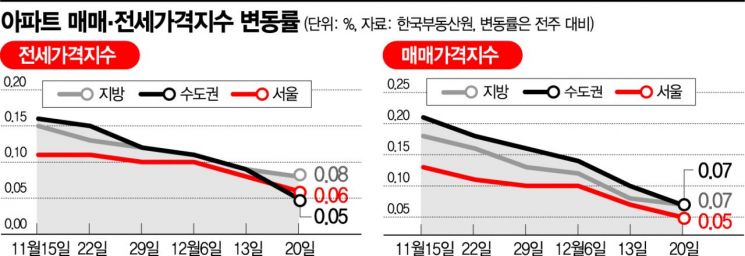
◆ Transactions abruptly halted despite falling sales and jeonse prices = According to the Korea Real Estate Board on the 24th, as of the 20th, the nationwide jeonse price change rate was 0.06%, down from 0.09% the previous week, indicating a slowdown in the increase. In Seoul, the rise slowed from 0.08% to 0.06%. Notably, among the 25 autonomous districts, apartment jeonse prices in Seongbuk-gu fell by 0.02% this week. This marks the first decline in 2 years and 5 months since July 2019 for Seongbuk-gu, and among Seoul’s 25 districts, Yangcheon-gu turned bearish for the first time in about 7 months since recording -0.02% in the last week of May this year.
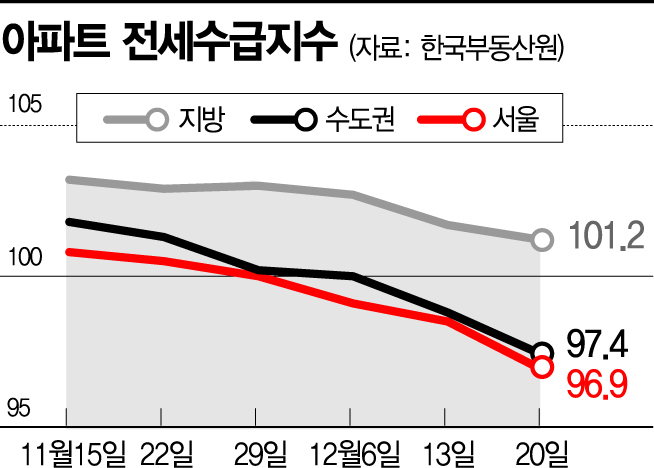
Prices have dropped, but listings are accumulating. The nationwide apartment jeonse supply-demand index recorded 99.4, falling below the baseline of 100 for the first time in a year and a half since June 2020. A supply-demand index below 100 indicates a lack of demand, while above 100 indicates a shortage of supply. It is also the first time in a year and a half that both the nationwide apartment sales and jeonse supply-demand indices have fallen below 100 simultaneously. In the metropolitan area, the sales supply-demand index has declined for six consecutive weeks, and the jeonse supply-demand index for three consecutive weeks.
According to Asil, a real estate big data company, as of the 24th, the total number of nationwide sales and jeonse/monthly rental listings was 475,706, an increase of over 4% compared to a month ago (454,325). Analysts attribute this to market fatigue over prices and concerns about stricter loan regulations next year, leading to a slowdown in buying demand. As the year-end moving off-season approaches, there are now more landlords seeking tenants than people looking for jeonse homes.
◆ More severe in regions like Daegu... Red alert for unsold units = The situation is even more severe in the provinces. In Daegu, jeonse prices fell by 0.03%, marking a downward trend for the first time in 1 year and 8 months since the third week of April last year (-0.01%). Among its eight districts, six showed declines (Jung-gu -0.06%, Dong-gu -0.05%, Seo-gu -0.02%, Nam-gu -0.01%, Buk-gu 0.02%, Dalseo-gu -0.06%). During the same period, apartment sales prices also fell by 0.03% compared to the previous week, continuing a six-week downward trend. Except for Suseong-gu, which remained flat (0.00%), the other seven districts showed declines. Wonju in Gangwon Province also turned negative, and Sejong recorded the lowest nationwide sales supply-demand index (81.1) and jeonse supply-demand index (86.9).
Amid the cooling transactions, unsold units are surging in various provincial areas. According to the Korea Real Estate Board’s Cheongyak Home as of this day, among 38 private apartment complexes in the provinces that held subscription applications in December, 22 failed to meet subscription quotas. More than one in two complexes failed to fill their recruitment units. Not only in Daegu, where 4 out of 5 complexes receiving applications this month failed to meet both first and second priority quotas, but also in Gyeongnam, Gyeongbuk, Jeonnam, and Jeonbuk, subscription shortfalls are occurring. The head of A Real Estate Agency in Dong-gu, Daegu, said, "Both buyers and sellers have completely stopped," adding, "Despite falling prices, there are no inquiries at all."
◆ Market instability causing listing backlog vicious cycle "Not centered on actual demand" = The problem lies in next year. The government plans to implement early stages 2 and 3 of borrower-level DSR (Debt Service Ratio) through strengthened household debt management measures starting next year. For existing borrowers, it will effectively become impossible to buy a home through ‘all-in’ borrowing. Commercial banks have also begun reducing mortgage and credit loans. Experts say that contrary to government forecasts, the jeonse market is not yet stabilizing.
Yoon Ji-hae, chief researcher at Real Estate R114, said, "Since sales and jeonse/monthly rental markets are complementary, instability in the jeonse market stimulates sales demand, which ultimately acts as a main factor driving house prices." Regarding the accumulation of jeonse listings, she added, "It’s not simply that there is no jeonse demand, but that turnover is not happening."
There are also criticisms that the supply was not originally centered on actual demand. Seo Jin-hyung, president of the Korea Real Estate Society and professor at Gyeongin Women’s University, pointed out, "Jeonse prices surged, but with jeonse loan restrictions, tenants cannot move in. The problem is that since the market is not centered on actual demand, a vicious cycle repeats where jeonse listings accumulate because tenants cannot move in."
© The Asia Business Daily(www.asiae.co.kr). All rights reserved.
![Clutching a Stolen Dior Bag, Saying "I Hate Being Poor but Real"... The Grotesque Con of a "Human Knockoff" [Slate]](https://cwcontent.asiae.co.kr/asiaresize/183/2026021902243444107_1771435474.jpg)

















