Two Years of COVID-19... Polarization Deepens in the Performance Industry
Every Time Social Distancing Measures Tighten
Most Daehangno Open-Run Tickets Canceled
Major Theater Performances Face Ticket Frenzy Due to Scarcity
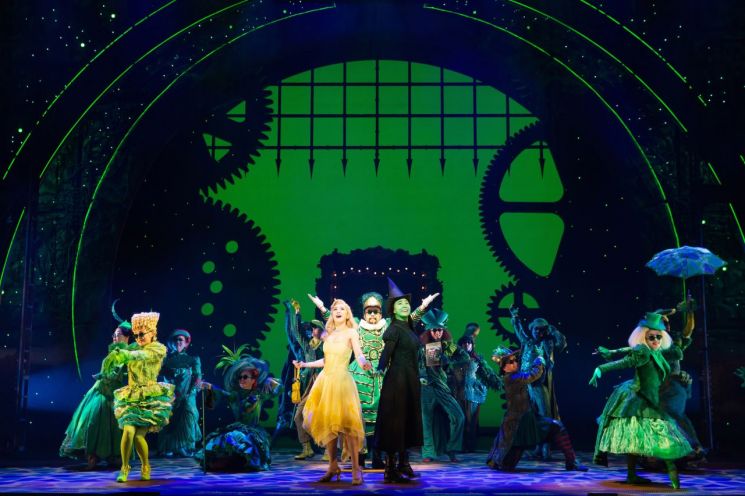
[Asia Economy Reporter Donghyun Choi] "I don't have any upcoming projects in preparation yet. I'm contemplating whether I should give up this profession. For the time being, I think I will have to work as a substitute driver."
When asked about future performance plans, Mr. Kim (42), a musical actor with 20 years of experience who recently completed a successful premiere and encore performances in Daehangno, gave this response. After the dazzling lights went off and the audience had all left, the actor waiting room fell silent, and he was no longer the star of the stage. He was a worker worried about his immediate livelihood. Even the production team bitterly remarked, "It's difficult to stage any more performances as there is no investment coming in."
A prominent feature of the performance market (limited to musicals and plays) in the second year of COVID-19 this year is the deepening polarization. Actors and staff working mainly in small theaters centered in Daehangno complain that the situation has not improved much despite the increase in vaccination rates and still face difficulties. On the other hand, large theaters have quickly recovered to pre-COVID-19 levels due to revenge consumption and year-end demand.
This is also confirmed by statistics. According to the Integrated Performing Arts Information System, in the second half of this year (as of the 22nd), sales at private theaters outside Daehangno reached 67.7 billion KRW, recovering to 84.4% of the total sales in the second half of 2019 (80.2 billion KRW). Under the same conditions, sales in Daehangno rose to 22.9 billion KRW, reaching 78.9%. On the surface, there seems to be little difference in the sales recovery trends between the two performance areas.
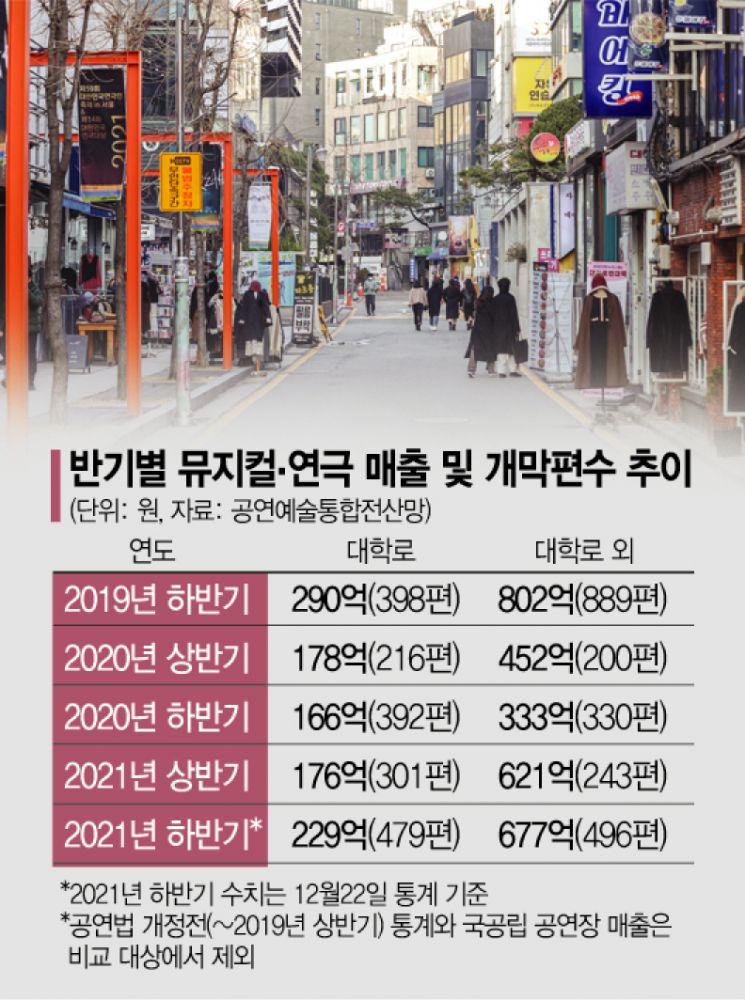
However, the story changes when looking at the number of performances opened. Outside Daehangno, 889 performances opened in the second half of 2019, but this year’s second half saw a 44.2% decrease to 496 performances. They defended sales by raising prices as the number of performances decreased. If the number of performances had been the same as in the second half of 2019, sales in the second half of this year would likely have exceeded pre-COVID-19 levels and set a record high. Conversely, the number of performances in Daehangno increased by 20.3%, from 398 to 475 during the same period. Most Daehangno theaters operate on a small scale and have adopted a survival strategy of ‘low margin, high volume’ despite reduced profits.
Industry insiders agree that Daehangno theaters have inevitably suffered more from government social distancing and quarantine measures. This is due to the unique characteristic that nearly half of Daehangno’s total sales come from open-run performances. Open-run refers to performances without a set end date, continuing indefinitely. The audience for open-run performances mostly consists of young, casual visitors who are not enthusiasts but are just beginning to experience the show. For them, attending a performance is a means rather than an end. They tend to watch performances during spare time before or after meeting acquaintances in the Daehangno commercial district. When operating hours of Daehangno restaurants and cafes and private gathering restrictions are imposed, demand inevitably decreases. Hyejin Kim, head of the Performance Information Support Team at the Arts Management Support Center, said, "Ticket prices are fixed according to theater size, and the influx of new audiences has decreased, which are major reasons why Daehangno’s performance market recovery is slow," adding, "Daehangno is currently operating mainly on sales from a small group of enthusiasts due to the COVID-19 situation."
On the other hand, large theaters are relatively less affected by strengthened quarantine measures. Their audience mainly consists of enthusiasts who attend performances as the main purpose, and ticket prices are generally higher. When government social distancing measures are tightened, more than 80% of open-run tickets in Daehangno are canceled, but large theater performances gain rarity value, causing ticket sales to surge. It is common for prices to skyrocket in the secondary market. Recently, with the government’s introduction of the vaccination certificate and negative test confirmation system (quarantine pass), allowing 100% seating capacity, the effects of ‘revenge consumption’ and ‘year-end demand’ have been maximized. Jonggyu Lee, director of the Korea Musical Association, said, "Large theaters have a structure where they lose a lot when losing and earn a lot when earning, so they have relatively benefited from the recent recovery phase of the performance market," adding, "Daehangno has the unique characteristic of being a creation-oriented market that requires a long and arduous process from initial investment to hit and popularization." He continued, "Measures to support the creative market through amendments to the Performance Act should be promptly prepared," and added, "Except for the 2008 global financial crisis and the COVID-19 period, the performance industry has been steadily growing, so if the current difficult situation is overcome well, a third leap forward will surely come."
© The Asia Business Daily(www.asiae.co.kr). All rights reserved.


















