Notice of "Refusal to Comply with Quarantine Guidelines" at a Cafe in Incheon
City Shifts Stance to Strong Response... Self-Employed Still Dissatisfied
Protests Held Demanding Lifting of Business Restrictions and Quarantine Pass
Reduced Citizen Cooperation Increases Local Government Burden
Experts Say "Existing Compensation Hardly Provides Relief"
"Broad and Long-Term Disaster Support Measures Needed"
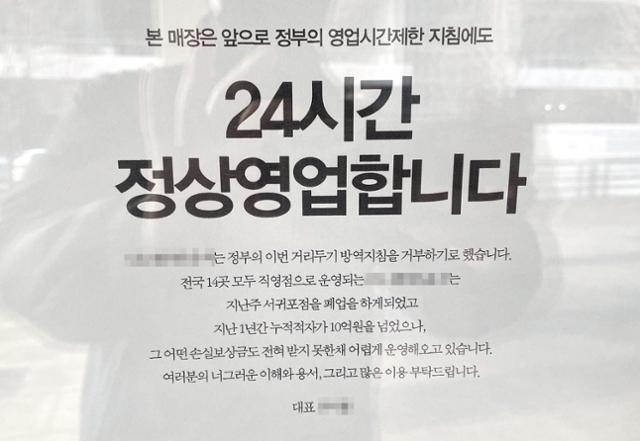 A notice from a large cafe in Incheon stating refusal to comply with the government's operating hour restrictions for multi-use facilities such as cafes and restaurants. / Photo by Online Community Capture
[Asia Economy Reporter Lim Juhyung] Although the government is tightening its quarantine policies to slow the spread of COVID-19, dissatisfaction among self-employed individuals and small business owners is growing. Eventually, a large caf? even emerged, refusing to comply with the government's operating hour restrictions and declaring it would operate 24 hours a day. If self-employed businesses such as restaurants and caf?s do not cooperate with the government, there is a risk that local government personnel working on the front lines will face an even greater burden.
◆"We refuse to comply with social distancing quarantine guidelines" - Controversy over caf?'s stance
'The November Lounge,' a large caf? operating 14 directly managed stores nationwide in Incheon, posted a notice on the 18th stating, "Our store will continue normal operations 24 hours a day despite the government's operating hour restrictions." This day marked the implementation of the government's strengthened quarantine measures.
In the notice, the business expressed, "We have decided to refuse the government's current social distancing quarantine guidelines. We had to close our Seogwipo branch last week, and our cumulative deficit over the past year has exceeded 1 billion KRW. However, we have been operating with great difficulty without receiving any compensation for losses."
They continued, "We ask for your generous understanding, forgiveness, and continued patronage," appealing for support. Among the 14 directly managed stores, five agreed with the headquarters' decision to continue operations and maintained 24-hour service. However, they reportedly only rejected operating hour restrictions while still enforcing private gathering regulations and the quarantine pass (vaccination or negative test certificate) requirements.
However, on the 20th, Yeonsu District in Incheon reported that the caf?'s Yeonsu District main branch and one directly managed store in Songdo International City operated 24 hours over two days (18th-19th), and filed a police complaint for violating the Infectious Disease Prevention and Control Act.
As local governments took strong action, the caf? eventually reversed its stance and complied with quarantine guidelines. On the 21st, the caf?'s main branch told Asia Economy in a phone interview, "From the previous day (20th), we decided to operate only until 9 p.m., the restricted operating hour, and we are actually doing so."
◆"Present fundamental alternatives" - Self-employed anger reaches its peak
Although the 'refusal to comply with operating hour restrictions' incident has been settled for now, the anger of self-employed individuals is unlikely to subside easily. When 'The November Lounge' posted its notice about continuing 24-hour operations, online self-employed communities such as 'Because It's Painful, I'm the Boss' responded with empathy, saying things like, "It might be cheaper to just pay the fines and operate. I wish I could join you," and "Stay strong. We support you."
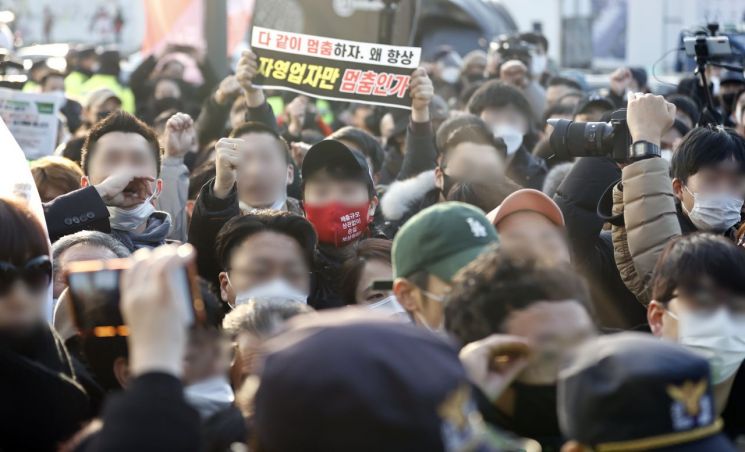 On the afternoon of the 22nd, participants who could not enter due to capacity limits at the "National Emergency Measures Committee for Self-Employed in Response to COVID-19 (Self-Employed Emergency Committee) Rally Against Government Quarantine Measures" held at Gwanghwamun Citizen's Open Square in Seoul demanded entry while shouting related slogans. / Photo by Yonhap News
Some self-employed individuals participated in large-scale protests opposing the government's strengthened quarantine guidelines. The 'COVID-19 Response National Emergency Committee of Self-Employed' (Emergency Committee), mainly composed of PC room operators, pubs, and space rental businesses, held a mass rally from 3 p.m. to 5 p.m. on the 22nd at Gwanghwamun Citizen's Open Square in Jongno-gu, Seoul.
At this event, protesters demanded the government abolish the quarantine pass, lift operating hour restrictions, and withdraw the expansion of the Labor Standards Act to businesses with fewer than five employees. Oh Sehee, president of the Korea Federation of Small and Medium Business, who attended the rally, urged, "Establish fundamental alternatives to the quarantine pass implementation, including labor cost support, immediately," and called for "targeted quarantine measures focusing on confirmed cases, such as limiting operating hours accordingly."
If the government does not accept these demands, additional collective actions were also announced. Oh emphasized, "If the five demands are not met, we will lead stronger unity among small business owners," and added, "If the current quarantine policies are not lifted and extended after January 2nd next year, we will hold another mass rally."
Previously, the Emergency Committee held a nationwide vehicle protest in July against quarantine guidelines. In October, they set up a tent near the government Seoul office to mourn self-employed individuals who had taken extreme measures due to financial hardship and staged a sit-in protest.
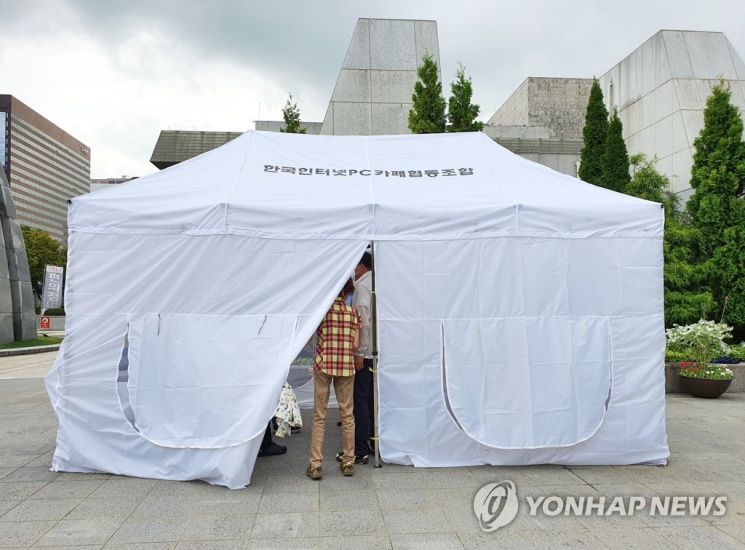 On the afternoon of October 7th, a tent of the National Self-Employed Emergency Response Committee was set up at Sejongno Park near the Government Seoul Office Building. / Photo by Yonhap News
After social distancing measures were eased and quarantine policies shifted to 'gradual daily recovery (With COVID-19),' collective actions paused briefly, but opposition has grown again as distancing measures were reinforced.
◆Citizens' cooperation with quarantine decreases, increasing local government burdens
If dissatisfaction among self-employed and small business owners grows and cooperation with quarantine decreases, there are concerns that the quarantine network could become unstable. This is because local government personnel working on the front lines, collaborating directly with medical staff and operating public health centers, could face additional burdens.
Over the past two years, self-employed businesses have generally cooperated with government quarantine measures, but some businesses attempting illegal operations forced local governments to deploy personnel for nighttime patrols.
For example, on July 30th, a nightclub in Goyang City, Gyeonggi Province, was caught by the Gyeonggi Province crackdown team for illegal late-night operations.
On the night of August 8th, a 'no-mask rooftop party' was held at a caf? on the Han River in Gangnam-gu, Seoul, which was discovered by Seoul city investigators.
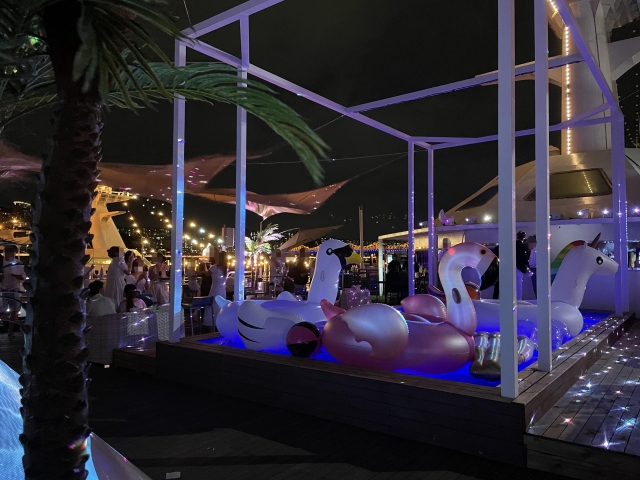 A Han River floating cafe in Seoul was caught violating quarantine rules on August 8. / Photo by Seoul City
This riverside caf? was registered as a regular restaurant but was actually operated like a club, secretly inviting guests through direct messages (DMs) on social media accounts to hold parties.
Additionally, at the end of October, ahead of Halloween, Seoul city authorities caught 19 businesses violating quarantine rules in busy districts and areas with high foreigner populations.
As social distancing prolonged, some exhausted businesses began resisting despite fines. If self-employed individuals dissatisfied with strengthened quarantine measures actively defy operating hour restrictions or conduct illegal operations, local governments will have no choice but to deploy more monitoring personnel, which will inevitably increase the overall burden on the quarantine network.
◆Experts: Existing loss compensation was insufficient to provide relief
Given this situation, the government decided to provide emergency funds to appease self-employed individuals and small business owners.
Hong Nam-ki, Deputy Prime Minister and Minister of Economy and Finance, said at a joint briefing held at the government Seoul office on the 17th, "We have mobilized all available financial resources, including the existing budget, various funds, and contingency funds, to prepare a 4.3 trillion KRW three-package support plan," adding, "We will begin swift support from the end of this year."
Specific support measures include providing a lump sum cash payment of 1 million KRW to businesses experiencing confirmed sales declines, regardless of sales size or quarantine measures. This includes 900,000 businesses that previously received loss compensation and 2.3 million businesses, such as travel and performance industries, that were not eligible for loss compensation.
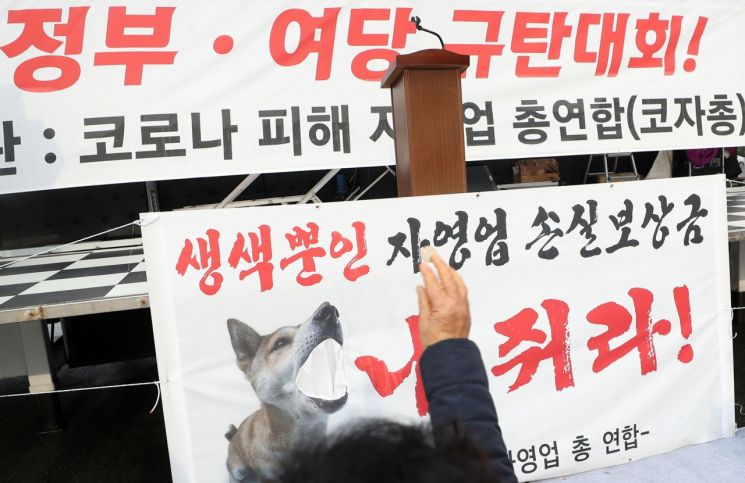 On the afternoon of the 16th, participants criticized the compensation for losses by throwing coins at the 'Government and Ruling Party Condemnation Rally Urging Substantial Compensation for COVID-19 Damage' held on the road in front of the Gyeongnam Provincial Government Plaza intersection in Seongsan-gu, Changwon-si, Gyeongnam. / Photo by Yonhap News
Additionally, to reduce the cost burden of quarantine supplies due to the expanded application of the quarantine pass, up to 100,000 KRW in in-kind support will be provided, and loss compensation for small business owners affected by future quarantine measures will be significantly expanded.
Deputy Prime Minister Hong emphasized, "We will revise related legal provisions to provide more substantial support, including newly covering businesses that were not previously eligible for loss compensation," and added, "Additional loss compensation will be provided according to the compensation formula."
Experts advise that to alleviate the suffering of self-employed individuals, the approach should go beyond simple loss compensation and consider long-term disaster support.
Professor Kim Taeg-gi of Dankook University's Department of Economics pointed out, "The problem with the Loss Compensation Act is that the criteria for loss and compensation are ambiguous, causing delays in calculating damages, and the compensation amount itself was too small to be helpful," adding, "In fact, the term 'loss compensation' is inaccurate. Providing financial support to self-employed individuals does not mean compensating for all losses. The term 'disaster support' is more appropriate."
He continued, "The morale of self-employed individuals continues to decline and dissatisfaction is rising, so the government needs to make efforts to address this," and suggested, "Beyond simple short-term cash support, broad and long-term disaster support measures such as long-term loans for small business owners and retraining support should be prepared to help them."
© The Asia Business Daily(www.asiae.co.kr). All rights reserved.
![Clutching a Stolen Dior Bag, Saying "I Hate Being Poor but Real"... The Grotesque Con of a "Human Knockoff" [Slate]](https://cwcontent.asiae.co.kr/asiaresize/183/2026021902243444107_1771435474.jpg)

















