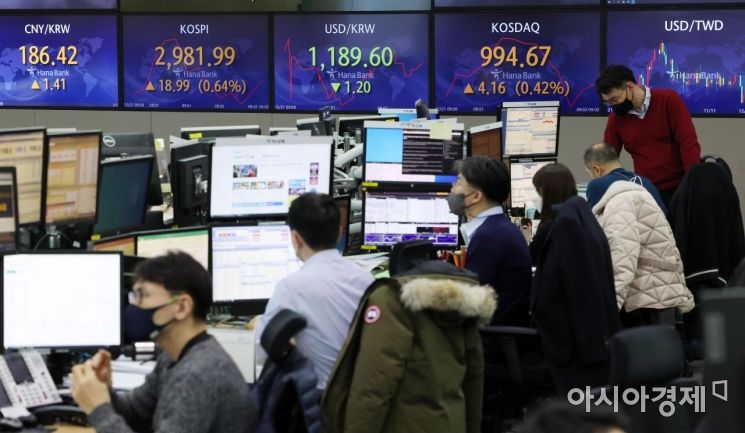
 On the 21st, the KOSPI opened at 2,981.67, up 18.67 points (0.63%) from the previous trading day, at the Hana Bank dealing room in Jung-gu, Seoul. The won-dollar exchange rate started at 1,189.8 won, down 1.0 won from the previous trading day. Photo by Hyunmin Kim kimhyun81@
[Asia Economy Reporter Hwang Junho] On the 22nd, the stock market started higher as concerns over lockdowns due to the COVID-19 variant Omicron eased.
On that day, the KOSPI opened at 2,993.50, up 18.47 points (0.62%). It maintained its upward trend and as of 9:17 a.m. on the same day, it was recorded at 2,993.80. While individual investors engaged in profit-taking with net sales worth 100.8 billion KRW, foreign investors and institutions showed net buying intentions of 58.1 billion KRW and 52.0 billion KRW respectively.
Foreign investors continued their net buying trend in the early trading hours following the previous day. This is analyzed as a result of increased preference for risk assets after U.S. President Joe Biden, in a national address, reiterated the call for vaccines against the variant virus and announced that measures such as economic lockdowns, which the financial market had feared, would not be implemented.
Among all stocks, 593 stocks were on the rise while 194 stocks were declining. Among the top market capitalization stocks, Samsung Electronics, the perennial leader, continued its upward trend from the previous day. As of this time, it recorded 79,300 KRW, up 1.54%. SK Hynix, another semiconductor stock, also rose 2.41% to 127,500 KRW. Semiconductor stocks have been rising for two consecutive days following Micron Technology's earnings announcement in the U.S., expressing confidence in the growth of the semiconductor industry.
Amid the rise of leading semiconductor stocks, the electrical and electronics sector jumped 1.04%. Steel and metals rose 0.68%, distribution 0.59%, and services 0.49%.
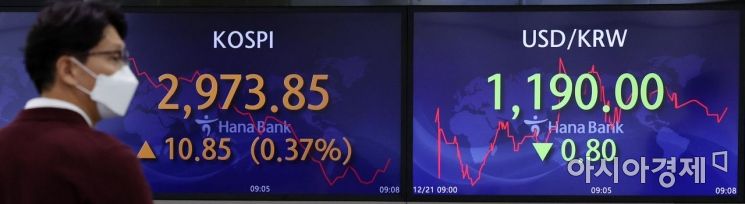 On the 21st, the KOSPI opened at 2,981.67, up 18.67 points (0.63%) from the previous trading day, at the Hana Bank dealing room in Jung-gu, Seoul. The won-dollar exchange rate started at 1,189.8 won, down 1.0 won from the previous trading day. Photo by Kim Hyun-min kimhyun81@
The KOSDAQ also opened at 1,004.10, up 7.50 points (0.75%) on the day. As of this time, individuals and institutions are leading the index rise with net purchases of 36.7 billion KRW and 16.9 billion KRW respectively, while foreign investors are conducting net sales worth 55.3 billion KRW.
Among all stocks, 958 stocks are rising and 347 stocks are declining. Among the top market capitalization stocks, the strength of gaming stocks stands out. Kakao Games (3.51%) and Wemade (3.63%) are rising. Following that, secondary battery stocks such as EcoPro BM (1.77%) and L&F (2.89%) also saw their stock prices rise from the early trading hours.
Seosangyoung, a researcher at Mirae Asset Securities, said, "The rise of reopening sectors in the U.S. stock market will act as a positive factor for the domestic stock market as well," adding, "The sharp rise in electric vehicle and solar power sectors can also predict strength centered on related stocks."
The dollar/won exchange rate, which had been pressuring the stock market, is also weak. On this day, the dollar/won exchange rate was 1,191.00, showing a 0.16% weakening compared to the previous day.
Kim Yumi, a researcher at Kiwoom Securities, said, "The dollar fell as concerns over Omicron eased, reducing the preference for safe assets in the financial market despite the rise in government bond yields," and forecasted, "The one-month dollar/won exchange rate will show a downward trend as the dollar weakens and the New York stock market rises along with a reduced preference for safe assets."
© The Asia Business Daily(www.asiae.co.kr). All rights reserved.
![Clutching a Stolen Dior Bag, Saying "I Hate Being Poor but Real"... The Grotesque Con of a "Human Knockoff" [Slate]](https://cwcontent.asiae.co.kr/asiaresize/183/2026021902243444107_1771435474.jpg)
















