[Asia Economy Reporter Ki-min Lee] Following the establishment of a strong labor union at Hyundai Motor Company, the new union branch chief election at Kia is also unfolding as a showdown between two strong factions. The 7+7 work system, which was a decisive factor in the Hyundai union election, has emerged as a key pledge of a particular candidate at Kia, drawing attention.
According to the Kia branch under the Metal Workers' Union on the 21st, the second round of voting for the 27th executive election to select the new union branch chief at Kia is scheduled for the 24th. Candidates Hong Jin-seong (number 1) and Yoon Min-hee (number 3) advanced to the second round. In the first round held on the 17th, 93.1% of the 28,696 union members participated, resulting in a neck-and-neck race with Hong receiving 35.4% and Yoon 34.8%. The key question is where the votes that supported moderate candidate Jang Soo-kwang (27.6%), who failed to advance to the runoff, will go.
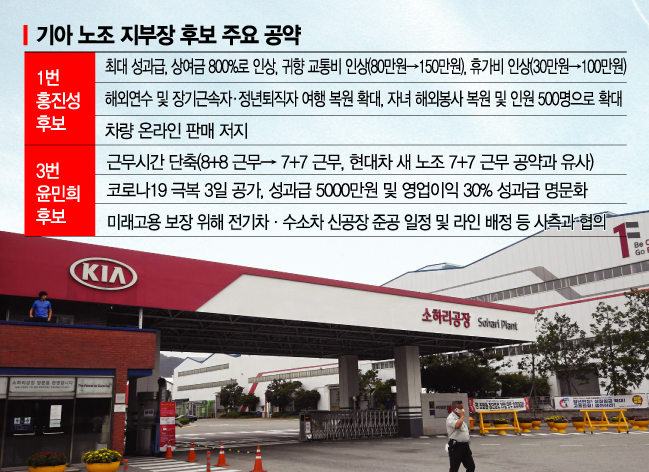
This Hyundai-Kia union branch chief election is characterized by a clash of bold pledges, which is expected to inevitably lead to friction with management. In particular, Yoon’s pledge of the 7+7 work system is similar to the recently elected Hyundai union’s 7+7 work system, raising the possibility of a joint front in the future.
Candidate Yoon proposed a work system where both the first shift (morning) and second shift (afternoon) involve working for 1 hour followed by a 10-minute paid break, repeated six times a day, with a paid 1-hour lunch break?this is the 7+7 pledge. This reflects recent calls from the labor sector to introduce European-style 35-hour workweeks or four-day workweeks, though actual implementation is still far off. Yoon’s plan is considered more intensive than Hyundai’s new union’s 7+7 work system, which involves working 1 hour 50 minutes, taking a 10-minute break, then working 1 hour 30 minutes twice a day, and extending the lunch break from 40 minutes to a paid 1 hour. Additionally, Yoon pledged to guarantee future employment by negotiating with management on the completion schedule and line assignments if new electric and hydrogen vehicle plants are built. Other promises include three days of paid leave to overcome COVID-19, a performance bonus of 50 million KRW, and formalizing a 30% profit-sharing performance bonus.
Hong, who faces Yoon in the second round, has vowed to demand from management the maximum performance bonus, increasing bonuses to 800%, raising homecoming transportation expenses from 800,000 KRW to 1.5 million KRW, and increasing vacation allowances from 300,000 KRW to 1 million KRW. Notably, Hong pledged to restore and expand overseas training, long-service and retirement trips, and overseas volunteer opportunities for employees’ children. Hong also promised to block the industry’s recent trend of ‘online vehicle sales’ to protect sales staff jobs.
Both candidates plan to demand that management pay a 5 million KRW performance bonus to all field workers, in response to recent payments of 5 million KRW performance bonuses only to high-performing office and research managers (managers, senior managers, and department heads). They also intend to negotiate with the company to change the current retirement age system?which allows two one-year contract extensions after the mandatory retirement age of 58?to a uniform retirement age of 62.
If no candidate receives a majority of votes from union members and a majority of votes in the second round, the Kia union plans to hold a third round of voting on the 30th. The winner is scheduled to be officially announced on January 1 of next year.
© The Asia Business Daily(www.asiae.co.kr). All rights reserved.

















