National Human Rights Commission Announces 2021 National Human Rights Survey Results
"Serious Discrimination" Increased from 34% to 47%
Most Affected Groups Are Economically Disadvantaged
[Asia Economy Reporter Lee Gwan-ju] The number of citizens who seriously consider human rights violations and discrimination has increased.
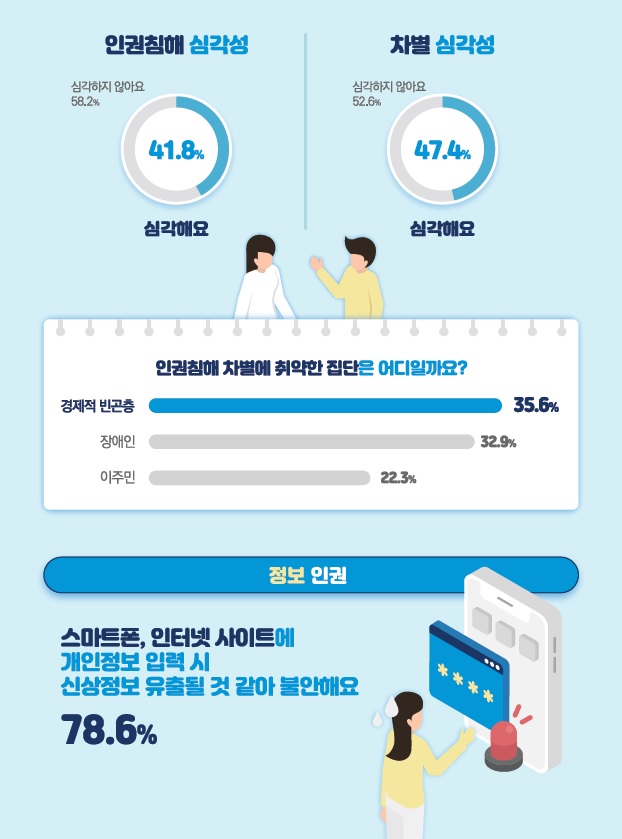
On the 21st, the National Human Rights Commission announced the results of the '2021 National Human Rights Survey' conducted from July to November on 17,593 adult men and women. The proportion of respondents who felt that human rights violations were serious recorded 41.8%. This is an increase after falling from 54% in 2019 to 30.4% in 2020 within one year.
The proportion of respondents who felt discrimination was serious also dropped from 69.1% in 2019 to 33.7% last year, but reversed to rise to 47.4% this year. The group most frequently identified as experiencing human rights violations or discrimination was the economically impoverished (35.6%), followed by people with disabilities (32.9%), migrants (22.3%), and those with low educational background or academic credentials (16.7%). Situations where human rights violations or discrimination are likely to occur (multiple responses) were most often reported as during police or prosecution investigations at 36.7%.
Regarding perpetrators of human rights violations or discrimination (multiple responses), the highest proportion was people who are not well known or not close at 65.2%, followed by acquaintances other than family or relatives (56.7%), natural or living environments (29.2%), and family or relatives (18.9%). Looking at specific relationships or situations, the most common response was workplace supervisors or superiors at 29.0%, followed by surrounding living environments (noise, lack of cultural and convenience facilities, etc.) at 19.2%, neighbors or groups such as clubs to which one belongs (16.1%), and service industry business owners and workers (13.0%).
When experiencing human rights violations or discrimination, 7 out of 10 people (72.8%) answered that they took no action. The reasons included concerns that the problem might worsen (33.9%), thinking it was not a big deal (21.8%), and not knowing how to respond (21.6%).
Eight out of ten people (78.6%) felt anxious about personal information being leaked when entering personal data on internet sites, and half of the citizens (50.3%) responded that they check all the contents when agreeing to the collection and use of personal information. Only 30.3% agreed with the opinion that installing CCTV in public places for safety is an invasion of privacy.
Experience of encountering hate speech (multiple responses) was 54.8%, with the channels of exposure being TV/radio (49.6%), online portals, cafes, communities (38.4%), internet broadcasting (36.7%), and friends, family, acquaintances (19.0%). Targets of hate speech (multiple responses) were politicians at 39.7%, followed by women (32.1%), sexual minorities (28.5%), specific religious groups (27.0%), and celebrities (23.6%).
© The Asia Business Daily(www.asiae.co.kr). All rights reserved.
![Clutching a Stolen Dior Bag, Saying "I Hate Being Poor but Real"... The Grotesque Con of a "Human Knockoff" [Slate]](https://cwcontent.asiae.co.kr/asiaresize/183/2026021902243444107_1771435474.jpg)















