Shinhan Bank's 'Ttaenggyeoyo' and Woori Bank's 'My Convenience Store' Launched in Succession
Latecomers' Performance Uncertain... "Various Incentives Needed"
[Asia Economy Reporter Jin-ho Kim] Banks are increasingly entering the lifestyle service market, starting with delivery applications (apps). Banks, which had been on the defensive in competition with big tech companies (large information technology firms), are now signaling fierce competition on the platforms that serve as the main stage for these tech giants. While the industry views this as the first step toward building comprehensive platforms by banks, some critics argue that there is little to attract consumers significantly.
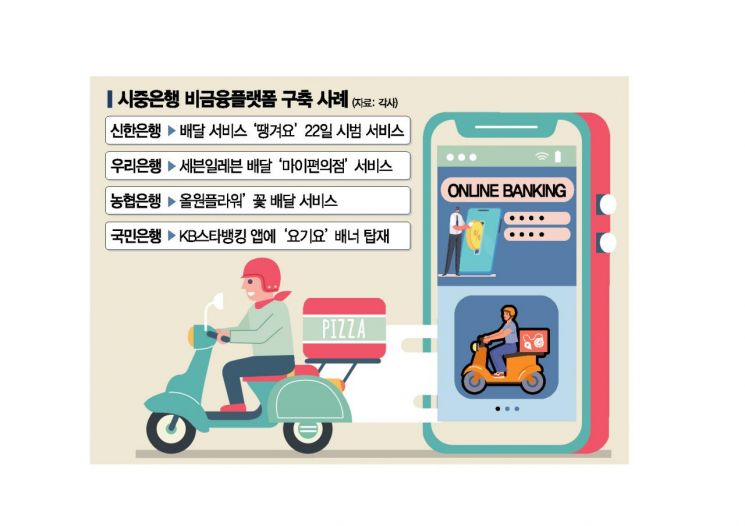
According to the financial sector on the 20th, Shinhan Bank will launch a pilot service for its self-developed delivery app ‘Ttaenggyeoyo’ on the 22nd. Starting with six districts in Seoul?Gangnam, Seocho, Songpa, Gwanak, and others?the plan is to secure about 80,000 affiliated stores across Seoul and Gyeonggi Province by the end of next year.
‘Ttaenggyeoyo’ is characterized by being operated separately from Shinhan Bank’s existing financial platform ‘SOL.’ Unlike other banks’ lifestyle services, it operates as a standalone app, allowing even non-Shinhan Bank customers to use it conveniently, similar to Baedal Minjok or Coupang Eats.
Woori Bank also launched the ‘My Convenience Store’ service in partnership with convenience store chain Seven Eleven starting today. Customers can order Seven Eleven products worth more than 15,000 KRW from 11 a.m. to 11 p.m. and have them delivered to their desired location. This service was launched to increase user engagement with the mobile banking app ‘Woori WON Banking.’
Kookmin Bank has added a banner for the delivery app ‘Yogiyo’ within its KB Star Banking app. NongHyup Bank offers a flower delivery payment service called ‘All One Flower’ through its mobile banking app ‘All One Bank.’
The reason banks are embedding delivery and other lifestyle services into their apps or developing separate apps is analyzed as a response to the intensifying invasion by big tech companies like Naver and Kakao. There is a sense of crisis that if banks do not actively attempt to transform into comprehensive platforms, they may be relegated in the future to mere subcontractors who only create financial products.
In particular, non-financial data is cited as the reason banks are focusing on ‘delivery.’ It is interpreted as a strategy to accumulate vast amounts of non-financial data by providing delivery services that consumers use most frequently during the COVID-19 pandemic.
Based on the accumulated non-financial data, banks plan to strengthen existing financial services such as new loan products. Shinhan Bank plans to offer various financial services tailored to self-employed merchants registered on ‘Ttaenggyeoyo,’ as well as to riders and users. In fact, in October, Shinhan Bank launched a dedicated loan product based on rider data from the delivery agency ‘Saenggakdaero’ associated with ‘Ttaenggyeoyo.’ A representative from a commercial bank said, "It can be seen as the initial stage of building a comprehensive platform through the fusion of financial and non-financial services."
However, there is skepticism about how meaningful the results will be for banks entering the already saturated lifestyle finance service market as latecomers. While attempts to strengthen non-financial services to build comprehensive platforms are positively evaluated, concerns about sustainability remain.
Especially in the delivery app market dominated by large companies like Baedal Minjok and Coupang Eats, there are concerns that Shinhan Bank’s ‘Ttaenggyeoyo’ could become as ineffective as public apps run by local governments if it lacks strong incentives to attract consumers. A representative from a commercial bank said, "The key ultimately lies in securing consumer convenience," and predicted, "Various incentives such as coupons and events will be prepared to activate the service."
Regarding Woori Bank’s ‘My Convenience Store’ service, there are criticisms that it is cumbersome because users must log in to the bank app to use it. This is because convenience store delivery services are already offered by all delivery companies.
Meanwhile, there are calls for deregulation of non-financial services to enable banks to build comprehensive platforms. Just as big tech companies were allowed to enter the financial sector, it is argued that banks should also be institutionally supported to actively pursue platform businesses.
© The Asia Business Daily(www.asiae.co.kr). All rights reserved.
![Clutching a Stolen Dior Bag, Saying "I Hate Being Poor but Real"... The Grotesque Con of a "Human Knockoff" [Slate]](https://cwcontent.asiae.co.kr/asiaresize/183/2026021902243444107_1771435474.jpg)















