Announcement on Gas Price Increase Today
Residential Rates Frozen Since July Last Year
[Sejong=Asia Economy Reporter Joo Sang-don] The government plans to freeze not only electricity rates but also other public utility charges such as city gas. However, if cost increases beyond the control of public enterprises, such as fuel costs, are not reflected, a deterioration in profits is inevitable. There is considerable concern that if prices are sharply raised after next year’s presidential election, the burden on the public will be significant.
Alongside electricity rates, city gas is the item attracting the most attention. The Ministry of Trade, Industry and Energy will decide and announce whether to raise city gas prices on the afternoon of the 20th, with the current likelihood leaning towards a freeze. A ministry official said, "We will announce city gas rates, including residential rates, for January next year."
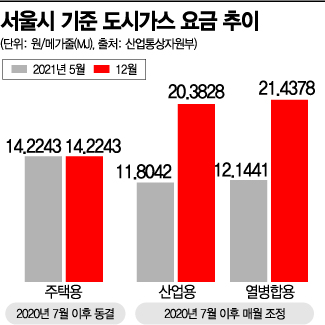
City gas rates have remained at current levels for over a year since the last increase in July last year. In July last year, the ministry adjusted the average city gas rate from the current 15.24 KRW per megajoule (MJ) to about 13.25 KRW, a reduction of approximately 2 KRW. Since then, residential rates have been frozen at 14.2243 KRW per MJ based on Seoul standards. However, industrial and combined heat and power gas rates have increased by more than 70% during the same period, from 11.8042 KRW to 20.3828 KRW, and from 12.1441 KRW to 21.4378 KRW, respectively.
Gas Corporation is reportedly holding firm in its position until the last moment with the ministry. City gas rates are adjusted monthly at the end of each month for the following month. When the Gas Corporation requests a rate adjustment plan from the ministry, the ministry decides whether to approve it and notifies the corporation. Previously, the Gas Corporation requested approval to raise city gas rates for residential and general use by about 10% starting January next year. A corporation official said, "The government is moving to freeze living-related utility rates such as electricity and city gas to suppress inflation, which is expanding the financial deficits of the public enterprises. Since city gas sales prices have been frozen since July last year, they are being sold below cost, which includes supply costs added to import prices, resulting in accumulated deficits, making a residential city gas rate increase inevitable."
Chae Hee-bong, president of the Gas Corporation, recently explained on his social media, "International natural gas prices have surged, and unpaid receivables are expected to reach 1.5 trillion KRW by the end of this year and 3 trillion KRW by the end of March next year," adding, "We judged that it is reasonable to raise city gas rates at least minimally, so we are pushing for a rate increase for residential use."
Electricity and city gas rates are price indicators that directly affect the public, serving as a gauge for whether other public utility rates will increase. If city gas rates are frozen along with electricity rates in the first quarter of next year, it is highly likely that local utility rates such as public transportation and water and sewage fees will also be kept at current levels.
Earlier, in September, the Ministry of Economy and Finance stated at a price-related vice-ministerial meeting, "Considering the difficult price conditions, the basic principle is to freeze all public utility rates except those already decided until the end of the year." Since then, the consumer price index rose 3.7% month-on-month in November, marking the largest increase in 10 years. The government’s stance on freezing public utility rates is likely to continue for some time.
However, it cannot be ruled out that public utility rates will rise one after another after the new government takes office next year due to political decisions. Since cost pressures such as fuel prices will continue next year, the increase in public utility rates could be larger than expected. Professor Kang Nam-hoon of Hanshin University’s Department of Economics said, "Freezing various public utility rates such as electricity to reduce the price burden on low-income households is a short-sighted solution and does not eliminate the causes of price increases. Simply suppressing public utility rates does not help carbon neutrality from the perspective of energy conservation, so costs should be gradually and appropriately reflected in electricity and gas rates."
© The Asia Business Daily(www.asiae.co.kr). All rights reserved.
![Clutching a Stolen Dior Bag, Saying "I Hate Being Poor but Real"... The Grotesque Con of a "Human Knockoff" [Slate]](https://cwcontent.asiae.co.kr/asiaresize/183/2026021902243444107_1771435474.jpg)















