Government Holds Off on Rate Hike Amid Inflation... Concerns Over Bombshell Increase After Presidential Election
[Sejong=Asia Economy Reporter Kwon Haeyoung] Korea Electric Power Corporation (KEPCO) has frozen electricity rates for the first quarter of next year. Despite growing pressure to raise electricity prices due to soaring fuel costs, the government has once again exercised its veto power, citing "consideration of the public's living conditions amid rising inflation." The government plans to suppress public utility fees, including electricity rates, until the first quarter, raising concerns that the increase in public utility fees, including electricity rates, could surge sharply after next year's presidential election.
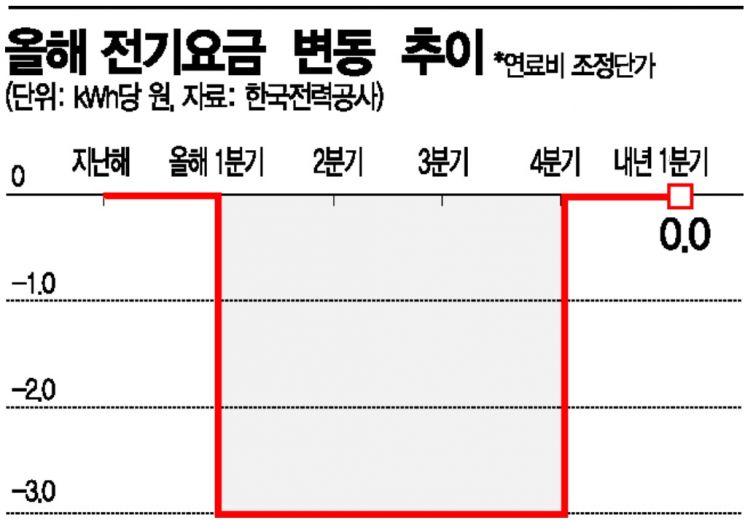
KEPCO announced on the 20th that it will apply a final fuel cost adjustment rate of 0 KRW per kWh for January to March next year. This means maintaining the same level as the fourth quarter of this year.
Previously, KEPCO had calculated the fuel cost adjustment rate for the first quarter of next year at 29.1 KRW per kWh through the "fuel cost linkage system," which reflects quarterly increases or decreases in fuel costs in electricity rates. Since fuel costs rose, there was a factor for a 29 KRW increase in electricity rates. According to KEPCO, during the fuel cost reflection period for the first quarter of next year, from September to November, the price of thermal coal averaged 181.81 KRW per kg after tax, up 20.3% compared to the previous three months. Liquefied natural gas (LNG) was 832.43 KRW per kg, and BC oil was 661.27 KRW per kg, rising 38.4% and 15.1%, respectively. This represents a 61.6% increase compared to the average fuel cost over the past year.
KEPCO submitted a proposal to the government to raise electricity rates by applying a maximum quarterly adjustment limit of 3 KRW per kWh, which is one-tenth of the adjustment rate, but the government’s exercise of veto power led to the decision to freeze rates.
The government explained the freeze by stating, "Although adjustment factors arose due to the sharp rise in international fuel prices, it is necessary to ensure the stability of the public's livelihood amid the prolonged COVID-19 pandemic and high inflation rates."
Since the introduction of the linkage system, KEPCO lowered electricity rates by 3 KRW per kWh in the first quarter of this year and decided to raise rates by 3 KRW in the fourth quarter due to the surge in fuel costs. As a result, despite the fuel cost surge starting early this year, KEPCO was unable to raise electricity rates by even 1 KRW this year. The inability to reflect the increase in fuel costs in electricity rates is expected to further increase KEPCO’s financial burden, which is already carrying debt worth 142 trillion KRW.
In particular, the government plans to suppress increases in public utility fees, including electricity rates, citing inflation management. There are concerns that the accumulated rise in fuel costs could eventually lead to a sharp increase in public utility fees after the presidential election.
A KEPCO official stated, "We are calculating the standard fuel cost and climate environment fees to be applied next year and plan to consult with the government on ways to reflect these comprehensively in the rates, considering the public burden."
© The Asia Business Daily(www.asiae.co.kr). All rights reserved.
![Clutching a Stolen Dior Bag, Saying "I Hate Being Poor but Real"... The Grotesque Con of a "Human Knockoff" [Slate]](https://cwcontent.asiae.co.kr/asiaresize/183/2026021902243444107_1771435474.jpg)
















