Construction Technology Research Institute Develops AI-Equipped Smart Road Lighting Platform
[Asia Economy Reporter Kim Bong-su] An artificial intelligence (AI)-based safety management system that uses lighting to detect threats such as accidents or disasters and sends warnings to drivers has been developed.
The Korea Institute of Civil Engineering and Building Technology announced on the 20th that it has developed such an AI-equipped smart road lighting platform.
Existing traffic situation management was conducted by central control operators directly judging information collected from CCTV monitoring systems and providing it to users. This centralized system requires 24-hour shift personnel and has the drawback of delayed response times due to situation assessment, making it difficult to respond promptly to emergencies.
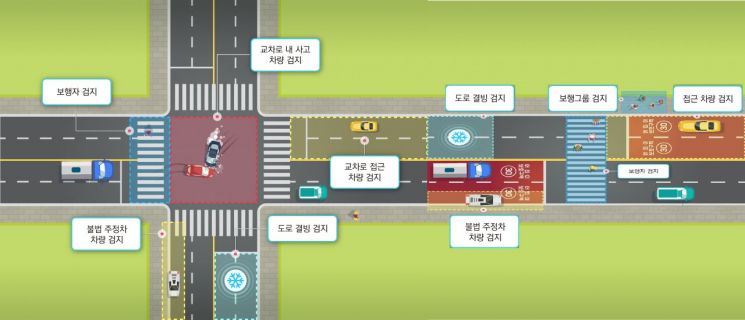
The Construction Institute’s smart road lighting research team developed a smart road lighting platform where AI, rather than personnel, instantly detects dangerous situations on the road and enables appropriate responses at the local level. Sensors such as CCTV and radar are installed on road lights or security lights to collect information, and customized warnings are displayed using audio information and lighting output devices. Data input through CCTV footage and other sources are analyzed via the smart road lighting integrated pole, AI analysis devices, and on-site independent operating systems (local/integrated platforms). Through this, threats to traffic safety, daily life safety, and disaster safety are detected, and necessary warnings are immediately provided to pedestrians and vehicles on-site via speakers, road electronic display boards, and gobo lighting (LED lighting that projects light onto desired locations such as building walls, floors, or ceilings).
The smart road lighting platform offers services for five major traffic accident hotspots, daily life safety services on residential roads, and disaster safety services. The five major traffic accident hotspots refer to crosswalks, intersections, child protection zones, tunnel sections, and areas prone to freezing/black ice. The platform provides pedestrian safe crossing support, risk situation recognition and warnings, and illegal parking/standing vehicle recognition and warning services in these areas. Additionally, it offers daily life safety services such as detecting assault, loitering, abnormal behavior, stalking, and kidnapping, as well as disaster safety services that detect hazardous material leaks.
For example, when a pedestrian is crossing a crosswalk during a flashing green light and a speeding vehicle approaches the crosswalk, smart road lighting poles installed at 50?60 meter intervals output gobo lighting on the road electronic display board and road surface to warn the driver to be cautious of pedestrians. If the vehicle is equipped with the next-generation intelligent transportation system (C-ITS), the warning is also provided through the navigation system. Simultaneously, an alert message about the approaching speeding vehicle is broadcast to pedestrians via speakers, guiding them to quickly evacuate to a safe sidewalk.
In the case of daily life safety services, when dangerous situations such as assault or kidnapping occur on residential back roads, on-site footage pops up and is transmitted in real time to the control center. On-site, warning lights and speakers notify that monitoring is underway from the control center, immediately warning to stop dangerous behavior.
Currently, the smart road lighting platform has established test beds at three locations: the Yeoncheon SOC Demonstration Research Center of the Construction Institute (five major accident hotspot services), Gwanak-gu, Seoul (daily life safety services), and Seosan-si, Chungnam (disaster safety services), where technology advancement is ongoing. In 2022, a comprehensive pilot operation of the entire smart road lighting platform service is planned through a local government contest.
The smart road lighting platform has the advantage of building a dense monitoring network at low cost by utilizing road lighting poles already installed across the national road network. It is designed to be linked with the Ministry of Land, Infrastructure and Transport’s standard smart city integrated platform, which has been distributed to over 100 local governments nationwide, allowing unnecessary system construction to be omitted during development. Through the linked system, local government road operation managers can immediately check risk information related to traffic safety, daily life safety, and disaster safety. Compared to recently distributed sensor-based systems, it can detect various risk events by utilizing a wider CCTV field of view. Furthermore, it performs immediate alerts and warnings on-site without going through a central control center, securing the golden time to prevent accidents.
Director Kang of the institute stated, “We will strive to ensure that the smart road lighting system, which can enhance public safety by preventing recent issues such as child protection zone disasters, large tunnel accidents, and black ice accidents, is successfully distributed to roads at all levels.”
© The Asia Business Daily(www.asiae.co.kr). All rights reserved.
![Clutching a Stolen Dior Bag, Saying "I Hate Being Poor but Real"... The Grotesque Con of a "Human Knockoff" [Slate]](https://cwcontent.asiae.co.kr/asiaresize/183/2026021902243444107_1771435474.jpg)















