Negative Policy Interest Rate and Quantitative Easing Policy Maintained
Gradual Reduction of Corporate Bond and CP Purchases... Ending in March Next Year
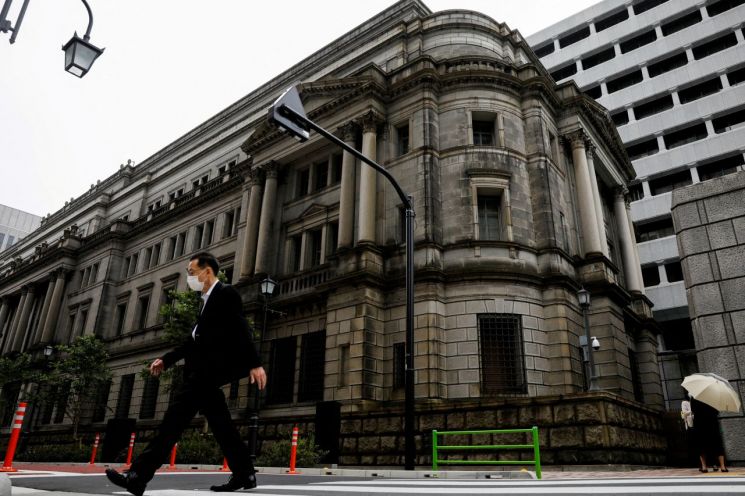
[Asia Economy Reporter Hyunwoo Lee] The Bank of Japan, Japan's central bank, announced that it will reduce its COVID-19 response funding support, which has been underway since March. The plan is to gradually decrease the scale of funding support and terminate the support policy in March next year, marking one year since its implementation. However, it stated that the quantitative easing policy based on the existing negative interest rates will continue to be maintained.
According to the Nihon Keizai Shimbun (Nikkei) on the 17th, following the financial policy meeting held the previous day, the Bank of Japan decided to gradually reduce the COVID-19 response funding support policy, which has been conducted since March with a 20 trillion yen (approximately 210 trillion won) cap on corporate bond and commercial paper (CP) purchases. The support policy is scheduled to end in March next year, marking one year since its implementation. However, the supply of loan funds for small and medium-sized enterprises (SMEs) will be extended by six months, continuing until September next year.
The Bank of Japan judged that the funding conditions for large Japanese corporations have significantly improved as the spread of COVID-19 has recently subsided, making an extension unnecessary. However, it stated that difficulties remain for SMEs, especially in the food service and accommodation sectors, so the loan fund supply period for SMEs will be extended.
Regarding the current economic situation, the Bank of Japan maintained its assessment that "although conditions remain difficult, the trend is toward recovery." However, it added that due to concerns over the emergence and global spread of the Omicron variant, it will review future policies considering inflation and rising production cost pressures.
© The Asia Business Daily(www.asiae.co.kr). All rights reserved.
![Clutching a Stolen Dior Bag, Saying "I Hate Being Poor but Real"... The Grotesque Con of a "Human Knockoff" [Slate]](https://cwcontent.asiae.co.kr/asiaresize/183/2026021902243444107_1771435474.jpg)
















