Sharing Directions for Carbon Neutrality Promotion at Energy Public Enterprises Carbon Neutrality Meeting
KEPCO and Other Power Public Enterprises to Reduce Coal and Expand Renewable Energy
Korea National Oil Corporation and Korea Gas Corporation to Transition to Clean Energy Systems
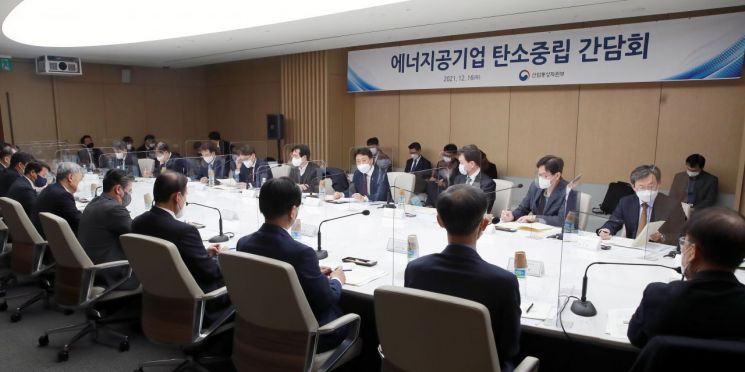
[Sejong=Asia Economy Reporter Joo Sang-don] To achieve carbon neutrality in the energy sector, which accounts for 87% of domestic greenhouse gas emissions, energy public enterprises are actively pursuing decarbonization of power generation centered on expanding renewable energy, improving energy efficiency, and establishing hydrogen platforms.
Recently, representatives from 15 energy public enterprises and public institutions, including Korea Electric Power Corporation (KEPCO), attended the ‘Energy Public Enterprises Carbon Neutrality Meeting’ chaired by Park Ki-young, Vice Minister of the Ministry of Trade, Industry and Energy, to share their planned directions for carbon neutrality promotion and explore cooperation measures.
The attending energy public enterprises expressed a strong sense of responsibility for the national task of achieving carbon neutrality and pledged to faithfully implement the detailed action plans of the government’s announced ‘Energy Carbon Neutrality Innovation Strategy.’
KEPCO presented its carbon neutrality promotion directions, including proactive construction and reinforcement of transmission and distribution networks, promotion of energy efficiency improvement, leading decentralized power generation and demand, and establishing a sustainable carbon neutrality implementation foundation.
Earlier, KEPCO set a medium- to long-term (2022?2026) management goal to expand cumulative renewable power generation capacity starting from 172.5 MW in 2022, 372.9 MW in 2023, and reaching 1,102.9 MW by 2026. At the meeting, a KEPCO official stated, "We will actively lead the decarbonization of power generation through phased reduction of coal power, significant expansion of renewable energy, and proactive construction of power grids."
The five power generation companies, including Korea South-East Power, plan to convert 24 coal-fired power plants to liquefied natural gas (LNG) by 2034, develop and apply zero-carbon new power generation technologies, and promote research and development (R&D) of carbon capture, utilization, and storage (CCUS) technologies and carbon dioxide reduction technologies.
Korea Hydro & Nuclear Power will not only operate nuclear power plants safely but also expand renewable energy projects targeting 43.1 GW of solar power and 2.2 GW of wind power by 2050, improve hydropower efficiency, and construct new pumped storage facilities. Korea District Heating Corporation plans to replace end-of-life combined heat and power (CHP) facilities with hydrogen CHP or apply CCUS technologies.
Korea National Oil Corporation and Korea Gas Corporation will ensure stable resource procurement to avoid energy supply issues during the carbon neutrality transition. They will also strive to transition to clean energy systems by introducing and producing clean hydrogen and building related infrastructure. Specifically, Korea National Oil Corporation will continue oil development and stockpiling projects for stable resource procurement and pursue new energy projects such as floating offshore wind power, carbon underground storage (CCS), and hydrogen and ammonia businesses to secure eco-friendly new energy. Korea Gas Corporation will establish hydrogen platforms by introducing and producing clean hydrogen, building production bases and refueling station infrastructure for transportation, and supply low-carbon LNG.
Korea Energy Agency will introduce an ‘Energy Efficiency Target Management System’ that manages energy source units at business sites by setting energy efficiency (unit) improvement targets for high energy-consuming businesses and evaluating and managing their performance to promote national energy efficiency innovation. It will also actively promote the introduction of the ‘Energy Supplier Energy Efficiency Improvement Obligation System (EERS),’ which assigns annual energy efficiency improvement targets to energy suppliers and achieves these targets through efficiency improvement investments for users. Korea Institute of Energy Technology Evaluation and Planning will actively pursue large-scale R&D preliminary feasibility studies to secure future carbon neutrality technologies such as CCUS and green hydrogen early.
Korea Mining and Resources Corporation and Korea Mine Reclamation Corporation merged to form Korea Mine Reclamation and Mining Corporation, which launched this September, and plans to invest in eco-friendly mine development, provide technical support, and promote the spread of renewable energy in abandoned mine areas.
© The Asia Business Daily(www.asiae.co.kr). All rights reserved.
![Clutching a Stolen Dior Bag, Saying "I Hate Being Poor but Real"... The Grotesque Con of a "Human Knockoff" [Slate]](https://cwcontent.asiae.co.kr/asiaresize/183/2026021902243444107_1771435474.jpg)















