Global E-commerce Growth Rate Halves... Fierce Competition Among Platforms
Education, Fulfillment, and Global Competitiveness as Key Focus Areas
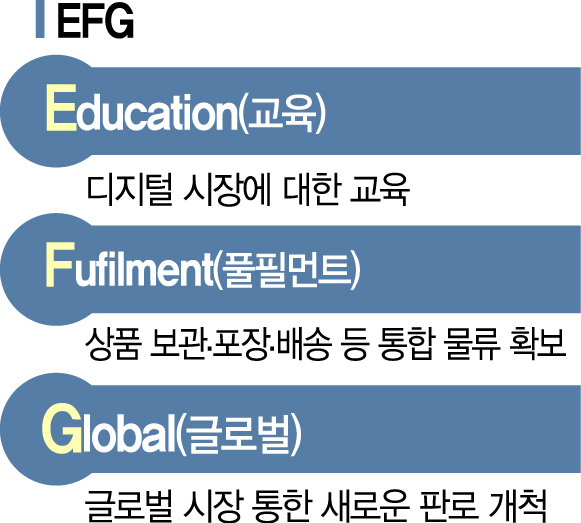
As the COVID-19 situation prolongs, the rapid growth of e-commerce is showing signs of slowing down. With the market growth no longer as robust as before, competition among platforms is intensifying. Platform companies such as Naver and Coupang are strengthening their e-commerce competitiveness through new survival strategies that go beyond digital transformation to include global expansion and enhanced fulfillment (integrated logistics management).
Growth Slows... EFG Competitiveness in Focus
According to global customer relationship management (CRM) company Salesforce on the 17th, the global e-commerce market is experiencing a slowdown in growth this year. The growth rate in the third quarter of this year was 11%, a 52% decrease compared to the previous year. This trend was also confirmed in the performance of global commerce platforms. Amazon’s operating profit in the third quarter of this year fell by 21%, and China’s largest commerce company Alibaba saw its net profit decrease by 87%. During the Singles’ Day period, Alibaba recorded a single-digit growth rate of around 8%, the first time since the event began in 2009.
As growth slows and competition in the e-commerce market intensifies, industry consensus suggests that existing small e-commerce merchants must now consider a ‘digital breakthrough.’ To open new sales channels, competitiveness in responding to digital trend changes through Education, Fulfillment, and Global expansion (EFG) has become a key topic. First, ‘Education’ involves securing competitiveness for small merchants through specialized digital education that supports growth and establishing business models. In Korea, Naver is leading the way with its programs. Since establishing the on- and offline education hub ‘Partners Square’ in 2013, Naver launched the country’s first online business school campus for small merchants this year. Currently, about 55,000 students are enrolled. ‘Pros’ composed of Naver employees provide educational programs necessary for managing small-scale businesses operated through digital platforms.
The importance of fulfillment for building a stable logistics network is also increasing. Fulfillment is an integrated logistics service that handles product storage, packaging, delivery, and inventory management. Since August, Coupang has been building global fulfillment for overseas marketplace sellers. Naver also supports its small merchants in utilizing fulfillment through its NFA platform since July. According to Naver, over 60% of small merchants using NFA were new entrepreneurs. Particularly, small merchants with monthly transaction amounts under 8 million KRW accounted for 70%, showing an overwhelming usage rate among small-scale merchants.
Advancing into the Global Market
There is also a strong movement to open new sales channels through the global market. Among global companies, Amazon, eBay, and Alibaba operate cross-border platforms that transcend national borders. Amazon has a dedicated cross-border corporation in Korea and operates the Amazon Global Store through 11st, where customers can purchase Amazon products. In Korea, Naver is attempting a new commerce platform in the global market. Naver’s ‘My Smart Store,’ launched in Japan last October, is based on the proven small merchant growth model Smart Store from Korea. It is an online store creation service that allows Japanese sellers to create and manage stores for free. Currently, it is integrated with ‘LINE,’ Japan’s national messenger, and is expected to enable search and payment partnerships through collaboration with Z Holdings in the future. Starting with My Smart Store, Naver is highly likely to expand cross-border business to global countries such as those in Europe.
Experts also emphasize the importance of EFG. Professor Jeong Yeon-seung of Dankook University, president of the Korea Distribution Science Association, said, “The global economic structure itself has changed due to COVID-19, and competition in the global commerce market has intensified further. Small merchants who have achieved digital transformation must evolve one step further for sustainable growth and flexible market adaptation. Commerce platforms must also enter a new growth phase by attempting digital breakthroughs through global expansion, stable fulfillment establishment, and specialized educational programs.”
© The Asia Business Daily(www.asiae.co.kr). All rights reserved.
![Clutching a Stolen Dior Bag, Saying "I Hate Being Poor but Real"... The Grotesque Con of a "Human Knockoff" [Slate]](https://cwcontent.asiae.co.kr/asiaresize/183/2026021902243444107_1771435474.jpg)
















