End of 9-Year 630 Billion Won Wage Controversy... Supreme Court: "Not a Violation of the Doctrine of Good Faith"
[Asia Economy Reporter Baek Kyunghwan] Hyundai Heavy Industries workers won a lawsuit worth 630 billion KRW against the company, demanding that bonuses be recognized as ordinary wages. The court ruled that when there is a possibility of overcoming business difficulties, the principle of good faith should not be used to easily reject workers' additional statutory wage claims. The case, which began in 2012, concluded after nine years and is expected to significantly influence the determination of ordinary wages in other companies.
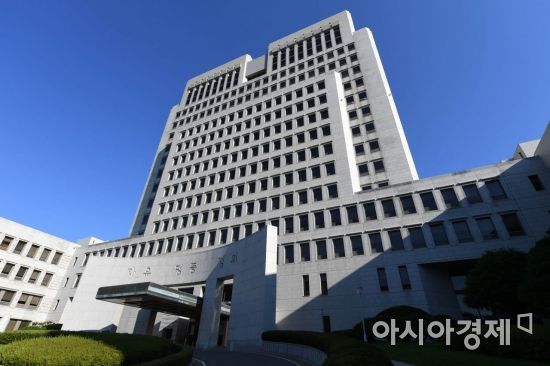
On the 16th, the Supreme Court's 3rd Division (Presiding Justice Kim Jae-hyung) overturned and remanded the lower court's ruling that had dismissed the wage claim lawsuit filed by 10 Hyundai Heavy Industries workers against the company.
In December 2012, 10 Hyundai Heavy Industries workers filed a lawsuit against the company, demanding that the entire 800% bonus?comprising a 700% regular bonus paid every even month and a 100% bonus for Lunar New Year and Chuseok?be included in the ordinary wage, and that the past three years be retroactively compensated.
They based their claim on the Supreme Court's 2013 plenary session ruling on the criteria for ordinary wages, which include three conditions: ▲Regularity (periodic payment) ▲Uniformity (payment to all workers meeting certain conditions) ▲Fixity (payment regardless of performance or achievements). Accordingly, the retroactive ordinary wage amount for approximately 38,000 workers reached 630 billion KRW. This amount was calculated for a period of four years and six months, from the end of December 2009 to the end of May 2014.
The rulings of the first and second trials differed. In February 2015, the first trial recognized the entire 800% bonus as ordinary wages. The retroactive wage was calculated based on the minimum standards of the Labor Standards Act, and the three-year retroactive claim was accepted.
The second trial court judged that if Hyundai Heavy Industries accepted the workers' demands, the company's survival could be threatened. Therefore, it ruled that the fixity of the 100% bonus paid during Lunar New Year and Chuseok among the 800% bonus was not recognized, and thus it could not be included in the ordinary wage. While agreeing with the first trial that bonuses qualify as ordinary wages, it held that only the 700% excluding the holiday bonuses should be included. Additionally, the court accepted the company's argument based on the principle of good faith (신의칙) to deny the retroactive payment for the three years requested by the workers.
However, on this day, the Supreme Court sided with the workers. The court stated, "Even if a company temporarily faces business difficulties, if the employer has made reasonable and objective business forecasts, it should have been able to foresee the deterioration of the business condition. When there is a possibility of overcoming future business difficulties, the principle of good faith should not be used to easily reject workers' additional statutory wage claims."
The court also found that the 'principle of good faith' (신의성실의 원칙, 신의칙), which was the biggest variable, was not violated. The court judged that Hyundai Heavy Industries' business condition was not at a poor level. It stated, "It is difficult to recognize that the payment of additional statutory wages would cause a serious business crisis to the defendant or threaten the very existence of the company."
Previously, in 2013, the Supreme Court's plenary session established a precedent that bonuses meeting regularity, uniformity, and fixity conditions are included in ordinary wages, but also ruled that workers' claims for additional past wages can be limited under the civil law principle of good faith. However, in August last year in the Kia Motors case and in March this year in the Kumho Tire ordinary wage lawsuit, the Supreme Court sided with the workers, ruling that paying additional wages does not necessarily cause significant difficulties for the company and that the principle of good faith should be strictly applied.
Meanwhile, on the same day, the Supreme Court also ruled in favor of Hyundai Mipo Dockyard workers in their wage claim lawsuit against the company. The Hyundai Mipo Dockyard workers, who also filed a lawsuit in 2012 demanding that bonuses be included in ordinary wages, had part of their case overturned and remanded by the Supreme Court, which stated that it could not be considered a violation of the principle of good faith.
© The Asia Business Daily(www.asiae.co.kr). All rights reserved.
![Clutching a Stolen Dior Bag, Saying "I Hate Being Poor but Real"... The Grotesque Con of a "Human Knockoff" [Slate]](https://cwcontent.asiae.co.kr/asiaresize/183/2026021902243444107_1771435474.jpg)















