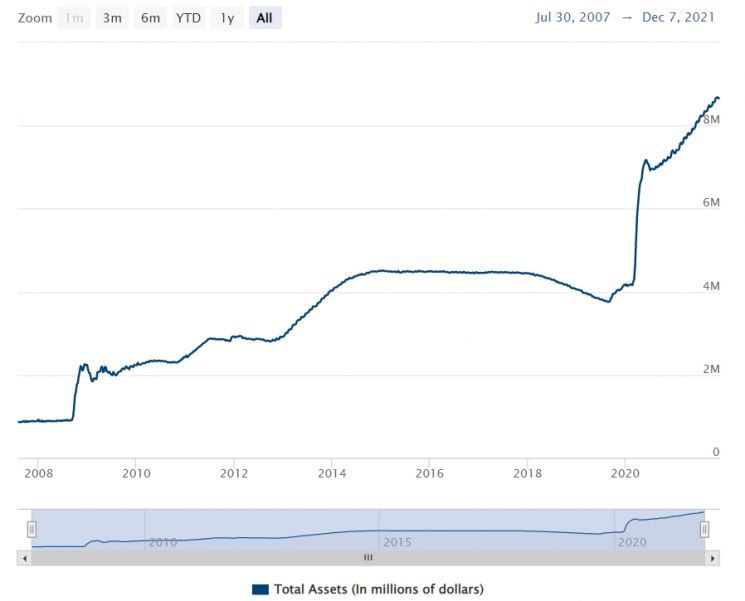
[Asia Economy Reporter Park Byung-hee] The U.S. central bank, the Federal Reserve (Fed), officially announced on the 15th (local time) that it will end quantitative easing in March next year. With this, the Fed's fourth round of quantitative easing, introduced in March last year due to the COVID-19 pandemic, will end after two years. The Fed's holdings, which were just over $4 trillion before the COVID-19 pandemic, increased to $8.6645 trillion as of the 7th.
The Fed is known to have implemented policies similar to today's quantitative easing during the Great Depression in the 1930s. However, the Fed explains that the asset purchase policy announced immediately after the 2008 global financial crisis was the official first round of quantitative easing. In November 2008, the Fed announced a practical first round of quantitative easing by injecting $600 billion to purchase mortgage-backed securities (MBS). Through the first round of quantitative easing, the Fed purchased a total of $1.75 trillion worth of assets.
The financial crisis lasted longer than expected, and in November 2010, the Fed announced a second round of quantitative easing to purchase $600 billion worth of government bonds. At that time, the Fed purchased $75 billion worth of government bonds monthly and ended the second round of quantitative easing in June 2011.
As the financial crisis shifted to the European debt crisis, the Fed announced a third round of quantitative easing in September 2012, purchasing $40 billion worth of MBS monthly. The Fed officially declared the end of the third round of quantitative easing in October 2014, two years later.
Over the past decade, as the Fed repeatedly implemented quantitative easing policies by utilizing its money issuance power, the size of the Fed's holdings increased sharply. Just before the financial crisis in September 2008, the Fed's holdings were below $1 trillion.
At the beginning of quantitative easing, there were analyses that the rapid increase in dollar liquidity would weaken the dollar's status as the key currency. However, the dollar index, which reflects the relative value of the dollar against six major currencies, was below 80 before the global financial crisis but has now risen to around 96.
This is because the global economy is closely interconnected, and a U.S. economic crisis quickly translates into a global economic crisis. For this reason, when an economic crisis hits the U.S., the dollar's appeal as a safe-haven asset is highlighted.
© The Asia Business Daily(www.asiae.co.kr). All rights reserved.
![Clutching a Stolen Dior Bag, Saying "I Hate Being Poor but Real"... The Grotesque Con of a "Human Knockoff" [Slate]](https://cwcontent.asiae.co.kr/asiaresize/183/2026021902243444107_1771435474.jpg)
















