[Asia Economy Reporter Jeong Hyunjin] The public identified the sharp increase in COVID-19 cases and the surge in real estate prices as this year’s biggest issues and most regrettable policies. With both issues expected to continue into next year, concerns about the possibility of populist policies arising from the presidential election have also emerged.
On the 16th, the Federation of Korean Industries announced the results of the '2021 Social and Economic Key Words Survey' conducted from the 3rd to the 13th of this month. The survey was commissioned to the market research firm Monoresearch and targeted 1,000 adults aged 20 and over, covering four areas: society, economy, industry, and international affairs.
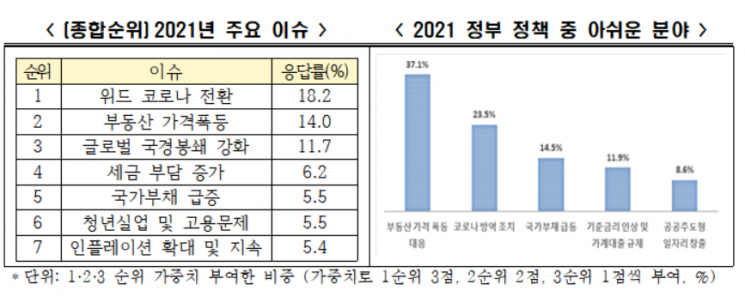
In the overall ranking covering all fields, 'the surge in confirmed cases following the transition to With COVID-19' ranked first (18.2%), and 'strengthened global border closures due to the spread of COVID-19 variants' ranked third (11.7%), with COVID-19-related responses totaling 29.9%, the highest response rate. The second place was 'real estate price surge and related scandals (such as LH employees’ real estate speculation)' with a 14.0% response rate, followed by 'increased tax burden' (6.2%), highlighting citizens’ concerns about livelihood issues as major topics.
By sector, in the social field, the most important domestic and international issue this year was 'the surge in confirmed cases following the transition to With COVID-19,' ranked first (35.3%). This was followed by 'real estate price surge and related scandals' (32.0%) and 'increased tax burden (health insurance premiums, employment insurance premiums, comprehensive real estate tax, etc.)' (13.8%). Other responses (18.9%) included the selection of presidential candidates by the two major parties (11.2%) and intensified generational, gender, and class conflicts (7.0%).
In the economic field, 'rising oil prices and food price inflation' ranked first (26.3%), followed by 'rapid increase in national debt (controversy over universal disaster relief funds)' (23.9%) and 'youth unemployment and employment issues' (22.9%). The response rate gap among the top three was not large, ranging from 1 to 3 percentage points. Other mentions included 'base interest rate hikes and household loan restrictions' (16.7%) and 'repeated surges and crashes in cryptocurrency' (9.2%).
In the industrial sector, the recent shortage of diesel exhaust fluid and vehicle semiconductors, categorized as 'global supply chain disruption,' ranked first with a 29.8% response rate. The second place was 'global popularity of Korean content such as Squid Game during the pandemic' at 29.2%, and third was 'acceleration of carbon neutrality transition including the 40% increase in Korea’s 2030 greenhouse gas reduction target (NDC)' at 19.9%. In the international field, 'strengthened global border closures due to the spread of COVID-19 variants' received the most responses at 39.5%, followed by 'prolonged US-China strategic competition and global supply chain restructuring' at 25.5%, and 'China’s Evergrande crisis and common prosperity' at 14.8%.
Among this year’s government policies, the most regretted area was 'response to the surge in real estate prices,' ranked first (37.1%), rather than COVID-19 quarantine measures. This was followed by ▲COVID-19 quarantine measures (23.5%) ▲rapid increase in national debt (14.5%) ▲base interest rate hikes and household loan regulations (11.9%).
The major issues that the public expects next year are similar to this year’s, but considering the presidential election in March, 'the possibility of populist policies due to the presidential election' was identified as a key issue with a 23.4% response rate. This was followed by 'real estate market instability' (20.0%), 'deepening division and conflict in Korean society' (11.8%), and 'youth unemployment and employment issues' (10.6%).
In response, the most desired policy from the next government to be inaugurated next year was 'COVID-19 quarantine and phased recovery of daily life,' ranked first (28.9%), followed by 'expansion of real estate supply and stabilization of the real estate market' at second place (21.0%). Next were 'rapid and strong economic recovery and revitalization' (19.4%) and 'economic and social structural innovation for future generations' (16.5%).
Kim Bongman, Director of the International Cooperation Office, stated, "As shown in the survey, the public prioritizes livelihood issues such as the sharp increase in COVID-19 cases, real estate price surges, and rising food prices as the core keywords for this year and next, rather than grand narratives. Policy authorities and the newly inaugurated government should make greater efforts to implement practical policies that resonate with the public’s basic concerns."
© The Asia Business Daily(www.asiae.co.kr). All rights reserved.
![Clutching a Stolen Dior Bag, Saying "I Hate Being Poor but Real"... The Grotesque Con of a "Human Knockoff" [Slate]](https://cwcontent.asiae.co.kr/asiaresize/183/2026021902243444107_1771435474.jpg)















