[Asia Economy Reporter Lim Cheol-young] The National Archives of the Ministry of the Interior and Safety will restore and publicly release online records related to Lee Yuk-sa, an independence activist and poet.
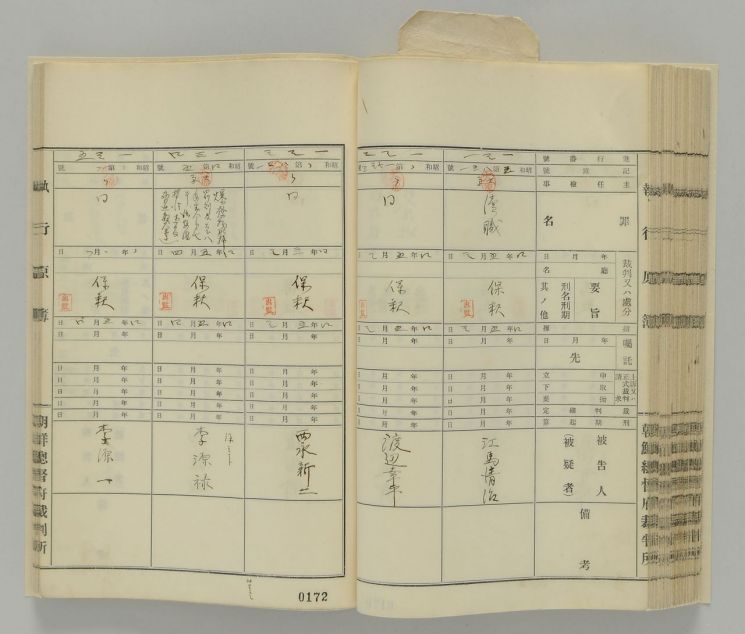
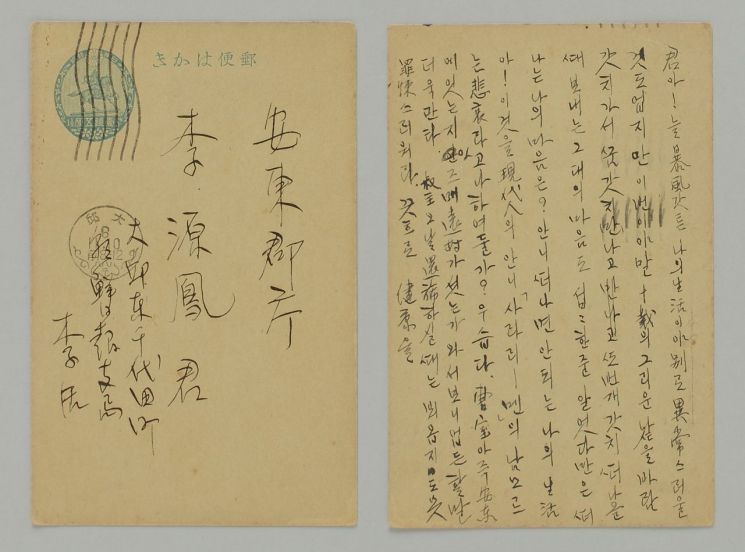
According to the National Archives on the 16th, the restored records were discovered through collaboration with the Lee Yuk-sa Literature Museum, uncovering records related to Lee Yuk-sa's public and private activities. The discovered records include a total of 7 items and 341 pages, such as the Japanese colonial period 'Execution Register' (1929) held by the National Archives, the Lee Yuk-sa Literature Museum’s 'Handwritten Chinese letters and postcards' (1930?1936), and the first edition of the 'Yuk-sa Poetry Collection' (1946).
The 'Execution Register' is a record compiled by the Daegu District Prosecutor's Office summarizing the disposition results of 1,028 suspects received from the police, and the original text is being made publicly available online for the first time. At that time, the Japanese police identified Lee Yuk-sa, who was active mainly in Daegu, along with his older brother Lee Won-gi and younger brother Lee Won-il, as suspects in the bombing incident at the Daegu branch of the Joseon Bank, and arrested them along with others such as Lee Jeong-gi and Jo Jae-man. The record lists Lee Yuk-sa under his real name, Lee Won-rok, with charges including the Explosives Control Regulation, political crime punishment, violation of the Public Security Preservation Act, threats, and attempted murder. Entry number 134 corresponds to Lee Yuk-sa (Lee Won-rok), with charges including violation of the Explosives Control Regulation, political crime punishment under Daijeong 8th Year Ordinance No. 7, violation of the Public Security Preservation Act, threats, and attempted murder. Entry number 135 is for his younger brother Lee Won-il.
Through the restoration of the 'Execution Register,' it was reconfirmed that Lee Yuk-sa was released on May 4, 1929, and the exact bail and release dates of Lee Yuk-sa and other independence activists were also verified.
The handwritten Chinese letter (1930) sent to his relative Lee Sang-ha during his time as a reporter for the Joongoe Ilbo is the only remaining handwritten Chinese letter by Lee Yuk-sa and is a rare material currently being considered for designation as a Registered Cultural Property by the Lee Yuk-sa Literature Museum. At that time, Lee Yuk-sa used the name Lee Hwal, and the letter reveals the difficult living conditions of the Lee Yuk-sa family.
In addition, the first edition of the Yuk-sa Poetry Collection published after his death in 1946 and the chemistry and biology textbooks from Bomun School that Lee Yuk-sa attended (1908) were also restored. Professor Jang Shin of the Academy of Korean Studies evaluated that the restored 'Execution Register' is not only a very important record in composing Lee Yuk-sa's life but also holds high historical value in terms of restoring the local nationalist movement history.
Meanwhile, the National Archives has been proactively discovering and restoring records with historical value or timely relevance since this year and providing public access to them. In May, after expert review, records related to key figures such as Lee Yuk-sa, the 48 national representatives of the March 1st Movement, and participants in the Eulmi Uprising were selected, and they will be sequentially released as restoration is completed.
Son Byung-hee, director of the Lee Yuk-sa Literature Museum, said, “Thanks to the efforts of the National Archives, rare materials related to Lee Yuk-sa have been restored to their original state, which is very gratifying. Above all, confirming the previously unpublished Japanese colonial period 'Execution Register' and the content of Lee Yuk-sa’s Chinese letter, which had been obscured due to mounting, is a precious achievement. Going forward, the Lee Yuk-sa Literature Museum will do its best to preserve the restored records. We deeply thank the National Archives.”
Choi Jae-hee, director of the National Archives, said, “The restored records of Lee Yuk-sa have great significance in that they created an opportunity for public and private cooperation to discover and jointly utilize important records. The National Archives will continue to strive to ensure that historically valuable records are safely preserved and easily accessible to the public.”
© The Asia Business Daily(www.asiae.co.kr). All rights reserved.
![Clutching a Stolen Dior Bag, Saying "I Hate Being Poor but Real"... The Grotesque Con of a "Human Knockoff" [Slate]](https://cwcontent.asiae.co.kr/asiaresize/183/2026021902243444107_1771435474.jpg)
















