[Sejong=Asia Economy Reporter Son Seon-hee] As the U.S. Federal Reserve (Fed) is expected to accelerate interest rate hikes next year, the possibility of South Korea raising its benchmark interest rate again in January next year has increased. Excessively high household debt ratio relative to gross domestic product (GDP), the inflation trend continuing since the second half of this year, and the U.S. interest rate policy have all added to the factors driving the rate hike.
The possibility of an additional rate hike by the Bank of Korea (BOK) is also confirmed by the remarks of Monetary Policy Committee (MPC) members. According to the minutes of the MPC meeting released by the BOK last month, 5 out of 6 MPC members mentioned the need for an 'additional rate hike.'
One member said, "It is judged that the inflation trend is structurally expanding," adding, "Considering the delayed reflection of rising housing prices and jeonse (long-term lease) prices, as well as exchange rate movements, it seems highly likely that the inflation rate exceeding the policy target will continue for a considerable period." He further stated, "It is desirable to additionally adjust the degree of monetary policy easing and closely monitor future developments."
Another member also said, "It is desirable to reduce the degree of monetary policy easing in terms of growth, inflation, and financial stability," and added, "The timing of further adjustments to the degree of monetary policy easing should be decided by closely examining growth and inflation conditions and whether financial imbalances improve," implying 'additional adjustments.'
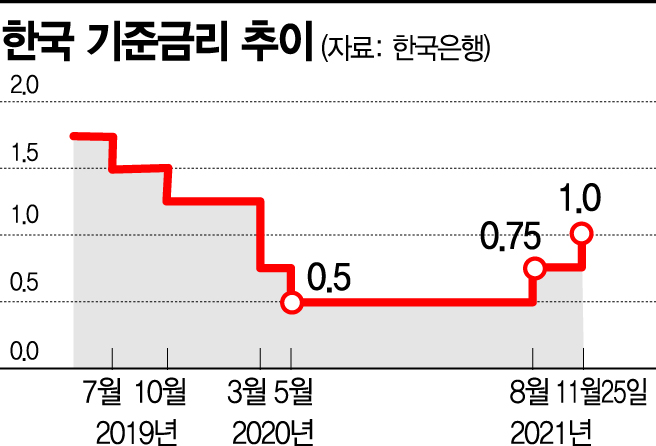
Among the six MPC members, the only dissenting opinion for 'holding' the rate was from member Joo Sang-young. However, even Joo, who argued for holding, mentioned in light of recent economic conditions such as employment and private consumption, "There has been a significant change worth considering whether to change the course of monetary policy," and "It is true that the time has come to discuss adjustments to the benchmark interest rate, which was historically lowered to the lowest level."
Since Joo, considered a representative dove (favoring monetary easing) within the BOK, also mentioned the need for a rate hike, if the economic recovery continues faster than expected, it is highly likely that the MPC will unanimously raise rates in January next year.
On the 15th, the won-dollar exchange rate opened at 1,185.0 won per dollar, up 2.4 won, showing an upward trend. If the Federal Open Market Committee (FOMC) discusses and moves toward tightening at a faster pace than expected by the 15th (local time), pressure on the exchange rate to rise is expected to increase further.
However, there is also a forecast that the presidential election in March next year could be a 'variable' in the timing of the rate hike. Professor Lee In-ho of Seoul National University’s Department of Economics said, "Raising the benchmark interest rate has the effect of tightening the market economy, so early next year will be a considerable burden." He added, "However, since the rate hike is expected after the U.S. tapering (asset purchase reduction), raising the benchmark interest rate after the first quarter in line with this would be effective (also for defending the exchange rate)."
© The Asia Business Daily(www.asiae.co.kr). All rights reserved.
![Clutching a Stolen Dior Bag, Saying "I Hate Being Poor but Real"... The Grotesque Con of a "Human Knockoff" [Slate]](https://cwcontent.asiae.co.kr/asiaresize/183/2026021902243444107_1771435474.jpg)
















