Joint Research by Professor Jang Howon’s Team at Seoul National University, Sungkyunkwan University, and Pohang University of Science and Technology
Overcoming Drawbacks of 2D Halide Perovskites
Enabling Long-Term Stable and Low-Energy Operation Without Interruption
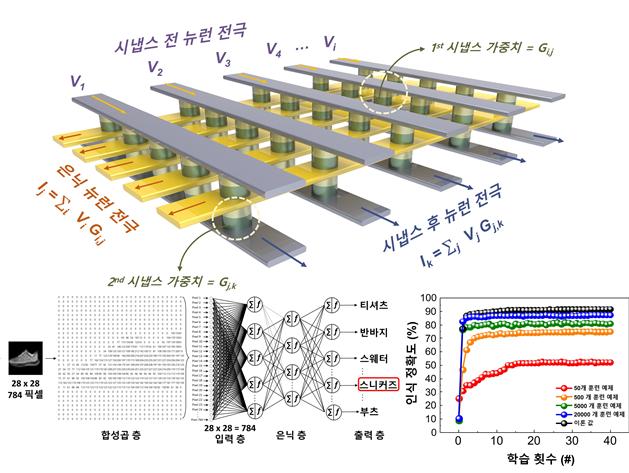 Conceptual diagram and results of artificial intelligence computation using next-generation neuromorphic devices mimicking the brain. Image courtesy of the National Research Foundation of Korea
[Asia Economy Reporter Kim Bong-su] A next-generation neuromorphic computing device that mimics the human brain and can operate continuously with low energy has been developed.
The National Research Foundation of Korea announced on the 14th that Professor Jang Ho-won’s research team at Seoul National University, in collaboration with research teams from Sungkyunkwan University and Pohang University of Science and Technology, developed a neuromorphic device that operates continuously like the brain with low power consumption by simultaneously solving the moisture instability and low reliability issues of two-dimensional halide perovskite, a next-generation semiconductor material attracting attention.
Halide perovskite is noted for its flexibility and relatively low production cost, making it suitable for neuromorphic computing and non-volatile low-power memory semiconductor technologies. However, its polycrystalline thin-film structure is difficult to control and vulnerable to moisture, posing challenges for commercialization.
The research team chose to grow a two-dimensional crystal structure vertically on the electrode instead of the conventional three-dimensional crystal structure to facilitate ion migration control. This approach resulted in significantly improved linearity, symmetry, and reliability compared to previously reported devices.
Furthermore, when evaluating how well artificial intelligence algorithms operated on circuits based on the fabricated device, the system recognized handwritten digits with 96.5% accuracy and identified types of clothing with 86.5% accuracy. This demonstrated a high level of recognition performance within an error margin of about 1% of the theoretical limit. Notably, the team experimentally verified that the device could operate for several months in the atmosphere by overcoming the major barriers of moisture instability and low reliability.
The research team plans to continue their work by applying the fabricated device to integrated circuit processes to design programmable chips, aiming to develop computing chips that operate like the brain and surpass existing CPU performance.
Our brain processes information continuously even while we sleep. The reason it functions smoothly is due to the remarkably efficient operating method of the brain. Also, existing digital von Neumann architecture computing faces problems such as enormous energy consumption from massive calculations, inefficient memory, and integration density limits. Therefore, research on semiconductor materials suitable for neuromorphic devices that can operate at low power by mimicking the operating principles of the human brain is active. Neuromorphic devices differ from conventional digital transistors by imitating synaptic operation, where the resistance state changes and is stored as a non-volatile multidimensional switching device depending on the history of input signals.
The results of this research were published online on the 23rd of last month in the international journal 'Materials Today.'
© The Asia Business Daily(www.asiae.co.kr). All rights reserved.
![Clutching a Stolen Dior Bag, Saying "I Hate Being Poor but Real"... The Grotesque Con of a "Human Knockoff" [Slate]](https://cwcontent.asiae.co.kr/asiaresize/183/2026021902243444107_1771435474.jpg)















