Booster Shot Interval Shortened to 3 Months... Pre-Reservations Start from the 13th
Citizens: "Is the Vaccine a Joke? Scientific Evidence Needed"
Kim Bu-gyeom: "If the Crisis Continues, Decisive Quarantine Measures Will Be Taken"
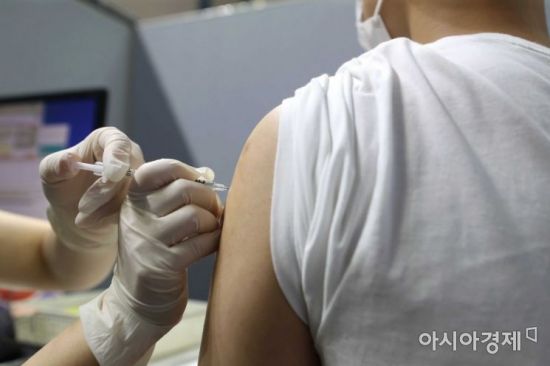 A citizen is receiving a vaccine at the vaccination center set up in Sadang Sports Complex, Dongjak-gu, Seoul. The photo is unrelated to specific expressions in the article. Photo by Asia Economy DB.
[Asia Economy Reporter Heo Midam] Concerns are rising among citizens regarding the shortening of the interval between the basic COVID-19 vaccination and the additional booster shot to 3 months. Initially, health authorities set the interval for the COVID-19 booster shot at 6 months. However, last month, depending on whether individuals were in high-risk groups, the interval was shortened to 4-5 months, and recently, as the quarantine situation worsened, it was reduced to 3 months.
Some voices have expressed concerns about the government's decision, pointing out issues related to safety and effectiveness. In particular, there are opinions that shortening the interval even for the general adult population, who have a relatively low fatality rate, was a hasty decision.
According to the COVID-19 Vaccination Response Promotion Team, adults aged 18 and over who have passed 3 months (90 days) since their second dose can make vaccination reservations starting today (the 13th).
The initially recommended booster shot interval was 6 months, but on the 17th of last month, the interval was shortened from 6 months to 4 months for high-risk groups such as those aged 60 and over and residents of nursing hospitals, and from 6 months to 5 months for those aged 18-59.
However, as the number of new confirmed cases has been around 7,000 daily and severe cases are nearing 900, indicating a serious spread of COVID-19, the government decided to accelerate the booster shot administration.
Those who have already booked booster shots at the 4-5 month interval can cancel and rebook. People aged 60 and over can receive the booster shot on the same day by visiting medical institutions without a reservation.
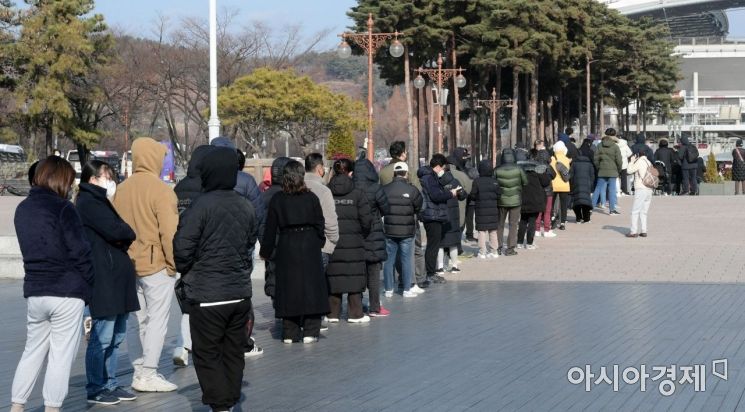 On the 12th, as the number of new COVID-19 cases continues to reach record highs daily, citizens are waiting for testing at a temporary screening clinic set up within World Cup Park in Mapo-gu. The photo is unrelated to specific expressions in the article. Photo by Dongju Yoon doso7@
With this measure, the number of booster shot recipients within the year will increase from 16.99 million to 26.41 million. Most people aged 18-49 who completed their second dose in October will become eligible for the booster shot in January next year. However, the validity period of the quarantine pass (vaccination certificate/negative test confirmation system) will be maintained at 6 months. This means that even if 3 months have passed since the second dose, entry to facilities subject to the quarantine pass such as restaurants, cafes, academies, and cinemas will not be immediately restricted.
Criticism is growing as the booster shot plan keeps changing. There are concerns that the government's inconsistent vaccine policies are only increasing confusion.
Office worker Jeon (25) said, "It's not like the vaccine has been out for several years; it's only been about a year. I'm hesitant to get vaccinated because I don't know what side effects I might suffer in the future, and now the vaccination schedule keeps changing, so I'm even more worried." He sarcastically added, "At first, they said to get the booster shot after 6 months, but now it's 3 months. At this rate, won't we have to get vaccinated once a month?"
He continued, "The vaccination cycle doesn't seem to have scientific evidence, so it's even more frightening," and criticized, "This isn't a game with vaccines; I'd rather have social distancing strengthened again."
There are also voices questioning whether additional vaccinations are necessary despite the risk of side effects, given that breakthrough infections have occurred even after the third dose. The health authorities announced on the 8th that among those who completed the third dose, 172 had breakthrough infections, with 1 severe case and no deaths.
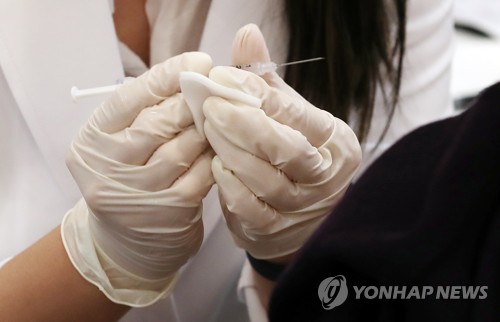 Citizens are receiving COVID-19 vaccinations at a vaccination center located in Mokdong, Yangcheon-gu, Seoul. The photo is unrelated to specific expressions in the article. [Image source=Yonhap News]
Yoon (26), an office worker who completed the second Pfizer dose in October, said, "Even with the third dose, you can't completely block the COVID-19 virus," and lamented, "Vaccination rates among citizens are increasing, but confirmed cases are also rising, so I wonder if it's really necessary to get vaccinated."
He added, "If the previous vaccination interval was 6 months, they should have stuck to 6 months, but because the vaccine policy keeps changing, trust is decreasing," and pointed out, "Also, people in their 20s like us mostly have mild or asymptomatic cases, so is it really necessary to get vaccinated?"
Currently, the UK and Greece have also shortened the vaccination interval from the existing 6 months to 3 months in response to the spread of Omicron. Additionally, Australia shortened it from 6 months to 5 months, and Japan moved it forward from 8 months to 6 months.
On the other hand, countries like Israel, which first introduced the third dose, as well as the United States and Canada, maintain the third dose interval at 5 or 6 months for all ages.
The government hinted at the possibility of returning to the existing social distancing system if the spread does not subside. On the 10th, Prime Minister Kim Boo-kyum presided over the Central Disaster and Safety Countermeasure Headquarters meeting and stated, "If it is judged that it will be difficult to reverse the crisis phase our community is facing in the near future, the government will have no choice but to decide on extraordinary quarantine measures, including strong social distancing."
© The Asia Business Daily(www.asiae.co.kr). All rights reserved.
![Clutching a Stolen Dior Bag, Saying "I Hate Being Poor but Real"... The Grotesque Con of a "Human Knockoff" [Slate]](https://cwcontent.asiae.co.kr/asiaresize/183/2026021902243444107_1771435474.jpg)

















