Professor Jeon Haegon’s Research Team at GIST Develops Algorithm
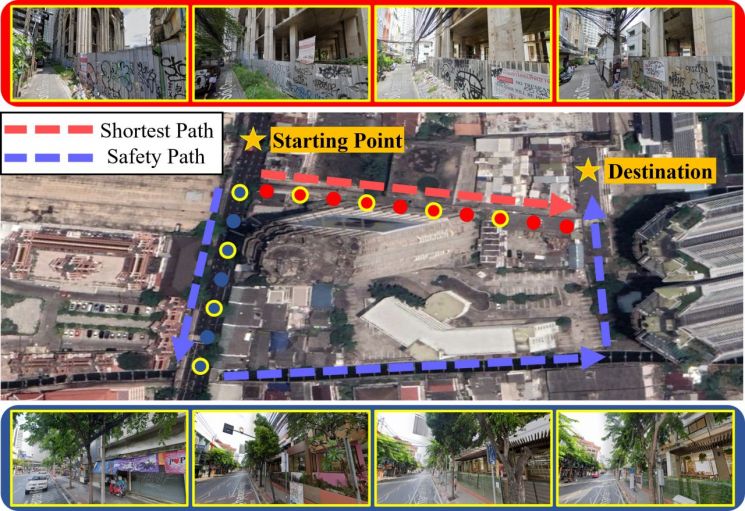 Example of Applying Artificial Intelligence Algorithm to Predict the Probability of Crime and Deviant Behavior Occurrence. Image provided by GIST
[Asia Economy Reporter Kim Bong-su] An artificial intelligence model that predicts the likelihood of everyday deviant behaviors such as crimes and jaywalking in specific areas has been developed.
Gwangju Institute of Science and Technology (GIST) announced on the 13th that a research team led by Professor Jeon Hae-gon from the AI Graduate School proposed a model that detects the possibility of deviant behavior occurrence using urban visual image information based on artificial intelligence techniques.
Understanding the impact of urban appearance and environment on society is one of the essential elements for urban planning and maintaining order policies. Recently, major research groups in computer vision and machine learning, such as Google, MIT, and Carnegie Mellon University, have been leading artificial intelligence research for public interest that supports this from a social structural perspective.
However, existing methodologies infer subjective perceived safety factors such as scenery, vitality, and affluence that are unrelated to actual crime occurrences within an area. In contrast, this study devised an algorithm that predicts not only crimes but also non-normative deviant behaviors like jaywalking. Furthermore, while previous studies relied on single images of narrow locations to predict risk, the research team integrated Google Maps street view images with GPS data of actual crime information to build the world's first large-scale objective crime and complaint report-based visual cognition dataset. This enabled precise exploration of a comprehensive range of locations to detect and predict deviant behavior occurrences.
Unlike previous crime and investigation-related studies that simply used demographic information such as population by age, middle-class ratio, and suicide rates in relation to crime, this research is expected to advance existing public safety policy formulation by providing street-level risk predictions that can practically contribute to crime prevention and security policy establishment.
Professor Jeon said, “The greatest significance of this research lies in implementing a comprehensive deviance theory in an AI model, beyond the mainstream urban security theory based on the Broken Window Theory.” He added, “We expect artificial intelligence technology to be more actively integrated into social science fields such as sociology and criminal psychology, which study the relationship between visual information and human criminal and deviant behavior triggers.”
The results of this study will be presented on February 22 next year at the international artificial intelligence conference, the 'AAAI Conference on Artificial Intelligence.'
© The Asia Business Daily(www.asiae.co.kr). All rights reserved.
![Clutching a Stolen Dior Bag, Saying "I Hate Being Poor but Real"... The Grotesque Con of a "Human Knockoff" [Slate]](https://cwcontent.asiae.co.kr/asiaresize/183/2026021902243444107_1771435474.jpg)















