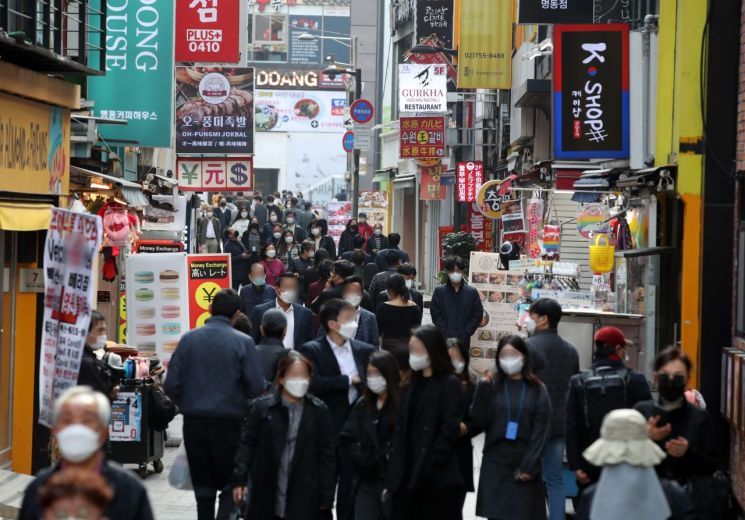
 On the first day of the phased daily recovery (With Corona) Step 1, on the 1st of last month, office workers were moving during lunchtime in Myeongdong, Jung-gu, Seoul. [Image source=Yonhap News]
[Asia Economy Reporter Seoyoung Kwon] More than three weeks after the implementation of the 'gradual recovery of daily life' (With Corona) policy, statistics show that nearly 70% of people feel that the risk of COVID-19 infection has increased.
On the 11th, Professor Yoom Yoomsoon's team at Seoul National University College of Public Health released the results of a 'Public Perception Survey on the Experience of Gradual Recovery of Daily Life.' The survey was conducted by Korea Research from the 22nd to the 29th of last month, targeting 912 adults nationwide, with a sampling error of ±3.25 percentage points at a 95% confidence level.
According to the survey, when asked how much daily life in society has recovered since the implementation of the gradual recovery of daily life on November 1, 33.8% responded positively, saying the recovery trend is clear, while 33.3% responded negatively, saying it is not clear. Additionally, 32.9% responded that it was moderate, showing that the three response rates were similar within the margin of error.
However, the proportion of respondents who felt that the risk of COVID-19 in our society has increased since the implementation of the gradual recovery of daily life was 68.9%, higher than the proportion who viewed the recovery effect positively. Furthermore, half of the respondents pointed out that measures to counter the increased COVID-19 risk due to the easing of social distancing were insufficient. Specific shortcomings included measures to expand hospital beds (58.1%), expansion of critical care medical staff (29.8%), and measures to maintain public compliance with personal quarantine rules (22.1%).
In the event that the spread of COVID-19 infection worsens or the burden on the healthcare system rapidly increases, 65.1% of respondents agreed with expanding the so-called 'quarantine pass,' currently applied to entertainment facilities, bathhouses, indoor sports facilities, casinos, etc., to multi-use facilities such as restaurants. On the other hand, 15.6% disagreed, and 19.3% neither agreed nor disagreed.
Next, among respondents who said they had been vaccinated against COVID-19 (92.5% of the total), when asked if they would receive a booster shot (additional vaccination), 78.9% responded that they would. Those who answered they would not receive the booster shot cited reasons such as 'feeling the vaccine was unsafe,' 'being dissatisfied with previous vaccination experience,' and 'feeling the vaccine's effectiveness was not significant.'
Professor Yoom analyzed, "Considering the timing of the survey, the 'With Corona' experience of about 3 to 4 weeks seems to have shifted public perception more toward concern and risk rather than expectation or positive outlook."
© The Asia Business Daily(www.asiae.co.kr). All rights reserved.
![Clutching a Stolen Dior Bag, Saying "I Hate Being Poor but Real"... The Grotesque Con of a "Human Knockoff" [Slate]](https://cwcontent.asiae.co.kr/asiaresize/183/2026021902243444107_1771435474.jpg)















