Handong Geun Cha's Team at CHA University Develops Inflammation-Free Biodegradable Polymer Scaffold
[Asia Economy Reporter Kim Bong-su] Domestic researchers have developed a 'biodegradable polymer scaffold' that effectively aids bone tissue regeneration without side effects such as inflammation. It is gaining attention for its potential effective use in treating fractures in elderly patients with poor adhesion, as well as in spinal and alveolar bone regeneration.
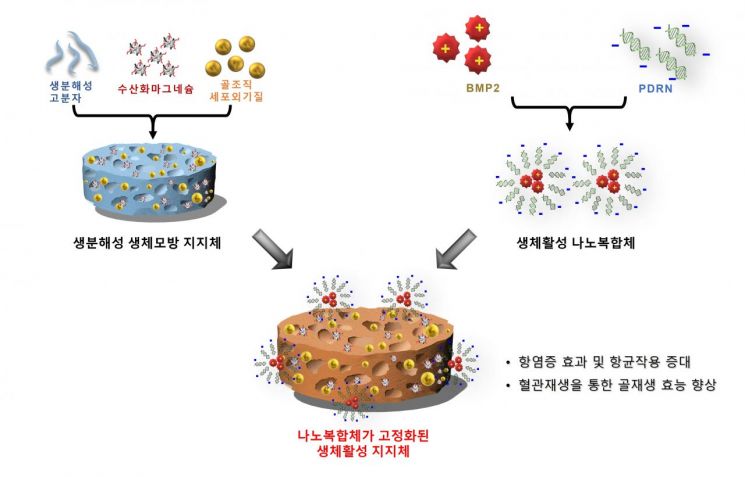
The National Research Foundation of Korea announced on the 9th that Professor Han Dong-geun's research team at CHA University developed a biodegradable polymer scaffold containing bioactive substances to assist bone tissue regeneration.
For damaged bone tissue to regenerate, a scaffold that maintains its structure for a certain period and supports cell growth and differentiation is necessary. Although biodegradable polymer scaffolds that promote bone regeneration have been developed before, the problem is that after implantation, they can lower the acidity of surrounding tissues, causing inflammatory reactions in the acidified tissue.
The research team devised a strategy to enhance the regenerative efficacy of damaged bone tissue by developing a biodegradable polymer scaffold containing bioactive substances that promote tissue regeneration. They selected a DNA fragment mixture PDRN extracted from salmon germ cells and bone morphogenetic protein BMP2 as bioactive substances to promote tissue regeneration. Additionally, they mimicked the actual bone tissue environment through extracellular matrix extracted from calf bone and minimized side effects caused by polymer degradation products by adding magnesium hydroxide. Magnesium hydroxide is a non-toxic ceramic particle that neutralizes the acidic degradation products of the biodegradable polymer used as the scaffold, thereby suppressing inflammation or necrosis in surrounding tissues.
In an experiment where a 4mm defect was created in the skull of mice, the biodegradable scaffold containing these bioactive substances was implanted, and after 8 weeks, the volume of newly formed bone tissue was found to have increased sixfold compared to the conventional scaffold. The inflammatory response decreased by about 20 times, and the number and volume of regenerated blood vessels recovered to levels similar to those of normal mice.
The research team stated, "This technology can be utilized not only as an alternative scaffold for existing spinal fusion surgeries targeting patients with spinal injuries, lumbar spinal stenosis, and lumbar disc herniation but also for orthopedic/spinal regenerative medical devices requiring bone tissue regeneration such as bone defects and alveolar bone reconstruction." They added, "For practical application, it is necessary to optimize the manufacturing process of the non-toxic scaffold and evaluate safety and efficacy through large animal preclinical trials and clinical trials."
The research results were published on the 8th in the international academic journal ‘Science Advances.’
© The Asia Business Daily(www.asiae.co.kr). All rights reserved.
![Clutching a Stolen Dior Bag, Saying "I Hate Being Poor but Real"... The Grotesque Con of a "Human Knockoff" [Slate]](https://cwcontent.asiae.co.kr/asiaresize/183/2026021902243444107_1771435474.jpg)















