Professor Park Je-geun's Research Team at Seoul National University Publishes Paper on 'Next-Generation Photonic Devices' in Nature
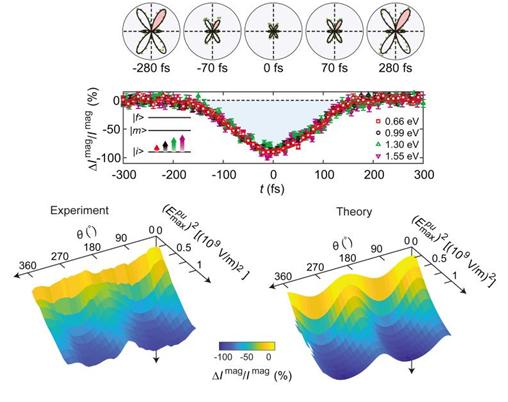 Reduction in Second Harmonic Generation Intensity Due to Strong Periodic Driving and Dependence on Light Intensity and Polarization: Experimental and Theoretical Results
When strong periodic driving (light) reaches the sample, it shows how the second harmonic generation (SHG) intensity decreases over time. The researchers confirmed that the change in SHG intensity strongly depends on the intensity and polarization direction of the applied light. The experimentally obtained reduction in SHG intensity according to light intensity and polarization direction matches the theoretically calculated values.
[Asia Economy Reporter Kim Bong-su] Domestic researchers have realized next-generation optical device technology that can control the electrical and magnetic properties of quantum materials for the first time in the world.
The Ministry of Science and ICT announced on the 9th that Professor Park Je-geun's research team from the Department of Physics and Astronomy at Seoul National University, together with a research team from the California Institute of Technology, developed this technology.
The research results were published on the same day in the international journal Nature. The research team experimentally confirmed that the optical properties of manganese thiophosphate (MnPS3), an insulator with a honeycomb-shaped planar structure, change significantly when exposed to strong light (>109 V/m), and through structural calculations, they demonstrated that the observed values and theoretical values match.
Previous studies only used weak light (~107 V/m) due to concerns about heat generation or damage caused by strong light, but this study is the world's first experimental realization using strong light (>109 V/m).
The research team implemented quantum Floquet engineering technology, a next-generation optical device technology that can control the electrical, magnetic, and optical properties of materials as desired, for the first time in the world. It is expected to have high applicability in the fields of materials science and optics. It can replace existing silicon-based semiconductor chips with optoelectronic devices using light, which can significantly reduce heat loss and fundamentally solve energy consumption problems, thus being recognized as a key technology for our society's transition to a low-carbon society.
Professor Park said, “This research achievement is the first case of implementing Floquet engineering technology in two-dimensional quantum materials,” and added, “It will be an important turning point in the rapidly growing field of Floquet engineering.”
© The Asia Business Daily(www.asiae.co.kr). All rights reserved.
![Clutching a Stolen Dior Bag, Saying "I Hate Being Poor but Real"... The Grotesque Con of a "Human Knockoff" [Slate]](https://cwcontent.asiae.co.kr/asiaresize/183/2026021902243444107_1771435474.jpg)















