Seminar Held by Ruling and Opposition Lawmakers and Media Policy Association
Professor Hong Won-sik Proposes 'Broadcasting Video Innovation Organization'
"Current Policies Fragmented Among MSIT, MCST, and KCC"
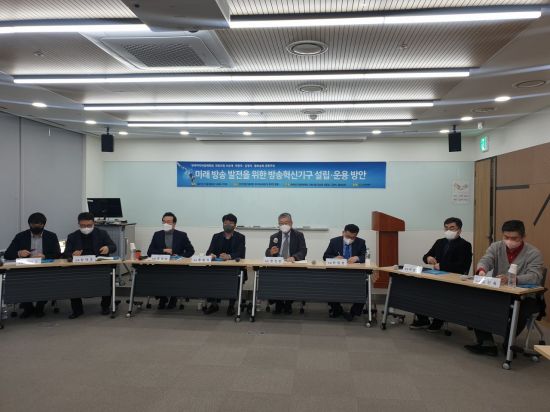 On the 8th, Democratic Party lawmakers Jo Seung-rae and Han Jun-ho, People Power Party lawmakers Kim Young-sik and Hwang Bo-seung-hee, and the Korean Media Policy Association jointly held a seminar titled "Establishment and Operation Plan of a Broadcasting Innovation Organization for Future Broadcasting Development." The photo shows the discussion in progress.
[Asia Economy Reporter Cha Min-young] Amid ongoing discussions on media governance reform, there have been calls for a new control tower called the 'Broadcasting and Video Innovation Organization' to promote integrated development in the broadcasting and video sectors. This is due to the difficulty of implementing unified promotion policies in the long term, as the main government departments are divided among several agencies. Industry experts also agreed that an integrated dedicated organization should be established to help domestic operators grow in competition with global online video services (OTT) such as Netflix and Disney Plus(+).
"What is Broadcasting Promotion? Realizing Shared Public Values"
Professor Hong Won-sik of Dongduk Women’s University emphasized this point at the seminar on 'Establishment and Operation Plans for a Broadcasting Innovation Organization for Future Broadcasting Development,' jointly hosted on the afternoon of the 8th by the Democratic Party lawmakers Jo Seung-rae and Han Jun-ho, the People Power Party lawmakers Kim Young-sik and Hwang Bo-seung-hee, and the Korean Media Policy Association. He stated, "There is a need to approach broadcasting promotion with a new concept."
Professor Hong, who delivered the keynote speech that day, argued that the definition of promotion policy should not be narrowly viewed as 'industrial promotion' but rather expanded to be understood as 'administrative support for the realization of shared public values.'
He pointed out, "Until now, broadcasting and video promotion policies have been implemented by imposing responsibilities on terrestrial broadcasters who generate excess profits, but problems arose when terrestrial broadcasters no longer produced such excess profits," adding, "The problem lies in promotion policies that are path-dependent and lack a long-term vision."
Furthermore, Professor Hong expressed concern that "Currently, the media departments?Ministry of Science and ICT, Ministry of Culture, Sports and Tourism, and Korea Communications Commission?are fragmented and each has different policy visions and goals," warning that "In the process of discussing new media governance to integrate and coordinate these, there is a risk of a distorted perception that simply regards the broadcasting media’s value as negligible and ICT industry alone as the national competitive engine."
He added, "To alleviate such concerns, it is necessary to establish and operate a Broadcasting and Video Innovation Organization that can professionally guarantee the identity of the broadcasting and video sector," emphasizing that "It should take the lead in the integrated operation of media development funds, research and development of promotion tasks, and harmonizing industrial performance with public interest."
Industry Experts Agree on the Need for a New Broadcasting Innovation Organization
In the subsequent discussion, Professor Lee Heon-yul of Korea University, who participated as a panelist, expressed concern about "the diminishing diversity of Korean cultural content within the global media landscape," and suggested, "A Broadcasting Innovation Organization is needed to nurture our own content within our society."
Attorney Kim Jin-wook of the law firm Juwon also argued, "It is no longer meaningful to separate media and information and communications," stating, "Effective governance that guarantees freedom of diversity in broadcasting policy and enables expansion of its scope is necessary." He explained that prioritizing the resolution of ownership and simultaneous operation and advertising regulations would be the first step toward launching global media.
Senior Specialist Ahn Jeong-sang of the Democratic Party emphasized, "Currently, media-related policies have been implemented without research," and stressed, "There is a need to establish a specialized research institute related to broadcasting and video media policies."
Professor Joo Jeong-min of Chonnam National University pointed out, "Before the domestic media market is engulfed by global online video services (OTT), it is necessary to reconsider the value of real-time broadcasting," and highlighted the need for "protection and fostering of traditional media where verified information is distributed."
Jang Dae-ho, Director of Broadcasting Policy Planning at the Korea Communications Commission, said, "Just as services cross borders, regulatory policy impacts also tend to transcend borders," and added, "It is necessary to introduce an integrated and universal media system domestically as well."
© The Asia Business Daily(www.asiae.co.kr). All rights reserved.
![Clutching a Stolen Dior Bag, Saying "I Hate Being Poor but Real"... The Grotesque Con of a "Human Knockoff" [Slate]](https://cwcontent.asiae.co.kr/asiaresize/183/2026021902243444107_1771435474.jpg)















