Increase in Digital Non-Face-to-Face Work
Acceleration of Organizational Restructuring and Voluntary Retirement
Impact on Spin-Offs Due to Separation of Production and Sales
[Asia Economy Reporter Oh Hyung-gil] In the insurance industry, once known as a ‘cognitive industry’ made up solely of people and paper, people are leaving. As digital and non-face-to-face interactions spread, insurance companies are accelerating workforce reductions through restructuring, and insurance planners working in sales are increasingly quitting or changing jobs due to the impact of COVID-19.
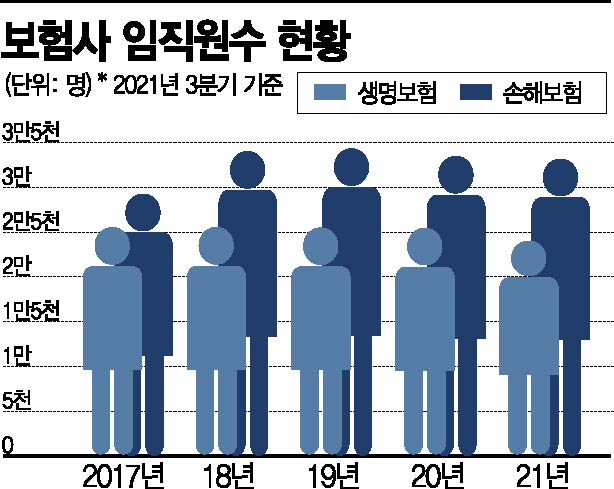
According to the insurance industry on the 8th, the number of employees has significantly decreased this year due to organizational restructuring and voluntary retirement promoted by insurance companies. As of September, the number of employees at life insurance companies was 23,852, which is 1,489 fewer than at the end of last year. The decrease rate reached 5.8%.
The number of life insurance employees had steadily remained at around 25,000 since 2017 but sharply declined this year.
During the same period, the number of employees at non-life insurance companies also decreased by 329 (0.9%) compared to the end of last year, totaling 33,112. Although the number had increased to 34,000 in 2018 and 2019, it turned to a decline after the COVID-19 outbreak.
Concerns about sluggish insurance market conditions and growth stagnation have led to a larger reduction in life insurance employees. This is also interpreted as reflecting the impact of ‘separation of manufacturing and sales’ to foster sales expertise by making sales companies independent. Mirae Asset Life and Hanwha Life launched subsidiary-type corporate agencies (GA) in March and April, respectively.
Additionally, insurance companies are conducting high-cost personnel reductions to resolve personnel stagnation and reduce costs. Mirae Asset Life carried out voluntary retirement in March for employees aged 50 and over, and office workers aged 45 and over, for the first time in three years.
In June, KB Non-Life Insurance offered an exceptional retirement package of 36 months’ special severance pay and accepted retirement applications from employees in their 40s or with over 20 years of service, reducing the workforce by 100.
Restructuring continues as the year-end approaches. In July, the labor and management of Shinhan Life, which was integrated and launched, agreed to implement a temporary voluntary retirement program this year. The target includes about 1,000 employees whose combined age and years of service total 60 or more, offering up to 37 months’ base salary and special support funds (startup support, children’s tuition, health checkup support).
Kyobo Life is also launching a voluntary retirement program targeting employees with over 15 years of service. Under the condition of providing additional pay on top of the existing three months’ base salary, this year they plan to expand the regular special retirement program as part of resolving personnel stagnation.

Increase in Voluntary Resignations and Job Changes Among Insurance Planners
As face-to-face sales have become difficult, insurance planners have been leaving insurance companies shortly after starting sales activities. According to the Financial Supervisory Service, the average 13-month registration retention rate of planners at 20 life insurance companies in the first half of the year was 41.5%. The 13-month retention rate indicates the proportion of planners who have been actively selling for more than one year.
DGB Life had the lowest 13-month planner registration retention rate at 7.1%, followed by KB Life (15.4%), Orange Life (21.8%), MetLife (25.4%), NongHyup Life (26.0%), and AIA Life (27.5%), where a significant number of planners left before reaching 13 months.
The life insurance company with the highest planner retention rate was ABL Life, recording a 13-month registration retention rate of 58.2%. Mirae Asset Life (52.3%) also showed a high retention rate above 50%. Prudential Life (49.6%), Samsung Life (47.7%), and Hanwha Life (45.9%) recorded relatively stable retention rates.
The average 13-month registration retention rate of planners at 12 non-life insurance companies was 57.6%. Hana Non-Life Insurance had the lowest rate at 41.5%, with Meritz Fire & Marine Insurance (46.3%) and Lotte Non-Life Insurance (48.2%) also staying in the 40% range. Samsung Fire & Marine Insurance (68.0%), Hyundai Marine & Fire Insurance (68.9%), and DB Insurance (69.8%) recorded retention rates approaching 70%.
© The Asia Business Daily(www.asiae.co.kr). All rights reserved.
![Clutching a Stolen Dior Bag, Saying "I Hate Being Poor but Real"... The Grotesque Con of a "Human Knockoff" [Slate]](https://cwcontent.asiae.co.kr/asiaresize/183/2026021902243444107_1771435474.jpg)

















