Government Makes It Difficult to Respond 'Oppose Vaccination' in 'School-Level Vaccine Vaccination' Demand Survey
Parents Protest "Implicit Vaccination Coercion" "Is This a Survey?"
Ministry of Education: "Survey to Understand Preferred Vaccination Methods... To Provide Support"
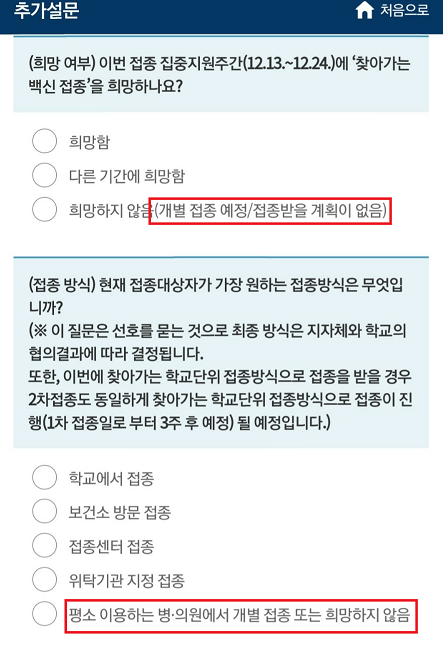 The Ministry of Education is conducting a survey on the demand for the "Visiting School Unit Vaccination" program targeting parents of elementary, middle, and high school students. However, there is backlash because the survey does not allow respondents to separately select the option "Do not wish to be vaccinated" in the questions regarding "willingness" and "vaccination method."
 Photo by Online Community Capture
[Asia Economy Reporter Kang Juhee] Amid strong opposition from parents regarding the implementation of the 'Youth Quarantine Pass' for ages 12 to 17 (6th grade elementary to 2nd year high school) starting February next year, a vaccine-related survey conducted by the Ministry of Education targeting parents has come under scrutiny. The issue raised is that the survey's answer choices group 'Do not wish to be vaccinated' together with 'Scheduled for individual vaccination,' making it impossible to express an unvaccinated opinion separately.
Parents are protesting, saying, "They did not separate the answer choices, so the results will appear as if everyone intends to be vaccinated." There were also criticisms that the survey subtly pressures vaccination. The Ministry of Education explained that the purpose of this survey is to identify the preferred vaccination method of those who wish to be vaccinated rather than whether they want to be vaccinated.
Since the 6th, the Ministry of Education has been conducting a demand survey for 'school-unit vaccination visits' through the 'Health Status Self-Diagnosis' application (app). This survey is conducted to carry out youth vaccination at the school level, targeting guardians or legal representatives of those aged 12 to 17. The survey was conducted over three days from the 6th to the 8th.
Previously, the government designated the period from the 13th to the 24th as the 'Vaccination Intensive Support Week.' Based on the survey results, it plans to decide in consultation with local governments whether vaccinations will be conducted at schools or at other institutions such as public health centers or vaccination centers.
The survey questions consist of four categories: Δvaccination target Δvaccination history Δwillingness Δvaccination method. The problematic part is the answer choices for 'willingness' and 'vaccination method.'
First, the willingness question asks whether one wishes to receive vaccination visits during the Vaccination Intensive Support Week, with three answer choices: Δwish to receive Δwish to receive at another time Δdo not wish (scheduled for individual vaccination/no plan to be vaccinated). However, 'scheduled for individual vaccination' and 'no plan to be vaccinated' are grouped together, making it impossible to select them separately.
For the vaccination method question, respondents are asked about their most preferred method, with five options: Δvaccination at school Δvaccination at public health center Δvaccination at vaccination center Δvaccination at designated entrusted institution Δindividual vaccination at usual hospital/clinic or do not wish. Again, 'do not wish' cannot be selected separately.
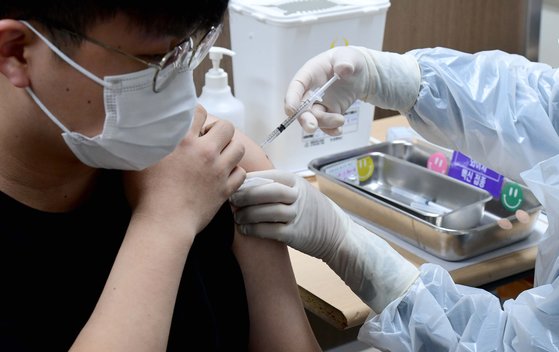 A student is receiving a COVID-19 vaccination at Hongik Hospital in Yangcheon-gu, Seoul.
 Photo by Yonhap News
Parents are protesting, calling it a "very strange survey." Posts criticizing the survey from parents have continued on online communities and social networking services (SNS).
One parent expressed anger, saying, "This is not asking whether to participate in vaccination or not, but rather assuming 'vaccination is mandatory.' Where is personal freedom? I am really furious."
Another parent expressed displeasure, saying, "What kind of survey is it to group 'do not wish to be vaccinated' with 'scheduled for individual vaccination'? If we don't participate, the result will show that most parents want vaccination, and even if we participate, the unvaccinated opinion is not conveyed. It feels like a cunning way to coerce vaccination."
Meanwhile, a survey showed that the majority of parents are reluctant to vaccinate their children. According to a survey conducted by the 'People's Coalition for a Fair Society' on 18,349 parents of elementary, middle, and high school students nationwide on the 5th and 6th, only 5.9% (1,084 parents) answered that they would vaccinate their children.
On the other hand, 60% of parents said they would not vaccinate their children until vaccine safety is secured, and 30% said they would not vaccinate regardless of safety.
Regarding the survey, the Ministry of Education explained that the purpose was to identify preferred vaccination methods, not to confirm willingness to vaccinate. A Ministry of Education official said, "The purpose of this survey is not to ask about willingness to vaccinate. It was created to understand demand for preferred vaccination methods and to support vaccination in consultation with local governments."
Meanwhile, three organizations, including the Rule of Law Restoration Action Coalition, filed a complaint with the National Human Rights Commission of Korea (NHRCK) on the 8th, arguing that the government's application of the quarantine pass to youths violates the right to learn and human rights.
At a press conference held in front of the NHRCK in Jung-gu, Seoul, the organizations stated, "The youth quarantine pass constitutes discriminatory acts infringing on equality rights as defined in Article 2, Paragraph 3 of the Human Rights Commission Act, which prohibits preferential treatment, exclusion, distinction, or disadvantageous treatment of certain persons related to the use of educational facilities." They pointed out, "It discriminates against unvaccinated students without reasonable grounds and is a clear human rights violation."
© The Asia Business Daily(www.asiae.co.kr). All rights reserved.
![Clutching a Stolen Dior Bag, Saying "I Hate Being Poor but Real"... The Grotesque Con of a "Human Knockoff" [Slate]](https://cwcontent.asiae.co.kr/asiaresize/183/2026021902243444107_1771435474.jpg)
















