Exploring Development Directions Such as Strengthening Dialogue Policing
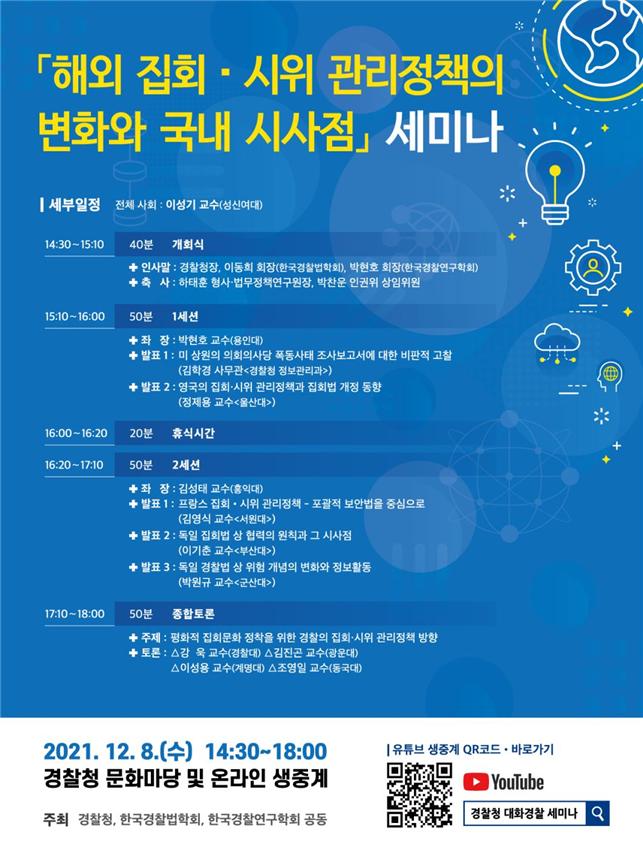
[Asia Economy Reporter Lee Gwan-joo] The National Police Agency, in collaboration with the Korean Police Law Association and the Korean Police Research Association, held a seminar titled "Changes and Implications of Overseas Assembly and Demonstration Management Policies" on the 8th at the National Police Agency building in Seodaemun-gu, Seoul.
This seminar was organized to explore the development direction of domestic assembly and demonstration management policies through cases from advanced countries. Kim Chang-ryong, Commissioner of the National Police Agency, stated, "So far, the police's assembly and demonstration management policies have developed into a human rights-friendly approach based on autonomy and communication. In particular, the 'Korean-style Dialogue Police System' has become a policing Hallyu content that attracts interest from advanced countries such as the United States and the United Kingdom," adding, "As a result, the freedom of assembly has been strengthened and illegal and violent acts have decreased, but new challenges such as intensified social conflicts and infectious diseases exist, so it is necessary to prepare by comparing and analyzing overseas cases."
Following this, Kim Hak-kyung, a National Police Agency official, who presented on the topic "A Critical Review of the U.S. Senate's Investigation Report on the Capitol Riot," said, "There were limitations to the police response based solely on physical force during the process of assemblies turning into riots, and it is necessary to strengthen procedural justice and legitimacy by utilizing systems such as the dialogue police system."
Professor Jung Je-yong of Ulsan University introduced the topic "UK's Assembly and Demonstration Management Policies and Trends in Assembly Law Amendments," explaining that "the UK's assembly law is known for minimizing regulations, but recently there have been movements to strengthen some regulations to reduce citizen inconvenience or maintain order, such as tightening noise standards for assemblies." Professor Kim Young-sik of Seowon University explained the case of the French 'Yellow Vest Movement,' which began in 2018 as resistance to fuel tax increases, highlighting the police's inadequate response and the legislative process and implications for enhancing on-site response capabilities, including strengthening police personal protection.
Additionally, Professor Lee Ki-chun of Pusan National University emphasized the background of the police's cooperation obligation stipulated in Germany to facilitate smooth assemblies and demonstrations and the necessity of introducing this domestically under the theme "The Principle of Cooperation in German Assembly Law and Its Implications." Professor Park Won-gyu of Kunsan University introduced the background in some German states such as Bavaria where the conditions for police authority activation to prevent serious risks were expanded from 'specific risk' to 'anticipated risk.'
© The Asia Business Daily(www.asiae.co.kr). All rights reserved.
![Clutching a Stolen Dior Bag, Saying "I Hate Being Poor but Real"... The Grotesque Con of a "Human Knockoff" [Slate]](https://cwcontent.asiae.co.kr/asiaresize/183/2026021902243444107_1771435474.jpg)















