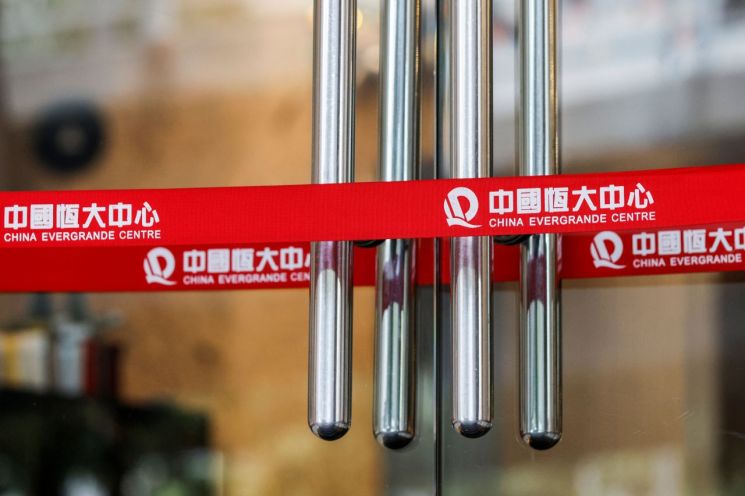
[Asia Economy Reporter Cho Hyun-ui] China’s second-largest real estate developer Evergrande has effectively entered a state of default after failing to pay the dollar bond interest by the June 6 grace period deadline.
According to major foreign media on the 8th, although Evergrande, bondholders, and global credit rating agencies have not yet officially declared a default, the market is treating the default as a fait accompli and is closely watching the upcoming debt restructuring process.
Bloomberg reported, "The end of the disorderly expanding real estate empire has begun," adding, "A long battle over who will claim the remaining assets has started."
Industry insiders believe that Chinese authorities will first accurately assess Evergrande’s debt scale before proceeding with the next steps in earnest.
As of the end of June, Evergrande’s total debt (1.9665 trillion yuan, approximately 364 trillion won) is less than its total assets (2.3775 trillion yuan, approximately 439 trillion won).
However, since a significant portion of the assets consists of real estate development projects with fluctuating value assessments, authorities reportedly believe that a revaluation at this point could show debt exceeding assets, according to economic media Caixin on the 7th.
Including guarantees for affiliated companies, Evergrande’s actual debt scale could be larger than publicly disclosed. After the status of Evergrande’s assets and liabilities is clarified, a scenario where bankruptcy restructuring procedures are initiated through applications by some creditors, leading to full-scale debt and restructuring processes, is strongly anticipated.
Authorities stated that at this stage, rather than directly rescuing Evergrande, they will focus on preventing Evergrande’s risks from spreading to the entire real estate industry and the national economy.
Both inside and outside China, there is speculation that the case will follow the precedent set by Hainan Airlines (HNA) Group, a large private enterprise that recently underwent debt restructuring and reorganization through bankruptcy proceedings. China’s response to Evergrande’s default appears to have largely referenced the HNA case.
During the HNA liquidity crisis, the Hainan provincial government, responsible for crisis management, formed the "Hainan Province-HNA Group Joint Task Force." This organization, led by officials dispatched from Hainan Province, included representatives from aviation-related companies and financial institutions.
When the Evergrande default crisis loomed, Guangdong Province dispatched a task force to lead the response within Evergrande and subsequently formed a Risk Resolution Committee, a working-level response team including state-owned enterprises and financial institution officials, which is structurally similar to the HNA Group Joint Task Force.
© The Asia Business Daily(www.asiae.co.kr). All rights reserved.
![Clutching a Stolen Dior Bag, Saying "I Hate Being Poor but Real"... The Grotesque Con of a "Human Knockoff" [Slate]](https://cwcontent.asiae.co.kr/asiaresize/183/2026021902243444107_1771435474.jpg)















