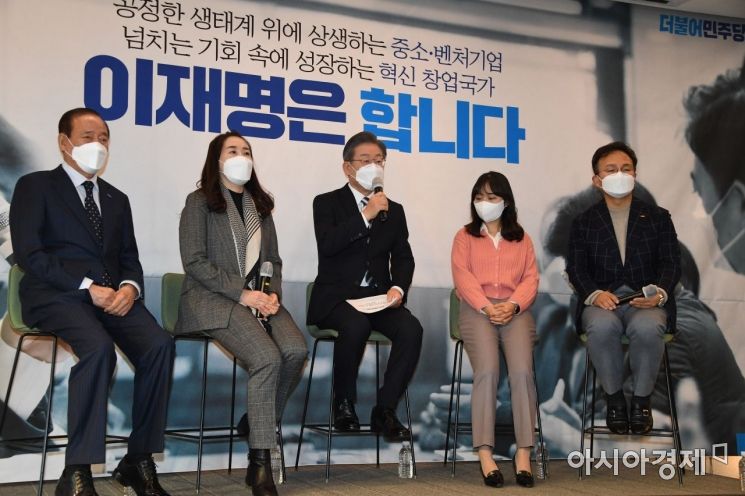
 Lee Jae-myung, the presidential candidate of the Democratic Party of Korea, is announcing policy pledges for small and venture businesses on the 8th at the Korea Industrial Complex Employers' Federation meeting room in SKV1, Gasan Digital Complex, Geumcheon-gu, Seoul. Photo by the National Assembly Press Photographers Group
[Asia Economy Reporters Koo Chae-eun, Lee Hyun-joo] There are differing opinions not only within the People Power Party but also within the Democratic Party regarding the ruling party’s “drive” to pass ‘Lee Jae-myung-style reform legislation’ such as the public sector labor director system within this year. The intention is to quickly implement bills bearing the ‘Lee Jae-myung brand’ to showcase a ‘sample of the next government,’ but there is concern that if caught up in the opposition’s ‘legislative dictatorship frame,’ it could backfire. Additionally, there are criticisms that candidate Lee’s emphasis on ‘speedy resolution’ and his departure from the traditional Yeouido parliamentary norms do not align with the National Assembly’s decision-making process.
On the 8th, the Planning and Finance Committee held a plenary meeting to discuss the submission of bills including the public sector labor director system, which was met with strong opposition from the People Power Party. Ryu Seong-geol, the People Power Party’s floor leader in the Planning and Finance Committee, told Asia Economy in a phone interview, “This matter is currently being discussed in the Economic and Fiscal Subcommittee’s bill subcommittee, and it is inappropriate to discuss it in the plenary meeting without bipartisan agreement.” Ryu said, “The day before, Yoon Hu-deok, the chair of the Planning and Finance Committee, said he would talk about four bills, but since the agenda is still undecided, I will attend the plenary meeting to ask why this is happening and fully express my opinions.” The People Power Party plans to issue a statement criticizing the Democratic Party’s legislative dictatorship and hold a press conference.
Subtle differences in perspective are also detected within the Democratic Party regarding this issue. One Democratic Party lawmaker said, “For example, in the case of the Jeon Du-hwan confiscation law, while the justification is agreed upon, it was pushed forward quickly and a constitutional appeal was filed, which could lead to a clash with the legislative branch,” urging a pace adjustment by saying, “Each law requires a period of ‘deliberation.’” Another lawmaker said, “I understand that the candidate is not asking for all livelihood and reform bills to be passed unconditionally but is asking for prioritization and selection to be done quickly,” adding, “If forced through without opposition agreement, the ruling party cannot ignore the ‘legislative enforcement’ frame from the ruling party’s perspective.”
On the 6th, the Democratic Party held a policy general meeting to discuss six ‘Lee Jae-myung-style bills’ as party policy, adopting only the Development Gains Recovery Act, which was not processed by the National Assembly’s Land, Infrastructure and Transport Committee, among the three real estate unearned income recovery laws (amendments to the Urban Development Act, Housing Act, and Development Gains Recovery Act). The remaining bills ? the Improvement of Parliamentary Immunity Act, Jeon Du-hwan Property Recovery Act, and Farmland Speculation Prevention Act ? were concluded to require further discussion. Only one of the six bills pushed by candidate Lee was adopted as party policy.
The bills expected to be submitted to the Planning and Finance Committee plenary meeting include not only the public sector labor director system but also the Basic Social Economy Act and the Social Value of Public Institutions Act. Other Lee Jae-myung-style livelihood-related bills that may be discussed during this extraordinary session include the Commercial Building Lease Protection Act for self-employed persons, the Online Platform Fairness Act and Online Platform User Protection Act (the two platform laws), and the National Core Strategic Industry Support Act, which expands support for key industries such as semiconductors, bio, and batteries.
© The Asia Business Daily(www.asiae.co.kr). All rights reserved.
![Clutching a Stolen Dior Bag, Saying "I Hate Being Poor but Real"... The Grotesque Con of a "Human Knockoff" [Slate]](https://cwcontent.asiae.co.kr/asiaresize/183/2026021902243444107_1771435474.jpg)















