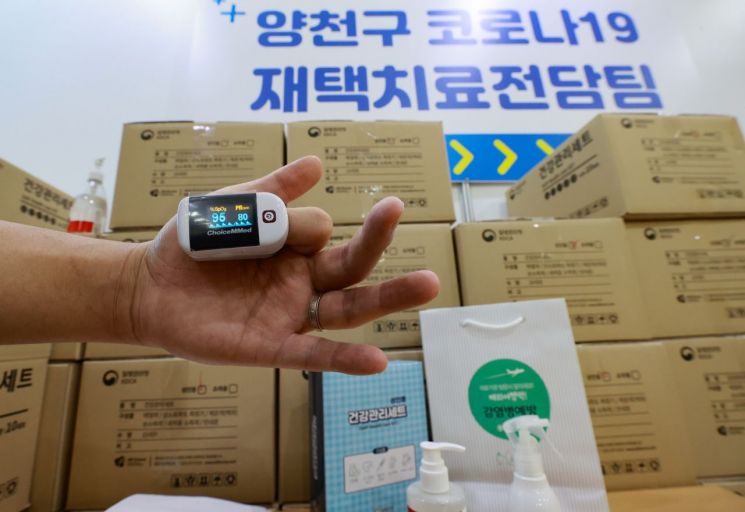
 Officials from the COVID-19 Home Treatment Team in Yangcheon-gu, Seoul, are checking health management kits, including oxygen saturation monitors, to be delivered to home treatment patients in the district. [Image source=Yonhap News]
[Asia Economy Reporter Lee Chun-hee] The government, in response to the increasing number of COVID-19 cases and to maintain medical capacity, has mandated 'home treatment' and is implementing measures to alleviate the burden on cohabiting family members caused by this policy.
Son Young-rae, head of the Social Strategy Division at the Central Disaster and Safety Countermeasure Headquarters, announced at a regular briefing on the morning of the 8th, "To ease the burden of family co-isolation, the isolation period for family members in quarantine will be shortened, and additional living expenses will be provided," revealing these improvements to home treatment.
Currently, if a cohabitant becomes a home treatment subject, both the individual and the cohabitant are prohibited from going out for work, school, or other reasons for more than 10 days and must self-isolate. However, essential outings such as garbage disposal and purchasing daily necessities are permitted.
Going forward, this isolation period will be shortened from the current 10 days to 7 days, and from the 8th day, cohabitants will be allowed to go to work or school. However, this measure applies only to cohabitants who have completed vaccination. Unvaccinated or partially vaccinated individuals must continue an additional 10-day isolation starting from the 8th day.
Additionally, considering the economic burden caused by inability to go to work due to family quarantine, additional living expenses will be supported starting today. For a family of four, the current support of 904,920 KRW will be increased by 460,000 KRW to a total of 1,364,920 KRW.
Son Young-rae emphasized, "Most countries focus inpatient treatment on patients who absolutely need it and manage the majority of patients through home treatment," stressing the need to increase the proportion of home treatment, which currently stands at about 50%.
To support this, the authorities will also strengthen local governments' home treatment promotion systems. The current 'Home Treatment Dedicated Team' will be reorganized into a 'Home Treatment Promotion Group' led by the deputy head of each city, county, or district, and administrative personnel outside of public health centers will be additionally assigned to home treatment tasks.
Furthermore, to expand medical infrastructure, the health monitoring period by medical institutions will be shortened from the current 10 days to 7 days. Currently, home treatment patients receive health monitoring twice daily. This will be reduced to 7 days, with the remaining 3 days conducted as self-isolation. However, the monitoring period can be extended based on medical professionals' judgment.
Management medical institutions and short-term outpatient clinics will also be expanded, and in cooperation with the Korean Medical Association and the Seoul Medical Association, a pilot program will be implemented to involve local clinics in home treatment.
The emergency transport system for worsening symptoms during home treatment will also be strengthened. Pre-designated transport medical institutions will be appointed, and these hospitals will be required to secure at least one emergency transfer bed at all times. Additionally, for non-emergency situations, personal vehicles and quarantine taxis can be used when visiting short-term or outpatient clinics.
Son added, "Starting January next year, oral antiviral treatments will also be provided to elderly home treatment patients and others."
© The Asia Business Daily(www.asiae.co.kr). All rights reserved.
![Clutching a Stolen Dior Bag, Saying "I Hate Being Poor but Real"... The Grotesque Con of a "Human Knockoff" [Slate]](https://cwcontent.asiae.co.kr/asiaresize/183/2026021902243444107_1771435474.jpg)















