Slower Price Increase Mainly in Seoul Outskirts
Buying Demand Weakens, Price Decline Realized
Direct Impact of Loan Restrictions and Interest Rate Hikes
Apartment Transactions in Gangbuk Plunge 74%
Premiums on Pre-sale Rights in Non-Regulated Areas Also Drop Sharply
[Asia Economy Reporters Minyoung Kim, Hyemin Kim, Dongpyo Kim] Mr. Kim, a man in his 30s who purchased an apartment in Gangbuk-gu, Seoul this summer, has been losing sleep lately. Although he made a ‘young-kkul’ (all-in) purchase by taking out both a mortgage and a personal loan ahead of his wedding, inventory within the complex has been piling up since last month, and signs of price declines have emerged. He said, "If the loan interest rate rises by just 1 percentage point, my annual interest burden will increase by 3 million won," adding, "I’m worried because house prices are falling while interest burdens are rising."
As apartment buying in the so-called Nodobang (Nowon, Dobong, Gangbuk) and Geumgwan-gu (Geumcheon, Gwanak, Guro) areas on the outskirts of Seoul, which led the rise in Seoul apartment prices this year, has sharply contracted, a decrease in transaction volume and price drops are becoming a reality. These areas, where relatively low- to mid-priced apartments are concentrated, had seen buying frenzies driven by panic buying among young people. Analysts suggest this is a typical pattern in the early stages of a housing market downturn: transaction contraction in outer areas → increase in urgent sale listings → price decline.
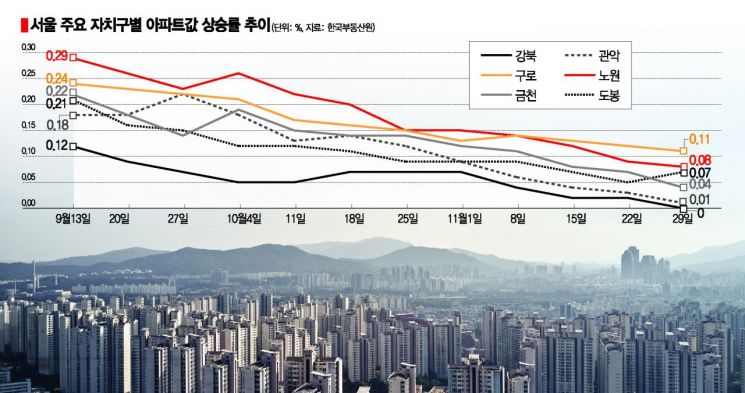
◆ Panic Buying Stops, Nodobang and Geumgwan-gu Buying Drops Sharply = According to the Korea Real Estate Board on the 8th, the weekly apartment price increase rate in Gangbuk-gu, Seoul, was 0% in the last week of last month (as of November 29). This is the first flat trend in about a year and a half since the first week of June last year. The other Nodobang areas such as Dobong (0.07%) and Nowon (0.08%), as well as Geumgwan-gu areas including Gwanak (0.01%), Geumcheon (0.04%), and Guro (0.11%), also saw their rates effectively fall to flat levels. Notably, Nowon-gu had the most active buying among Seoul’s 25 districts, with a cumulative increase rate of 9.59% until last week.
This contrasts with areas like Gangnam (0.15%), Seocho (0.17%), Mapo (0.15%), and Yongsan (0.23%), which exceeded the Seoul average increase rate of 0.10%. The rise in prices of low- to mid-priced apartments on the outskirts, which led Seoul’s price increases this year, is now stopping first. Considering that young buyers with high loan dependency were concentrated in these areas, it is interpreted that they are the first to be hit by government loan regulations and rising market interest rates.
◆ Transaction Volume Cut to One-Quarter in One Year... Only Urgent Sales Are Trading = The transaction cliff is also severe. According to the Seoul Real Estate Information Plaza, the number of apartment transactions in Gangbuk-gu in October was 31, a 74% plunge compared to the same period last year. Other outer areas also recorded their lowest transaction volumes this year: Geumcheon 64, Nowon 152, Dobong 96, Gwanak 106, and Guro 121.
The atmosphere on the ground is no different. A representative from a certified real estate agency in Gangbuk-gu said, "Since loan regulations intensified in September, transactions have frozen solid," adding, "There were no transactions at all last month."
The situation is similar in Sanggye-dong, Nowon-gu, where reconstruction of aging mid-rise Jugong apartments is underway. Only urgent sales priced 70 to 80 million won below market value are barely trading. The head of a real estate agency in the area said, "We only get calls asking how much prices have dropped; except for urgent sales, transactions have almost stopped."
As buying interest declines, listings are piling up. According to Apartment Real Transaction Data (Asil), a real estate big data company, among Seoul’s 25 districts, apartment listings in outer areas such as Gangbuk-gu (31.2%), Nowon-gu (27.5%), Dobong-gu (25.6%), and Guro-gu (24.6%) have surged by more than 20% compared to three months ago (as of September 2).
◆ Premiums on Pre-sale Rights in Non-Regulated Areas Also Plummet = In the metropolitan outskirts, where niche investment demand had gathered due to strengthened real estate regulations, buying interest has weakened, causing pre-sale right prices to fall sharply. Yangpyeong and Gapyeong counties, which are non-regulated areas, are representative examples. In major complexes in Yangpyeong, premiums on 84㎡ (exclusive area) pre-sale rights once reached 100 million won as soon as resale restrictions were lifted, but now have dropped to around 60 million won. A representative from a real estate agency in Yangpyeong said, "Until October, asking prices kept rising, but recently demand has decreased, transactions have stopped, and listings are accumulating." According to Asil, listings in Yangpyeong County have increased by 147.6% over the past three months, ranking first in listing growth rate across Gyeonggi Province.
© The Asia Business Daily(www.asiae.co.kr). All rights reserved.


















