Presiding over the 19th Korea-Russia Economic Science and Technology Joint Committee Video Conference
Hong "Hopes for Korean Companies' Participation in Russian Hydrogen Mobility Utility Project"
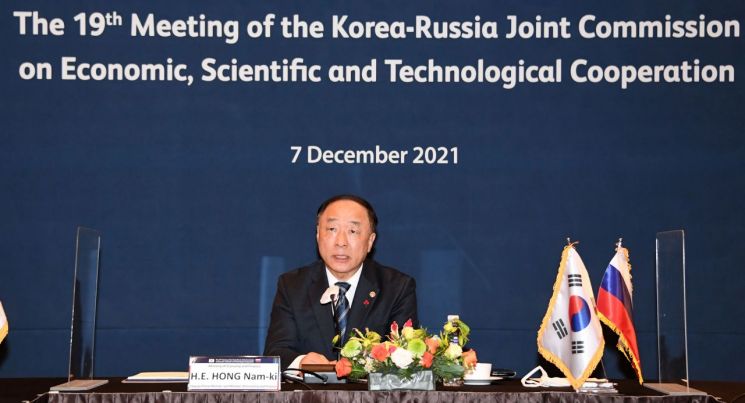 Hong Nam-ki, Deputy Prime Minister and Minister of Economy and Finance, presided over the opening remarks at the '19th Korea-Russia Economic Science and Technology Joint Committee' held via video conference on the afternoon of the 7th at The Plaza Hotel in Jung-gu, Seoul, attended by Yuri Trutnev, Deputy Prime Minister of Russia and Plenipotentiary Representative of the Far Eastern Federal District. (Photo by Ministry of Economy and Finance)
[Sejong=Asia Economy Reporter Moon Chaeseok] Deputy Prime Minister and Minister of Economy and Finance Hong Nam-ki proposed accelerating negotiations to establish an investment fund worth 1 billion dollars (approximately 1.178 trillion KRW) with Russia by the first half of next year. Two years ago, a related fund for materials, parts, and equipment was initially established at 400 million dollars (approximately 471.2 billion KRW), and he suggested expanding the scale to advanced industries and healthcare, urging to speed up related negotiations.
The Ministry of Economy and Finance announced that Deputy Prime Minister Hong proposed this during the '19th Korea-Russia Economic Science and Technology Joint Committee' virtual meeting held on the afternoon of the 7th at the Plaza Hotel in Jung-gu, Seoul. At the meeting, Hong said, "We hope that the Korea-Russia investment fund, agreed upon and under discussion at the 2019 Joint Committee, will accelerate negotiations aiming for an agreement by the first half of next year so that the fund can serve as a catalyst for industrial cooperation between the two countries." Previously, in September 2019, the two countries agreed at the 18th Joint Committee to establish a 1 billion dollar fund to build a Korea-Russia materials, parts, and equipment value chain. Through this, they planned to invest in Russia's highly developed basic original technologies and combine them with Korea's commercialization technologies to enhance competitiveness in the materials, parts, and equipment sector.
Hong also suggested achieving meaningful results in building infrastructure for new and renewable energy such as hydrogen and establishing an industrial complex in the Primorsky Krai. Earlier, in his congratulatory speech at the Korea-Russia Business Dialogue in August, Hong proposed strengthening cooperation in promising fields including the development of innovation platforms and hydrogen cooperation, including the establishment of an Arctic hydrogen base. He emphasized, "Especially in the hydrogen sector, if a close cooperative system is established by combining Russia's hydrogen production capacity with Korea's hydrogen vehicle production and hydrogen utilization capabilities, there is vast potential for cooperation related to climate change response such as new and renewable energy production." He added, "I hope for meaningful progress in Korea-Russia hydrogen cooperation, including Korean companies participating in hydrogen mobility projects in Russia in the future."
The two countries agreed to consider holding a groundbreaking ceremony for the Primorsky Krai industrial complex next year and discussed support measures for the entry of Korean medical institutions into the local market. Hong said, "The establishment of the Primorsky Krai industrial complex is a representative project that can create a mutual 'win-win' by enabling Korean companies to enter new markets and revitalizing investment in the Far East region." He added, "I expect meaningful progress such as the signing of a 'business activity agreement' in the first half of next year and timely construction of infrastructure related to the industrial complex."
Meanwhile, Hong also requested cooperation from Russia, which is implementing export quotas on nitrogen fertilizers such as urea, to ensure smooth transfer of existing contract volumes for Korean companies. He proposed discussing specific cooperation measures related to key items between the two countries, including urea water. Additionally, they discussed ▲ exploring cooperative projects such as joint research related to the Arctic ▲ requesting minimization of export restrictions on soybeans, wheat, corn, and other products.
A Ministry of Economy and Finance official said, "Going forward, the two countries plan to implement and develop the agreements from this Joint Committee through various high-level and working-level consultations, including the Joint Committee and the 9-Bridge Implementation Consultative Body." He added, "Since this meeting was held virtually, the 20th Korea-Russia Economic Science and Technology Joint Committee is scheduled to be held in Korea next year."
The meeting has reached its 19th session this year since 1997. It is a high-level regular consultation channel that discusses overall economic cooperation issues such as trade, infrastructure, industry, and science and technology between the two countries. The Korean side was led by Deputy Prime Minister Hong as the chief representative, with officials from nine related ministries including the Ministry of Economy and Finance and the Ministry of Trade, Industry and Energy attending. The Russian side was led by Deputy Prime Minister and Presidential Envoy to the Far Eastern Federal District Yuri Trutnev as the chief representative, with officials from 11 ministries including the Ministry for the Development of the Russian Far East and Arctic, Ministry of Economic Development, Ministry of Health, and related agencies such as the Sakhalin regional government attending.
© The Asia Business Daily(www.asiae.co.kr). All rights reserved.
![Clutching a Stolen Dior Bag, Saying "I Hate Being Poor but Real"... The Grotesque Con of a "Human Knockoff" [Slate]](https://cwcontent.asiae.co.kr/asiaresize/183/2026021902243444107_1771435474.jpg)















