Ministry of Environment Hosts the 22nd Korea-China-Japan Environment Ministers' Meeting
Adoption of the 3rd Joint Action Plan (2021?2025)
Establishment of Climate Change Carbon Neutral Policy Dialogue
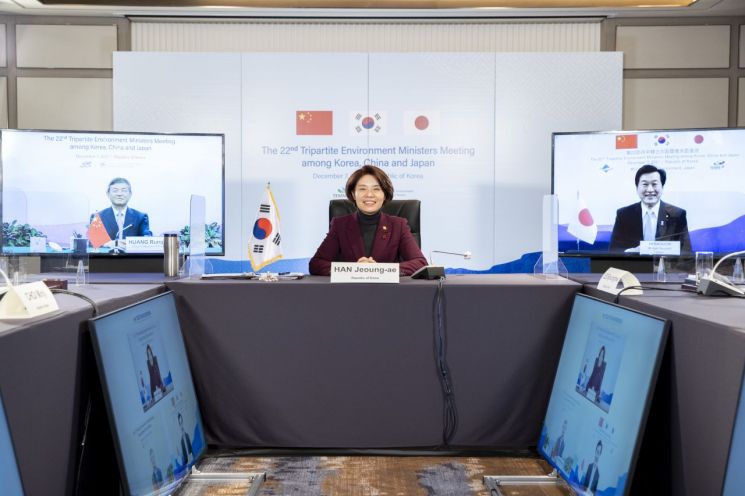 Minister of Environment Han Jeong-ae (center) attended the 22nd Trilateral Environment Ministers Meeting (TEMM22) held via video conference on the afternoon of the 7th at the Chosun Palace Hotel in Seoul. She signed the joint agreement containing the meeting results together with Huang Runqiu, Minister of Ecology and Environment of China (left), and Tsuyoshi Yamaguchi, Minister of the Environment of Japan, and posed for a commemorative photo.
[Asia Economy Reporter Joo Sang-don] The three countries of Korea, China, and Japan have agreed to share their policies and discuss sectoral cooperation measures by 2025 in areas such as carbon neutrality, fine dust improvement, circular economy, and biodiversity restoration.
On the 7th, the Ministry of Environment held the '22nd Korea-China-Japan Environment Ministers' Meeting (TEMM22)' via video conference in Seoul to discuss major environmental issues in Northeast Asia and future cooperation measures.
The meeting was attended by more than 50 participants, including Korea’s Minister of Environment Han Jeong-ae, China’s Minister of Ecology and Environment Huang Runqiu, Japan’s Minister of the Environment Yamaguchi Tsuyoshi, and officials from the three countries’ environment ministries.
First, the three ministers shared the current status of their countries’ policies and discussed cooperation measures to jointly respond to environmental issues in Northeast Asia and globally.
Minister Han first expressed hope to strengthen cooperation with China throughout the entire process of establishing, implementing, and sharing results of the seasonal management system to improve fine dust, and to maintain close cooperation between the two countries in promoting coal phase-out and renewable energy transition.
She also introduced laws and policies for achieving carbon neutrality, proposed actively sharing best practices and experiences with Japan, and especially suggested that the two countries establish a cooperative channel to realize a circular economy society in the plastics sector by sharing excellent cases and policies.
Minister Huang Runqiu of China’s Ministry of Ecology and Environment emphasized the importance of low-carbon green transition policies and expanding eco-friendly practices across all sectors including land, industry, and transportation, stating that policy efforts continue to reach the goal of carbon neutrality. He also expressed hope that Northeast Asia will continue cooperation to resolve issues such as fine dust improvement and marine plastic pollution.
Minister Yamaguchi Tsuyoshi of Japan’s Ministry of the Environment introduced Japan’s policy efforts to achieve a circular economy society, including the enactment of the 'Act on Promotion of Plastic Resource Circulation,' and proposed that Korea, China, and Japan cooperate in forming an intergovernmental committee to address the global plastic problem. He also expressed hope to strengthen policy exchanges on biodiversity restoration and fine dust improvement.
Subsequently, the three countries adopted the '3rd Joint Action Plan (2021?2025),' which presents priority cooperation areas and cooperation measures for the next five years.
The priority cooperation areas of the 3rd Joint Action Plan include ▲ air quality improvement ▲ 3R (reduce, reuse, recycle), circular economy, zero waste cities ▲ marine and water environment management ▲ climate change ▲ biodiversity ▲ chemical management and environmental disaster response ▲ transition to green economy ▲ environmental education, public awareness, and participation, totaling eight areas.
Notably, the new joint action plan establishes a climate change carbon neutrality policy dialogue to actively promote exchanges of policies, systems, and technologies related to carbon neutrality among the three countries.
The three ministers also pledged sincere implementation of the 3rd Joint Action Plan and strengthened cooperation. In particular, Minister Han proposed actively utilizing the climate change carbon neutrality policy dialogue to exchange sectoral implementation strategies, technologies, and best practices for carbon neutrality, and expressed hope to discover concrete cooperative projects among the three countries in the biodiversity field, such as restoration of endangered species.
Minister Han said, “The 3rd Joint Action Plan will be a milestone of cooperation to realize a sustainable future for Korea, China, and Japan,” adding, “When the three countries harmonize and cooperate, we can accelerate a sustainable world.”
© The Asia Business Daily(www.asiae.co.kr). All rights reserved.
![Clutching a Stolen Dior Bag, Saying "I Hate Being Poor but Real"... The Grotesque Con of a "Human Knockoff" [Slate]](https://cwcontent.asiae.co.kr/asiaresize/183/2026021902243444107_1771435474.jpg)















