[Asia Economy Reporter Kim Daehyun] Securities industry officials involved in 'illegal bond parking transactions' have been convicted by the Supreme Court. This ruling is known as the Supreme Court's first judgment on bond parking transactions.
Bond parking transactions involve asset management company fund managers temporarily entrusting bonds they have purchased to brokerage securities firms without recording them in the books. This is illegal because additional profits or losses may occur arbitrarily during this period without the investor's consent.
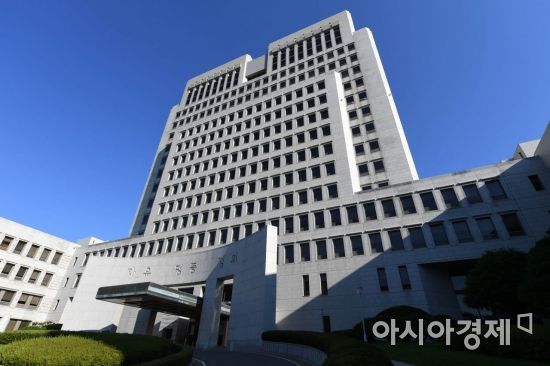
On the 7th, the Supreme Court Division 1 (Presiding Justice Park Junghwa) confirmed the original sentence of 2 years imprisonment with 3 years probation for Mr. A (50), former head of the bond management division at an asset management company, who was indicted for violating the Capital Markets Act, the Act on the Aggravated Punishment of Specific Economic Crimes, and breach of trust in the course of duty.
Previously, Mr. A and other fund managers were prosecuted for engaging in 'bond parking' transactions in 2013 in collusion with securities company employees, in exchange for covering overseas travel expenses. Investigations revealed that Mr. A attempted bond parking transactions involving approximately 460 billion KRW worth of bonds. The prosecution judged that institutional investors such as insurance companies and the National Pension Service suffered losses of about 11.3 billion KRW due to an unexpected sharp rise in bond interest rates.
The first trial sentenced Mr. A to 3 years imprisonment and a fine of 27 million KRW, along with an order to confiscate approximately 13 million KRW. The second trial reduced Mr. A's sentence to 2 years imprisonment with 3 years probation, reasoning that since the investors' losses could not be specifically identified, the charge should be breach of trust in the course of duty rather than breach of trust under the Act on the Aggravated Punishment of Specific Economic Crimes.
The Supreme Court also upheld this judgment. The court stated, "The lower court did not err in its legal interpretation regarding breach of trust, including violation of duty, the business judgment rule, intent for breach of trust, intent for illegal gain, occurrence of property damage, acquisition of property benefits, causation, and joint principal offender," and dismissed all appeals.
Meanwhile, 20 others including fund managers and securities company employees who were prosecuted together also received confirmed sentences of imprisonment and fines respectively.
© The Asia Business Daily(www.asiae.co.kr). All rights reserved.
![Clutching a Stolen Dior Bag, Saying "I Hate Being Poor but Real"... The Grotesque Con of a "Human Knockoff" [Slate]](https://cwcontent.asiae.co.kr/asiaresize/183/2026021902243444107_1771435474.jpg)
















