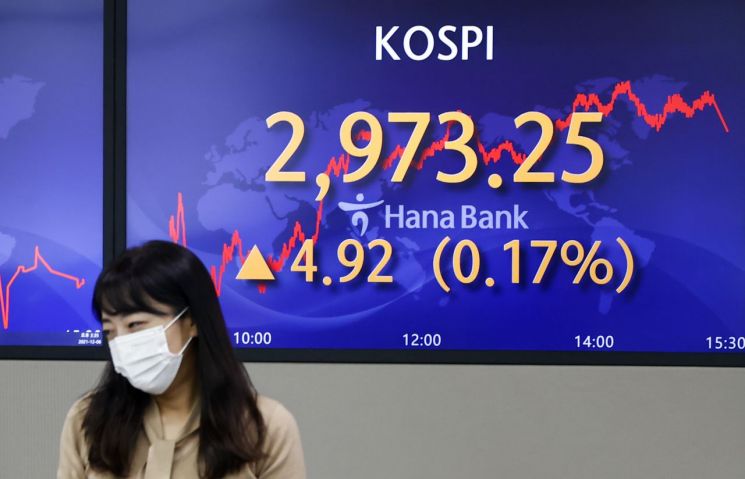
[Asia Economy Reporter Lee Seon-ae] On the 7th, the domestic stock market, which started higher, is showing a sideways trend as it fluctuates between declines and gains during the session. Only individual investors are net buyers, while foreigners and institutions are unable to gain momentum due to net selling.
As of 10:50 a.m. that day, the KOSPI was up 0.11% at 2967.40, and the KOSDAQ was up 0.54% at 9971.19. The market is maintaining a slightly weak sideways trend without strong upward momentum.
Only individuals are net buyers alone. In both the KOSPI and KOSDAQ markets, they have net buying advantages of 306.3 billion KRW and 103.2 billion KRW, respectively. Foreigners and institutions are net sellers. Foreigners are net selling 91.1 billion KRW and 106.6 billion KRW in both markets, respectively. Institutions have a net selling advantage of 230.1 billion KRW in the KOSPI market, while in the KOSDAQ market, they have a net buying advantage of about 8.6 billion KRW. However, foreigners and institutions are recording net purchases in the futures market.
The weak sectors in the KOSPI are pharmaceuticals, medical precision instruments, and paper and wood products, while the strong sectors are construction, textiles and apparel, and transportation and warehousing.
The strong sectors in the KOSDAQ are information technology, medical and precision instruments, and telecommunications equipment, while the weak sectors are digital content, paper and wood products, and broadcasting services.
Seosangyoung, a researcher at Mirae Asset Securities, said, "The U.S. stock market showed strength due to the report release, with travel, leisure, and airline sectors soaring, and the People's Bank of China's reserve requirement ratio cut and improvement in employment trend indices are positive factors for the Korean stock market." He added, "However, considering the possibility of the Federal Reserve's hawkish stance due to improvements in U.S. employment trend indices and the fact that the Omicron issue, a decisive factor for the U.S. stock market rise, has already been priced in, the upside is expected to be limited." He further noted, "The process of digesting selling pressure will proceed through China's import-export trends and the results of Australia's monetary policy meeting."
Han Ji-young, a researcher at Kiwoom Securities, emphasized, "Considering that the KOSPI has risen consecutively over the past four trading days during which global markets were undergoing corrections, there is short-term profit-taking pressure. However, given the positive changes in global major investment banks' views on the semiconductor industry, the expanded expectations for resolving the excessive neglect compared to major countries' stock markets after the second half of the year, and the favorable outlook for the won-dollar exchange rate, increasing the weighting of large-cap stocks including electronics is considered valid."
Meanwhile, concerns over China's Evergrande ((恒大·Evergrande) real estate issues seem to have little impact on the U.S. market. The dispatch of a working group by Chinese local governments to Evergrande and the People's Bank of China's surprise cut in the reserve requirement ratio appear to have calmed investors' anxieties.
One researcher explained, "Although the default of China's Evergrande Group is becoming visible, it is necessary to note the high willingness of the Chinese government to minimize the impact of these groups' defaults, such as the People's Bank of China's 50 basis point cut in the reserve requirement ratio." He added, "Concerns over Evergrande Group's default, which had been at the center of negative factors for some time, are expected to be perceived as the disappearance of material issues in the stock market going forward."
© The Asia Business Daily(www.asiae.co.kr). All rights reserved.
![Clutching a Stolen Dior Bag, Saying "I Hate Being Poor but Real"... The Grotesque Con of a "Human Knockoff" [Slate]](https://cwcontent.asiae.co.kr/asiaresize/183/2026021902243444107_1771435474.jpg)















