Battery and Internet Sector Weakness Worsens Investor Sentiment
BBIG Index Down 2.3% Since Last Month
Expectations for DRAM Price Rebound
KRX Semiconductor Top 15 Index Up 12.8%
[Asia Economy Reporter Minji Lee] Attention that was focused on the BBIG (Battery, Bio, Internet, Game) theme is shifting to the semiconductor sector. At one point, the BBIG theme established itself as a major pillar of the stock market, even threatening the position of semiconductors as the 'leading stock.' However, as profit-taking sales emerged and positive catalysts relatively decreased, investor sentiment weakened. The securities industry views that since the semiconductor sector has long suffered from undervaluation, increasing its weighting is effective.
According to the Korea Exchange on the 7th, since last month, the KRX Semiconductor TOP15 Index rose from 1934.79 to 2185.99, an increase of about 12.8%. This significantly outperformed the KOSPI's rise of 0.1%, indicating that expectations for the semiconductor industry drove the index's increase.
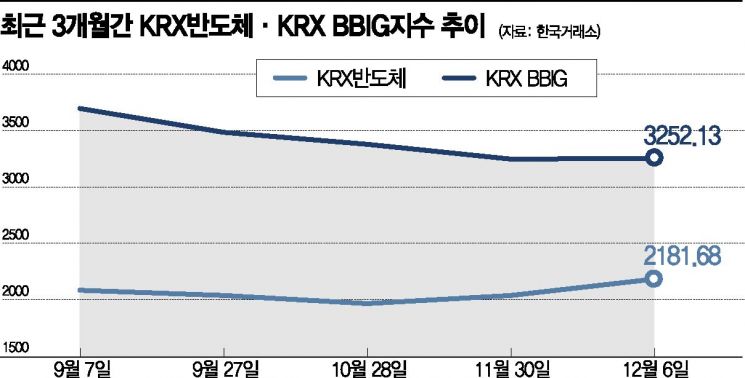
The semiconductor sector index surpassed the market capitalization weighting of the semiconductor sector (24%) for the first time in August and significantly outperformed the BBIG theme index (26%), which had established itself as a major sector. Since last month, the BBIG index fell about 2.3%, underperforming even the KOSPI returns. Expanding the period to the recent three months, the divergent paths of the two indices become even clearer. The BBIG theme shrank about 12%, from 3696.04 to 3252.13, while the semiconductor index showed a rise of over 4%. As a result, as of the previous day, the market capitalization weightings of the semiconductor sector and the BBIG theme are competing around the 24% level.
Although the BBIG theme recently included major game stocks that surged sharply due to expectations for non-fungible tokens (NFTs) and the Metaverse business, the overall theme retreated due to the poor stock performance of battery and internet companies. Kwanghyun Kim, a researcher at Yuanta Securities, said, "In the case of the BBIG theme, new liquidity inflows last year once brought it close to Samsung Electronics' market capitalization, establishing it as a leading stock. However, over time, as investors sought new investment destinations, BBIG became a target for selling, and its relative weighting has decreased."
The semiconductor index's rise was largely influenced by the sharp increases of the leading stocks Samsung Electronics and SK Hynix, which rose 9.2% and 11.3%, respectively. The combined net buying amounts by foreigners and institutions for these companies were 2.2694 trillion KRW and 1.6686 trillion KRW, ranking first and second among net purchased stocks. The semiconductor index also includes many KOSDAQ companies in the materials, parts, and equipment (SoBuJang) sector, such as semiconductor test equipment maker Lino Industrial (13%), semiconductor foundry DB Hitek (20%), and semiconductor design company LX Semicon (25%), all of which posted double-digit gains contributing to the index's rise.
The vertical rise in semiconductor-related stocks is underpinned by expectations of a rebound in DRAM prices and increased server orders next year. The spot price of DRAM fell about 40% from $5.30 on March 22 this year to $3.16 on the 22nd of last month but has rebounded this month, recovering to around $3.30. The market has detected a temporary rise in spot prices, which has led to forecasts of higher fixed transaction prices for DRAM in the first half of next year, raising expectations for an improvement in the semiconductor industry. Market data also supports the stock price rise, with overseas media Digitimes projecting server shipments to grow 7% from 16.7 million units this year to 18.15 million units next year.
In the securities industry, while the external environment significantly impacts the stock market and confidence in the sustained rebound of DRAM spot prices is not yet strong, there is a consensus that the potential for stock price increases remains large due to the continued overselling of semiconductor companies. Doyeon Choi, a researcher at Shinhan Financial Investment, said, "Conservative supply responses by DRAM manufacturers and the transition to DDR5 will accelerate the improvement of the semiconductor industry. While there is confidence that the industry has bottomed out, since certainty about a full upward turn has not yet increased, the potential for semiconductor stock price rises remains substantial."
© The Asia Business Daily(www.asiae.co.kr). All rights reserved.
![Clutching a Stolen Dior Bag, Saying "I Hate Being Poor but Real"... The Grotesque Con of a "Human Knockoff" [Slate]](https://cwcontent.asiae.co.kr/asiaresize/183/2026021902243444107_1771435474.jpg)















