Resolution on Enforcement Decree of School Health Act at State Council
Preventing Overload of COVID-19 Tasks and Strengthening Student Health Management
Enforcement Decree of Lifelong Education Act Specifies Priority Voucher Issuance Requirements
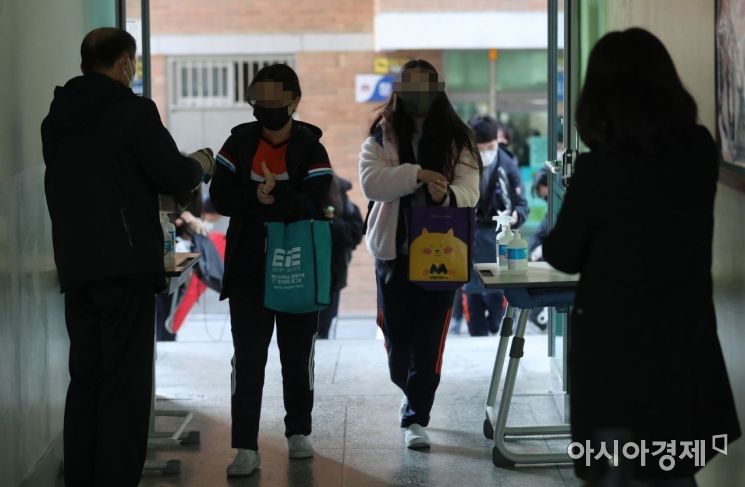 On the morning of the 22nd, when full attendance was implemented at elementary, middle, and high schools nationwide, students at a middle school in Seoul applied hand sanitizer as they arrived at school. Photo by Joint Press Corps
[Asia Economy Reporter Han Jinju] A new regulation will require schools with 36 or more classes to assign at least two health teachers.
On the 7th, the Ministry of Education reviewed and approved a partial amendment to the Enforcement Decree of the School Health Act at the Cabinet meeting. The related enforcement decree was revised and newly established in accordance with the School Health Act, which will take effect on the 9th.
Health teachers are educators who play a role in promoting student health and protecting the health of school members. Amid the prolonged COVID-19 pandemic and increased workload, this amendment provides an opportunity to secure additional health teachers who are on the front lines of school quarantine.
Previously, the Enforcement Decree of the School Health Act required health teachers to be assigned to all middle and high schools and elementary schools with 18 or more classes. However, through this amendment, health teachers will be assigned to all schools except universities, and schools with 36 or more classes will be able to assign two or more health teachers.
The Ministry of Education stated, "We expect that an appropriate level of health services and education will be provided to all students."
At the same Cabinet meeting, the Enforcement Decree of the Lifelong Education Act was also passed, which stipulates the eligibility criteria for priority issuance of lifelong education vouchers and allows local governments to issue and operate vouchers according to demand.
Under the Enforcement Decree of the Lifelong Education Act, priority applicants for lifelong education vouchers include basic livelihood security recipients, lower-income groups, disability allowance recipients, disability pension recipients, single-parent families, and those with income below 65% of the median income.
To select eligible recipients, income and property investigation items necessary for recipient selection are specified, and with the applicant's consent, cooperation from related agencies can be requested. Detailed matters such as the operation of the voucher issuance information system by authorized local governments and designation of dedicated agencies are also stipulated.
The budget for lifelong education vouchers will double from 7.4 billion KRW this year to 14.1 billion KRW next year, and the number of recipients will also double. The Ministry of Education plans to accept applications for lifelong education vouchers in January next year, verify eligibility, and issue vouchers to about 30,000 people.
Deputy Prime Minister and Minister of Education Yoo Eun-hye said, "Through this amendment to the enforcement decree, we will be able to respond to the increasing demand for lifelong learning and lay the foundation for expanding educational opportunities for lifelong education marginalized groups. We will improve the system and strengthen cooperation with local governments to realize a lifelong learning society for all citizens."
© The Asia Business Daily(www.asiae.co.kr). All rights reserved.
![Clutching a Stolen Dior Bag, Saying "I Hate Being Poor but Real"... The Grotesque Con of a "Human Knockoff" [Slate]](https://cwcontent.asiae.co.kr/asiaresize/183/2026021902243444107_1771435474.jpg)















