Emphasizing the Need to Separate Corporate Law and Urging Expansion of Management Autonomy
"Differential Voting Rights Should Be Introduced and Restrictions on Major Shareholders' Voting Rights Should Be Lifted"
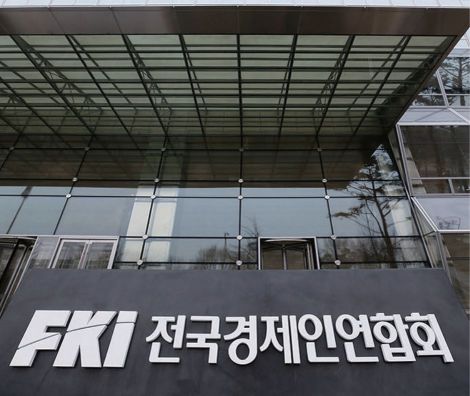
[Asia Economy Reporter Lee Hye-young] The Federation of Korean Industries (FKI) has proposed to the next government the enactment of a 'Model Company Act' that separates company law from the Commercial Act. The Model Company Act, which includes the introduction of management defense measures and the abolition of restrictions on major shareholders' voting rights, aims to strengthen corporate competitiveness.
On the occasion of its 60th anniversary, the FKI announced on the 7th that it had prepared a separate company law system consisting of a total of 7 chapters and 678 articles in collaboration with academic authorities on the Commercial Act. This is because the current provisions related to company law in the Commercial Act cause reverse discrimination against domestic companies and may weaken corporate competitiveness.
The FKI argued that when the Commercial Act was enacted in 1962, Korea's per capita Gross Domestic Product (GDP) was only $100, but now, with the trade volume growing to the 8th largest in the world, it is necessary to review the company laws of major countries such as the United States, Japan, Germany, and the United Kingdom to establish a system that meets global standards.
To this end, the FKI explained that it completed the 'FKI Model Company Act' together with Professor Choi Jun-seon, Emeritus Professor at Sungkyunkwan University Law School, Professor Shim Young of Yonsei University, Professor Choi Byung-gyu of Konkuk University, Professor Kwak Kwan-hoon of Sunmoon University, and Professor Kang Young-ki of Korea University.
The Model Company Act proposed by the FKI first includes provisions to expand the types of shares a company can issue to support smooth fundraising and to be used for management defense. It also allows companies to grant stock options (poison pills) to shareholders or third parties and permits the issuance of various types of shares, such as dual-class voting shares, according to the company's needs.
The FKI explained that most U.S. states have introduced dual-class voting rights, and Japan also allows companies to issue various types of shares.
The Model Company Act also proposes to abolish the so-called '3% rule,' which limits the voting rights of major shareholders and their related parties to 3% when appointing audit committee members. This rule is seen as an obstacle to freely structuring corporate governance and has a high potential to be abused as a means for foreign speculative forces to attack management rights.
Along with this, the FKI proposed the introduction of the 'business judgment rule,' which exempts directors from legal liability if their decisions, even if resulting in losses to the company, are made based on reasonable judgment. The FKI emphasized that the United States recognizes the business judgment rule through case law, and Germany has incorporated this rule into its company law to exempt directors from liability for their business decisions.
The FKI also expressed the view that the multiple derivative lawsuit system introduced through last year's amendment to the Commercial Act has a high potential for abuse by speculative capital and needs revision.
The current domestic multiple derivative lawsuit system allows a parent company shareholder holding 1% of shares for six months in an unlisted subsidiary or 0.5% in a listed subsidiary with more than 50% ownership to file a derivative lawsuit against the subsidiary's directors. The FKI pointed out the need to strengthen the criteria so that, like in Japan, lawsuits can only be filed when there is a 100% wholly-owned subsidiary relationship and the parent company shareholder holds 1% of shares for more than six months.
Yoo Hwan-ik, head of the FKI Corporate Policy Office, said, "'The systems and improvements proposed in the 'FKI Model Company Act' are all based on global standards," adding, "We hope the FKI Model Company Act will be used as a reference when the next government establishes its national agenda to activate corporate investment and entry into new industries."
© The Asia Business Daily(www.asiae.co.kr). All rights reserved.
![Clutching a Stolen Dior Bag, Saying "I Hate Being Poor but Real"... The Grotesque Con of a "Human Knockoff" [Slate]](https://cwcontent.asiae.co.kr/asiaresize/183/2026021902243444107_1771435474.jpg)















