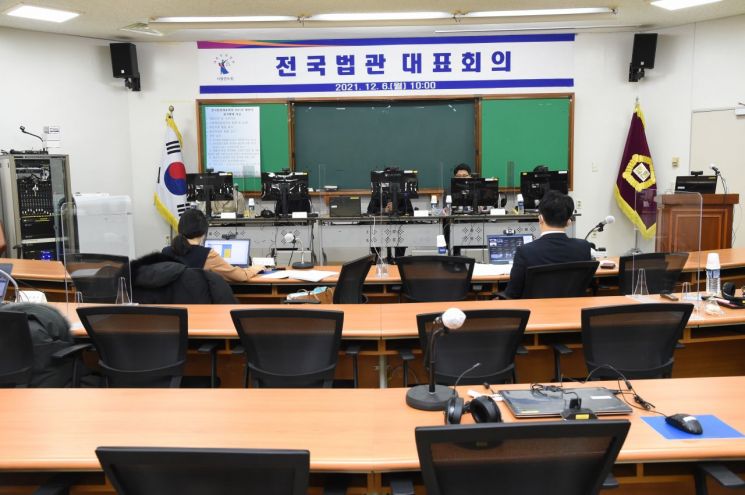
 The National Judges' Representatives Meeting was held on the morning of the 6th at Lecture Room 12 of the Judicial Research and Training Institute in Ilsandong-gu, Goyang-si, Gyeonggi-do. Considering the COVID-19 situation, the meeting was conducted in a hybrid format with remote participation. Photo by the Supreme Court.
[Asia Economy Reporter Choi Seok-jin, Legal Affairs Specialist] At the regular meeting held on the 6th by the National Council of Judges, it was decided that when assigning criminal trial divisions, factors such as seniority, gender, and previous assignment history should be taken into consideration.
Additionally, to establish the 'Court President Candidate Recommendation System,' it was resolved to prepare unified regulations regarding the candidate recommendation procedures and to respect the opinions of the implementing courts as much as possible in the selection of court presidents.
The National Council of Judges held this regular meeting for the second half of the year from 10 a.m. at Lecture Room 12 of the Judicial Research and Training Institute in Ilsandong-gu, Goyang-si, Gyeonggi-do, where these decisions were made. The meeting was conducted in a hybrid format due to the Court Administration Office’s COVID-19 Response Committee’s decision to limit the maximum number of attendees to 49 for meetings and events. Out of 125 council members nationwide, 114 participated in the meeting.
The agenda items discussed at the meeting included ▲proposals for improving the task assignment committee system ▲proposals for the stable establishment and improvement of the court president candidate recommendation system ▲and proposals regarding adherence to principles and standards in judicial personnel management.
First, regarding the improvement of the task assignment committee system, the Council of Judges resolved to include in the standards ▲the establishment of unified criteria for the installation and operation of task assignment committees applicable to courts nationwide ▲the preparation of regulations by the Supreme Court on the establishment and operation of task assignment committees ▲measures to ensure transparency and fairness in the decision-making of task assignment committees, procedures for collecting opinions and raising objections from judges, and the specification of the authority, duties, and qualifications of task assignment committee members.
Furthermore, ▲to promote good trials for the public and enhance trust in the judiciary, courts at all levels should take the best possible measures to resolve imbalances in workload and preferences between criminal trial task assignments and other task assignments ▲and when determining the assignment of criminal trial divisions, efforts should be made to balance seniority and gender, considering previous assignment histories.
Regarding this, the originally proposed agenda was ▲to avoid bias toward specific seniority groups or genders in criminal trial division assignments unless there are special circumstances, but this was amended during the meeting.
Next, concerning the court president candidate recommendation system, the Council resolved to ▲prepare unified regulations on the candidate recommendation procedures at each implementing court ▲and to respect the opinions of the implementing courts as much as possible in the selection of court presidents after candidate recommendations.
Lastly, regarding adherence to principles and standards in judicial personnel management, the Council resolved to ▲comply with personnel principles and standards for judge transfers and overseas training selections and to provide prior notice when principles or standards are changed ▲and to provide sufficient data and human and material resources to committees involved in judicial personnel management so that they can effectively review personnel matters.
Although there was interest in whether the agenda on 'post-retirement employment restrictions for judges' would be discussed, especially in relation to former Supreme Court Justice Kwon Soon-il, who served as an advisor to Hwacheon Daeyu immediately after retirement and received high advisory fees, this issue was not discussed at the meeting.
© The Asia Business Daily(www.asiae.co.kr). All rights reserved.
![Clutching a Stolen Dior Bag, Saying "I Hate Being Poor but Real"... The Grotesque Con of a "Human Knockoff" [Slate]](https://cwcontent.asiae.co.kr/asiaresize/183/2026021902243444107_1771435474.jpg)















