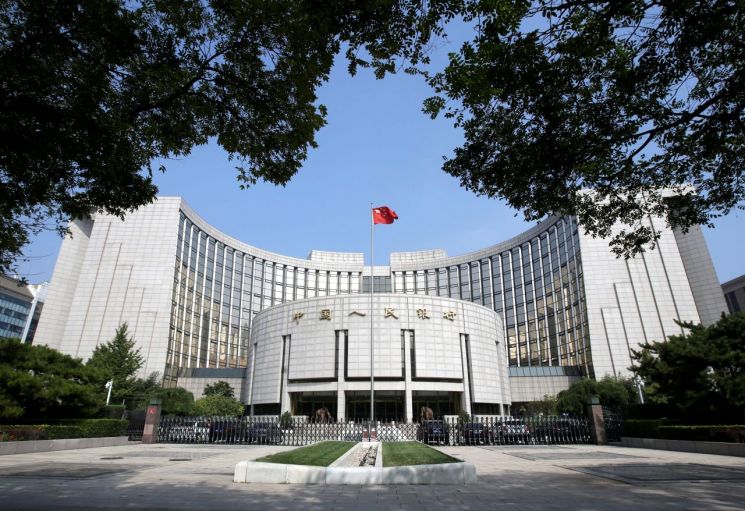
[Asia Economy Reporter Song Seung-seop] The People's Bank of China, the central bank of China, is lowering the bank reserve requirement ratio by 0.5 percentage points for the first time in five months. This move is interpreted as an effort to mitigate the shock amid a rapid economic slowdown and the debt crisis of Evergrande Group, the country's second-largest real estate developer.
On the 6th, the People's Bank of China announced on its website that it will reduce the bank reserve requirement ratio starting from the 15th. With this measure, the average reserve ratio in China's financial sector will drop to 8.4%.
This is the first reserve ratio cut by the People's Bank of China in five months since July. At that time, due to reasons such as a surge in international raw material prices, the reserve ratio was lowered by 0.5 percentage points for the first time in 15 months.
The reserve ratio cut was carried out swiftly. Typically, the People's Bank of China announces reserve ratio plans after the financial markets close on Friday evening. It appears this decision was made quickly to alleviate shocks from the rapid economic slowdown and the Evergrande Group's default crisis.
China's economic growth rate in the first quarter recorded 18.3% due to the base effect of COVID-19. However, it shrank through the second quarter (7.9%) and third quarter (4.9%).
In the case of Evergrande Group, the atmosphere of default is becoming a reality as it announced that it is unlikely to fulfill a debt guarantee of $260 million (approximately 307.5 billion KRW).
In this situation, lowering the reserve ratio has the effect of somewhat reducing the shock to the banking sector. The People's Bank of China explained, "The decision to cut was made to support the development of the real economy and to stably lower financial costs," adding, "We will continue to implement a moderate monetary policy while maintaining a stability-first stance to reasonably meet liquidity demand."
Furthermore, the People's Bank of China forecasted that the reserve ratio cut will reduce the loan costs of financial institutions in China by 15 billion yuan (approximately 2.8 trillion KRW) annually. It also predicted that long-term liquidity amounting to 1.2 trillion yuan (approximately 223 trillion KRW) will be supplied.
© The Asia Business Daily(www.asiae.co.kr). All rights reserved.
![Clutching a Stolen Dior Bag, Saying "I Hate Being Poor but Real"... The Grotesque Con of a "Human Knockoff" [Slate]](https://cwcontent.asiae.co.kr/asiaresize/183/2026021902243444107_1771435474.jpg)















