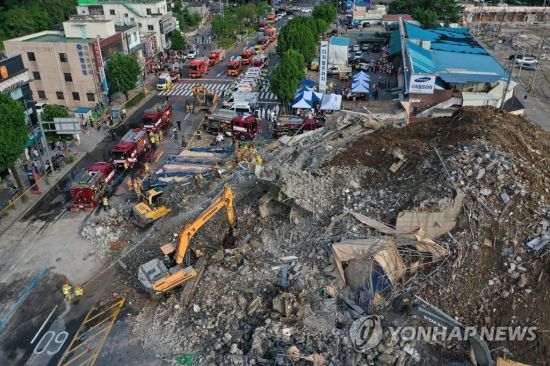
 On the afternoon of June 9, a building under demolition in Hakdong, Dong-gu, Gwangju collapsed, causing debris to spill onto the road and burying city buses. The photo shows 119 rescue workers conducting rescue operations at the accident site. Photo by Yonhap News
[Asia Economy Honam Reporting Headquarters Reporter Park Jin-hyung] In the trial of the 'Gwangju Hakdong Disaster,' Hansol Enterprise, a demolition subcontractor, argued that the investigation results by the Ministry of Land, Infrastructure and Transport's Central Building Accident Investigation Committee (Sajowi) lack evidentiary power.
The Criminal Division 11 of the Gwangju District Court (Presiding Judge Jeong Ji-seon) held a trial on the 1st for seven construction-related personnel and three companies indicted on charges including professional negligence resulting in death or injury, and conducted witness examination of Sajowi members including Professor Lee from Gunsan University’s Department of Architectural Engineering.
During cross-examination, the defense attorney for Hansol site manager Kang (28) cited the investigation report released by Sajowi, asking, "It is stated that in cases requiring legal judgment such as civil/criminal judicial procedures or administrative litigation procedures, it cannot be applied," and inquired about the reason.
Lee replied, "I did not confirm the exact legal basis, and the Korea Infrastructure Safety Corporation wrote and provided that phrase."
In response to the attorney’s question, "Do you think it has evidentiary power?" the court intervened, indicating that it was inappropriate to ask the witness for an opinion.
According to Sajowi, the accident was confirmed as a man-made disaster caused by proceeding with demolition work using an unreasonable dismantling method.
The investigation revealed that the demolition company, contrary to the plan, demolished half of the interior floor of the building and piled soil over 3 stories high (more than 10 meters) during work, causing the first-floor slab to fail under the weight.
As a result, rapid inflow of backfill into the basement occurred, and the impact from the movement of upper-layer soil toward the front of the building was the direct cause of the collapse.
On the 15th, witness examinations of the National Forensic Service and the Central Accident Investigation Team of the Korea Occupational Safety and Health Agency will be conducted.
Meanwhile, the defendants in this trial include Seo (57), site manager of redevelopment contractor Hyundai Industrial Development; Kim (57), safety manager; Noh (53), public affairs manager; Kang (28), site manager of Hansol, a general building demolition subcontractor; Jo (47), CEO of Baeksol and excavator operator of a re-subcontractor; Kim (49), site manager of Dawon ENC, responsible for asbestos demolition subcontracting; and Cha (59), supervisor at the demolition site.
They are charged with causing the building collapse accident (5 floors above ground, 1 basement floor) in Gwangju Hakdong District 4 on June 9 by ignoring the dismantling plan and regulations or neglecting supervisory duties, resulting in 17 city bus passengers passing nearby being casualties (9 deaths, 8 injuries).
© The Asia Business Daily(www.asiae.co.kr). All rights reserved.
![Clutching a Stolen Dior Bag, Saying "I Hate Being Poor but Real"... The Grotesque Con of a "Human Knockoff" [Slate]](https://cwcontent.asiae.co.kr/asiaresize/183/2026021902243444107_1771435474.jpg)















