Seoul Metropolitan Area 'Very High' · Non-Metropolitan Area 'Moderate'
Occurrence Rate 111.2% Exceeds Medical Response Capacity in Seoul Metropolitan Area
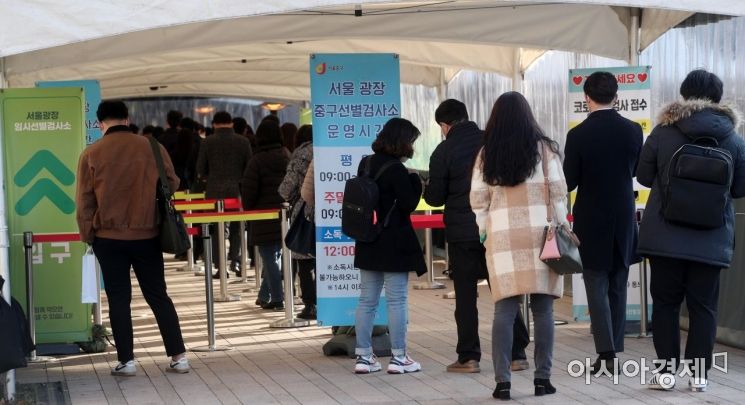 On the 6th, citizens lined up in front of the temporary COVID-19 screening clinic at Seoul Plaza to get tested. According to the Central Disease Control Headquarters, as of midnight that day, 4,325 new COVID-19 cases were reported. This is the highest number ever recorded for a Sunday occurrence and Monday tally. Photo by Hyunmin Kim kimhyun81@
[Asia Economy Reporter Lee Chun-hee] The government has assessed the COVID-19 epidemic risk level as 'Very High' nationwide for two consecutive weeks, stating that "the Seoul metropolitan area has reached the limit of response capacity."
On the 6th, the Central Disease Control Headquarters announced that the weekly COVID-19 risk assessment for the first week of December (November 28 to December 4) rated the nationwide and Seoul metropolitan areas as 'Very High,' while non-metropolitan areas were rated 'Moderate.' Nationwide has maintained the highest level, Very High, for two consecutive weeks, and the Seoul metropolitan area for three consecutive weeks. The Central Disease Control Headquarters evaluates COVID-19 risk across three domains?response capacity, incidence status, and vaccination?using 17 evaluation indicators, rating them weekly on a five-level scale: Very Low, Low, Moderate, High, and Very High.
Lee Sang-won, head of the Epidemiological Investigation and Analysis Division at the Central Disease Control Headquarters, stated at the regular briefing that "the results are the same as those of the fourth week of November," but added, "Overall indicators show a worsening trend." This indicates that the incidence has already exceeded the limits of medical response capacity.
In the first week of December, the nationwide incidence ratio compared to medical response capacity was 87.8%, but the Seoul metropolitan area was at 111.2%, meaning weekly cases have already exceeded response capacity. This is a sharp increase of 21.7 percentage points compared to 89.5% the previous week. Non-metropolitan areas showed a lower level at 49.8%, but this also surged by 11.5 percentage points from 38.3% the previous week.
Regarding incidence indicators, on the announcement date of the 4th, 5,327 new confirmed cases (local transmission) were reported, setting a new record high, and 70 deaths were recorded that day, also marking the highest number of deaths to date.
ICU bed occupancy rates continue to rise regardless of the Seoul metropolitan or non-metropolitan areas. Particularly, non-metropolitan areas surged to 62.8%, up 12.5 percentage points from 50.3% the previous week, showing that the ICU bed shortage crisis in the Seoul metropolitan area is spreading to non-metropolitan regions.
At the Daily Recovery Support Committee's Medical and Quarantine Subcommittee meeting held the previous day, warnings were issued considering this situation. Lee said, "Opinions were expressed that 'the Seoul metropolitan area is at the limit of response capacity, and non-metropolitan areas are worsening, requiring efforts to block the spread of regional infections,'" and that accelerating the third dose vaccination for those aged 60 and over, completing vaccinations for middle and high school students, early blocking of the Omicron variant, and public communication regarding vaccination certificates, negative test confirmations (quarantine pass), vaccination, and home treatment were suggested.
The authorities particularly emphasized the importance of the third dose vaccination. Lee urged, "We believe it is appropriate for everyone eligible to receive the third dose to do so," adding, "For the elderly, the benefits of receiving the third dose are much greater," stressing the necessity of vaccination.
© The Asia Business Daily(www.asiae.co.kr). All rights reserved.
![Clutching a Stolen Dior Bag, Saying "I Hate Being Poor but Real"... The Grotesque Con of a "Human Knockoff" [Slate]](https://cwcontent.asiae.co.kr/asiaresize/183/2026021902243444107_1771435474.jpg)















