Fair Trade Commission, Ministry of Justice, and 3 Other Ministries Hold 'Fair Economy Performance Report Conference'
147 out of 175 Tasks Completed
Subcontract Direct Payment System Settlement Amount Increased from 9.8 Trillion to 43.4 Trillion KRW · Win-Win Settlement Amount from 93.6 Trillion to 119.8 Trillion KRW
Supplementation of Penalty Reduction Criteria in Case of Large-Scale Infectious Disease Outbreaks
Special Employment Type Workers Covered by Industrial Accident Insurance Increased from 61,000 to 670,000
Government to Explore Innovation and Fairness Measures in Non-Face-to-Face and Digital Economy Going Forward
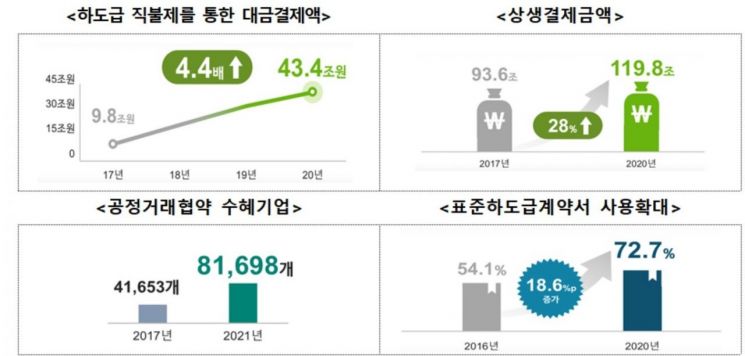
[Asia Economy Reporter Joo Sang-don] Among the total 175 fair economy tasks promoted by the Moon Jae-in administration, 147 tasks (84%) have been completed. Actual payment amounts through the subcontract direct payment system increased 4.4 times, and win-win settlement amounts rose by 28%, confirming tangible achievements. Going forward, the government plans to seek ways to ensure innovation and fairness coexist in the changing environment of the non-face-to-face and digital economy.
On the 6th, five ministries including the Fair Trade Commission, Ministry of Justice, Ministry of Employment and Labor, Ministry of SMEs and Startups, and Financial Services Commission held a 'Fair Economy Performance Reporting Conference' at the Government Seoul Office.
This event was organized to report the spread of fair culture achievements in both the private and public sectors through real-life cases experienced by citizens and companies, and to explore necessary strategies for continuous performance creation in various areas of the fair economy such as improving the 'Gap-Eul relationship,' eradicating abuse of economic power, spreading a culture of coexistence, and protecting the rights of vulnerable groups.
At the reporting conference, Cho Sung-wook, Chairman of the Fair Trade Commission, reported on the achievements of the fair economy over the past four and a half years from the perspective of 'life changes' of economic actors including SMEs, small business owners, workers, consumers, large corporations, and public institutions.
Accordingly, for SMEs, issues of unpaid payments were improved through the subcontract direct payment system and win-win settlements. Actual payment amounts through the subcontract direct payment system increased from 9.8 trillion KRW in 2017 to 43.4 trillion KRW in 2020, a 4.4-fold increase. Win-win settlement amounts also rose by 18% during the same period, from 93.6 trillion KRW to 119.8 trillion KRW. The proportion of companies using the standard subcontract contract form increased by 18.6 percentage points from 54.1% in 2016 to 72.7% in 2020.
Support measures such as tax reductions and livelihood protection for small business owners who faced increased economic difficulties due to COVID-19, as well as strengthening their bargaining power, were also implemented. Additionally, the Fair Trade Commission supplemented penalty reduction criteria in the event of large-scale infectious disease outbreaks and strengthened institutional improvements, law enforcement, and information provision in sectors with many vulnerable consumers, such as detecting collusion in mobile phone micro-payment late fees.
Furthermore, the rights of vulnerable workers, such as special employment type workers and construction site laborers who were previously in blind spots of protection, were enhanced. As a result, the number of special employment types covered by industrial accident insurance increased from 9 in December 2018 to 15 in July 2021, and the number of covered workers rose from 61,000 to 670,000.
The Fair Trade Commission evaluated that transparency and fairness in corporate governance were strengthened through the enactment and amendment of three fair economy laws including partial amendments to the Commercial Act, a full revision of the Fair Trade Act, and the enactment of the Financial Complex Corporate Group Act, as well as the market establishment of the 'Stewardship Code.' Corporations also reduced the number of circular shareholding loops from 282 in 2017 to 16 in 2020, and the installation rate of internal transaction committees increased from 35.5% to 40.2% during the same period. Additionally, achievements such as opening up group meal service contracts worth 1.2 trillion KRW were realized.
At the event, vice ministers from related ministries, the Vice Chairman of the Korea Employers Federation, the Vice Chairman of the Korea Federation of SMEs, the Chairman of the Korea Consumer Agency, and the Director of the KDI Regulatory Research Center gathered to discuss the future direction of fair economy development. Economic and consumer organizations and experts highly evaluated the gradual improvement of unfair trade practices targeting SMEs and others as 'Eul (乙)' and the achievements in protecting consumer rights in the non-face-to-face and digital markets, urging the government to continue steady and sustained promotion of the fair economy.
Lee Dong-geun, Vice Chairman of the Korea Employers Federation, said, "The government's fair economy policy has greatly contributed to creating a fair economic order and culture, and companies are actively striving for this," adding, "Encouragement and motivation are needed to lead voluntary changes by companies themselves rather than regulations." Seo Seung-won, Vice Chairman of the Korea Federation of SMEs, suggested, "Although the government's efforts have improved the sense of change on the ground, such as the establishment of a breakthrough to eradicate technology theft through amendments to the Subcontracting Act and the Win-Win Cooperation Act, continuous institutional improvements are needed to revitalize SME management in the future." Won Young-hee, Chairperson of the Korea Consumer Agency, requested, "Please continue efforts to amend the Electronic Commerce Act to strengthen the responsibility of online platforms," and Yang Yong-hyun, Director of the KDI Regulatory Research Center, proposed, "To resolve fairness issues in transactions on online platforms, it is necessary to enact the Online Platform Fairness Act and strengthen corporate merger reviews to correct platform monopolies."
In response, vice ministers from related ministries stated that they will strengthen the foundation of the fair economy to enable economic vulnerable groups to leap forward through inclusion and coexistence in the process of recovering daily life and adapting to the changing environment of the non-face-to-face and digital economy. Chairman Cho said, "We will continue efforts to enact the On-Platform Act, which has been a focus for digital economy fairness," adding, "We will establish a rational regulatory system for corporate group governance and enhance the on-site impact by promptly remedying damages through work-sharing and cooperation with local governments in the Gap-Eul sectors."
© The Asia Business Daily(www.asiae.co.kr). All rights reserved.

















